Somewhere around two thousand years ago, Greek travelers began trading lists of the man-made marvels a person simply had to see. Over time the list settled into seven — a tidy number, easy to remember — and we’ve called them the Seven Wonders of the Ancient World ever since.
Here’s the humbling part: of all seven, only one is still standing. The rest were toppled by earthquakes, burned, melted down, or simply lost to time. Here’s what each one was — and what became of it.
The Great Pyramid of Giza
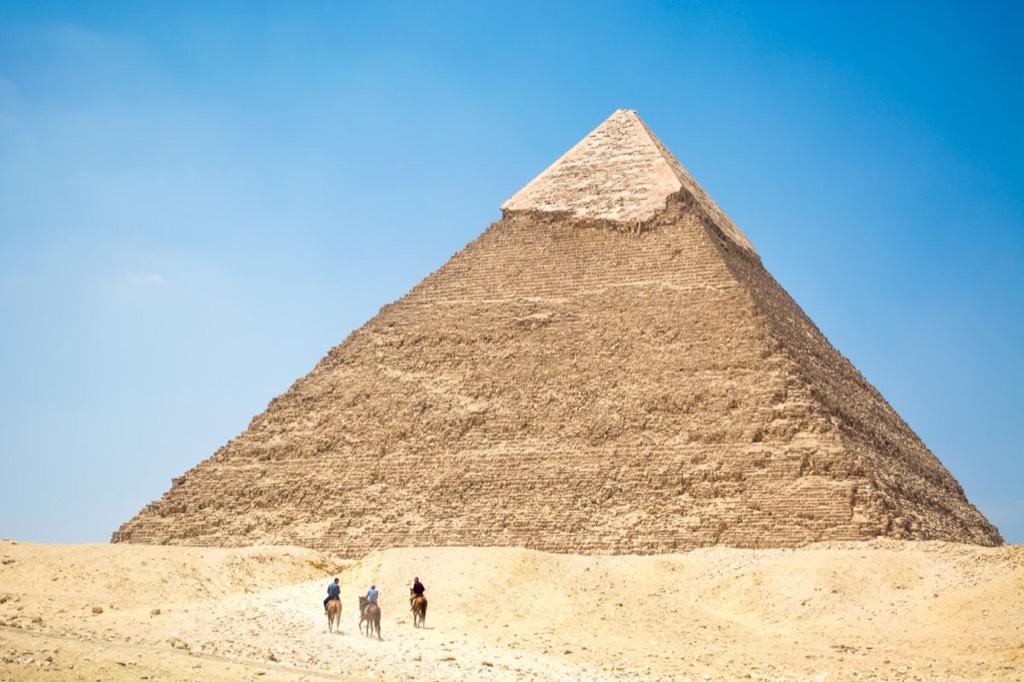
The lone survivorBuilt as a tomb for the pharaoh Khufu around 2560 BC, the Great Pyramid is by far the oldest wonder on the list — and the only one you can still visit today. For nearly 4,000 years it was the tallest structure on Earth.
It has lost its smooth white limestone casing and a bit of its height, but it’s still there on the edge of Cairo, doing what it was built to do: outlast everything. If you ever stand at the base of it, the thing that gets you is the sheer size of the blocks.
The Hanging Gardens of Babylon
The one we're not sure existedThe gardens were said to rise in green terraces above the desert, watered by some clever hidden system, supposedly built by King Nebuchadnezzar II to cheer up a homesick wife. It’s a lovely story.
The trouble is that no one has ever found a trace of them, and Babylonian records don’t mention them at all. Some historians think they were in a different city; others suspect they were half legend from the start. It may be the one wonder that was more wonderful in the telling than in the ground.
The Statue of Zeus at Olympia
Gold, ivory, and goneAround 435 BC the sculptor Phidias built a seated Zeus some 40 feet tall, plated in gold and ivory, filling the temple that housed it. Visitors said the king of the gods looked as if he might stand up and lift the roof off.
After the ancient Olympic Games were banned, the statue was carried off to Constantinople and, most accounts agree, lost in a fire around 475 AD. Nothing of it survives but the awe in the descriptions people left behind.
The Temple of Artemis at Ephesus
Burned by a man seeking fameThis vast marble temple in what is now Turkey was grand enough that some travelers rated it the most beautiful of all seven. In 356 BC a man named Herostratus burned it down for no reason other than to make his name remembered forever.
It was rebuilt, then damaged again, and today only a single reconstructed column stands on the site. Herostratus, annoyingly, did get his wish — we’re still saying his name.
Of all seven wonders, only the oldest is still standing.
The Mausoleum at Halicarnassus
The tomb that named all the othersBuilt around 350 BC for a regional ruler named Mausolus, this towering tomb was so famous that his name became our word for any grand tomb: mausoleum. It stood for centuries, decorated by the finest Greek sculptors of the day.
A string of earthquakes finally brought it down, and much of its stone was later hauled off to build a crusader castle. A few of its sculptures survived and sit in the British Museum today.
The Colossus of Rhodes
Fifty-four years of gloryThe people of Rhodes built a bronze statue of their sun god Helios, roughly the height of the Statue of Liberty, to celebrate surviving a siege. It stood over their harbor around 280 BC, gleaming in the sun.
It lasted barely half a century before an earthquake snapped it at the knees. The pieces lay where they fell for centuries — so impressive even in ruins that people still came to see them.
The Lighthouse of Alexandria
A light that lasted 1,500 yearsThe Pharos of Alexandria guided ships into Egypt’s greatest harbor with a fire that burned at its top, visible for miles. At perhaps 330 feet, it was one of the tallest structures in the world and the model for every lighthouse that followed.
It outlived every other wonder but the pyramid, standing for around 1,500 years before a series of earthquakes finally toppled it by the 1400s. Divers have since found some of its massive blocks on the seabed of Alexandria’s harbor.
What strikes you, going down the list, is how little we did to protect any of it. These were the marvels of their age, and time came for six of the seven anyway. Which makes that one weathered pyramid on the edge of Cairo all the more remarkable — still here, still standing, after everything.