Think about the last 24 hours of your life—you probably woke to a home that was already the perfect temperature, heated leftovers in sixty seconds, maybe checked the news on a device connected to a global network that fits in your pocket. None of that was inevitable. Each of those small everyday moments traces back to a specific American workshop, a government project, or a lone engineer who stayed up one night asking “what if?”
From a bicycle shop in Dayton, Ohio, to a Cold War military contract, these eight inventions rewired the rhythms of daily life on every continent. Some changed everything in a generation; others sat in hospital kitchens for years before the world caught on. But all of them started here—and none of us have been quite the same since.
The Telephone
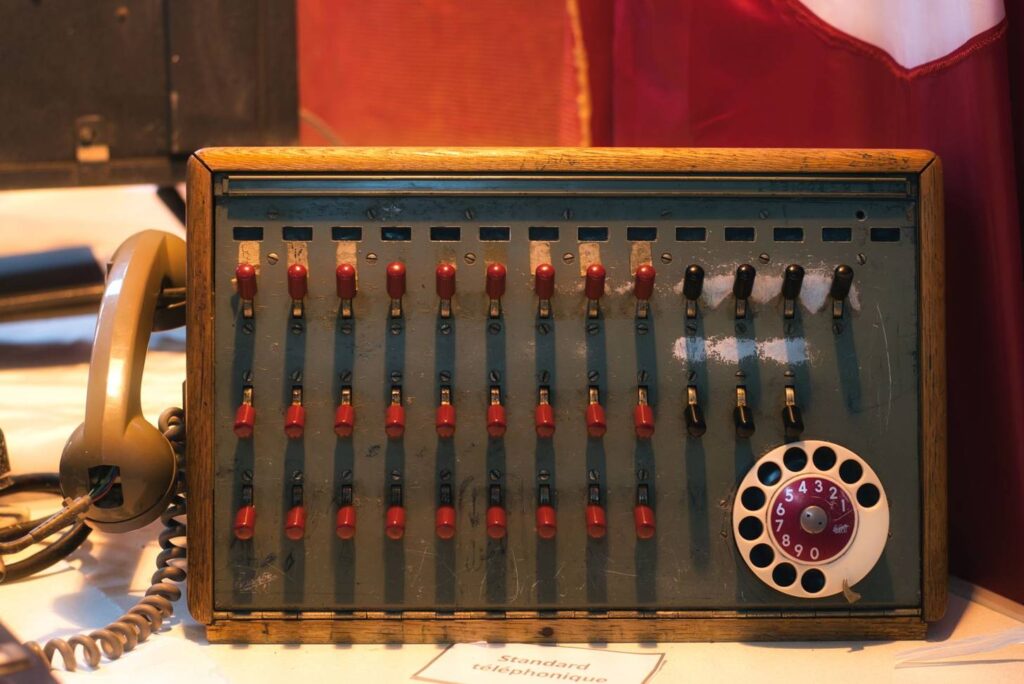
The wire that connected usOn March 10, 1876, Alexander Graham Bell spoke the first intelligible telephone message to his assistant Thomas Watson: “Mr. Watson, come here—I want to see you.” Bell had been racing against rival inventor Elisha Gray; his patent application arrived at the U.S. Patent Office just hours ahead of Gray’s. Within a decade, telephone exchanges had spread from Boston to London. By 1900 there were 1.4 million phones in the United States alone—a number that would have seemed fantastical just a generation before.
What the telephone did wasn’t just speed up messages—it changed the texture of connection. Before it, if you wanted to talk to someone, you went there, wrote a letter, or hired a messenger. After it, the sound of a familiar voice could travel across a continent in an instant. That shift from writing to speaking over distance reverberated through banking, medicine, journalism, and family life in ways Bell himself never fully anticipated.
The Electric Lightbulb
Light without flameThomas Edison tested roughly 3,000 different materials before settling on a carbonized bamboo filament that could glow reliably for more than 1,200 hours. He demonstrated it publicly on New Year’s Eve, 1879, stringing the streets of Menlo Park, New Jersey, with electric lights—a spectacle that drew crowds from across the region. But Edison understood that a bulb alone was nothing without a delivery system; in 1882 he opened Pearl Street Station in lower Manhattan, the world’s first central electrical generating station, and wired entire city blocks.
The ripple effects went far beyond the convenience of reading by something other than candlelight. Factories could run night shifts. Theaters could dazzle audiences every evening. Refrigeration became practical. The modern electrical grid—which powers your bedside clock, the hospital around the corner, and the internet routers in the basement—grew from the web Edison began knitting in 1879.
The Airplane
Twelve seconds at Kitty HawkAt 10:35 a.m. on December 17, 1903, Orville Wright climbed onto a gasoline-powered biplane called the Flyer and traveled 120 feet above the sand dunes at Kitty Hawk, North Carolina—the first sustained, controlled, powered flight in history. The flight lasted 12 seconds. By the end of that single morning, Wilbur and Orville had made four flights, the longest covering 852 feet in 59 seconds. The brothers, bicycle mechanics from Dayton, Ohio, with no university degrees and only modest funding, wired their father a telegram: “Success.”
Within six years, the U.S. Army had purchased its first military airplane. Within a generation, passenger aviation had crossed the Atlantic. Today more than four billion people fly each year, moving through airports and connecting with family, business partners, and far-flung corners of the world that would have taken months to reach by ship just a century earlier—all because two brothers refused to believe the problem was unsolvable.
The Moving Assembly Line
Speed changes everythingHenry Ford introduced the moving assembly line at his Highland Park, Michigan, plant in 1913. The idea itself borrowed from overhead conveyors in Chicago meatpacking plants, but what Ford systematized was precision at scale: each worker stayed in one place and performed one task as the car frame rolled past. The time to build a Model T fell from more than 12 hours to 93 minutes. The price dropped so dramatically that by 1914 Ford’s own assembly workers—paid the then-remarkable wage of $5 a day—could actually afford to buy one.
The assembly line didn’t just change manufacturing—it changed what “affordable” meant as a concept. Radios, refrigerators, washing machines, and eventually televisions all became mass-market goods because factories worldwide adopted Ford’s template. In the century after Highland Park, assembly-line logic spread to every corner of global manufacturing, from consumer electronics in Shenzhen to pharmaceuticals in Mumbai.
Air Conditioning
Taming summer heatWillis Carrier was a 25-year-old engineer in Buffalo, New York, when he designed the world’s first modern air conditioning system in 1902. His client was a Brooklyn printing firm where summer humidity made paper swell and colors misregister on press. Carrier’s solution—a system that controlled both temperature and moisture in the air—worked so well that it launched an entirely new industry. Within a few years the textile industry had adopted it, then movie theaters, then office buildings.
The downstream effects reshaped American geography in ways few anticipated. Cities like Phoenix, Houston, and Miami only became viable places to live and work year-round after widespread air conditioning made summer tolerable indoors. The Sun Belt’s economic rise in the latter half of the 20th century tracks almost perfectly with the spread of central air. Globally, the technology also enabled data centers and precision electronics manufacturing—industries that simply cannot function without climate control.
The Microwave Oven
An accidental kitchen revolutionPercy Spencer was a Raytheon radar engineer testing an active magnetron in 1945 when he noticed the candy bar in his pocket had melted. Curious, he pointed the magnetron at popcorn kernels—they popped—and then at an egg, which promptly exploded. Raytheon filed a patent for a “microwave cooking process” that same year. The first commercial microwave, the 1947 Radarange, stood nearly six feet tall, weighed 750 pounds, required water cooling, and cost about $5,000—roughly $73,000 in today’s money. It was sold mostly to military installations and hospital kitchens.
By 1975, microwave ovens were outselling gas ranges in the United States. By the mid-1980s they were in over half of American homes; today that figure exceeds 90%. Spencer, a self-taught engineer who held about 150 patents, never finished high school—and his accidental discovery now sits on virtually every kitchen counter in the developed world, reheating coffee and defrosting chicken at the push of a button.
The Internet
Two letters that started everythingOn October 29, 1969, a UCLA student named Charley Kline tried to type the word “login” to a computer at Stanford Research Institute over a new government network called ARPANET. The system crashed after receiving just two characters: “lo.” That stumbling first transmission—the most consequential incomplete sentence in history—was the birth of what would become the internet. The network had been conceived by the Defense Department as a communications system resilient enough to survive nuclear attack by routing data around damage.
Engineers Bob Kahn and Vint Cerf developed TCP/IP in 1974, giving every computer on any network a common language. ARPANET was formally decommissioned in 1990, by which point the commercial internet had already taken root. Today more than five billion people use the internet. It moves trillions of dollars in commerce, carries the sum of human knowledge, and connects people across every border—all tracing back to that two-letter crash in a UCLA laboratory on an October evening in 1969.
GPS
You are always hereThe Global Positioning System was a Cold War military project, conceived by the U.S. Department of Defense in the early 1970s to give nuclear submarines precise location data they couldn’t otherwise get underwater. The full constellation of 24 satellites reached initial operational capability in 1993. President Ronald Reagan had opened the system to civilian use a decade earlier—after Soviet fighters shot down Korean Air Lines Flight 007 in 1983 in part due to navigational error, he ordered GPS made available so such tragedies could be avoided.
You probably used GPS three times before breakfast this morning without noticing: the phone that woke you, the navigation app that routed around traffic, the payment terminal at the coffee shop. GPS is now embedded in smartphones, ATMs, shipping containers, farm equipment, and emergency-response systems. Industry estimates put its contribution to the global economy at more than $1 trillion annually. It was built to find submarines… and it ended up finding everything.
These eight inventions share something beyond their American origins: each one solved a problem most people didn’t know they had, and once the solution existed, life without it became almost unimaginable. The next time the microwave beeps, the GPS recalculates, or the lights flicker on at dusk, remember—someone in a laboratory or workshop once placed a stubborn bet on an idea the world wasn’t ready for. They were right.
Frequently asked questions
How does Bell’s telephone compare to earlier communication breakthroughs in history?
Bell’s 1876 telephone was arguably more transformative than the printing press in one key respect: it made real-time two-way conversation possible across any distance. Innovations like Roman road networks moved information physically, and ancient Egyptians developed papyrus as a writing medium (see our look at what the ancient Egyptians invented), but none replicated the intimacy of a spoken exchange. The telephone’s true legacy is the voice-call habit that still dominates personal and business communication today.
Did air conditioning really reshape American and global geography?
Absolutely. Before widespread air conditioning, the American Sun Belt was largely uninhabitable for a large year-round workforce. Cities like Phoenix, Miami, and Houston only grew into major metropolitan areas after central air became affordable in the 1960s and 1970s. The shift also reshaped global trade: climate-controlled manufacturing and pharmaceutical production—both dependent on Carrier’s original insight—now support trillions of dollars in goods annually. Like the standardization of time zones (see our piece on how we split the day), air conditioning turned a practical problem into a permanent infrastructure.
Were the Wright Brothers really working alone, or did they build on earlier work?
The Wright Brothers built on decades of prior work by glider pioneers like Otto Lilienthal and Octave Chanute, but the crucial breakthrough—a three-axis control system that let a pilot steer a powered aircraft—was theirs alone. Earlier thinkers had solved pieces of the puzzle, much as ancient Roman engineers solved pieces of structural challenges we still rely on today (see 9 ancient Roman inventions we still use). The Wrights’ genius was synthesis: combining known aerodynamics, engine technology, and their own wing-warping insight into one working machine.
Which ancient civilizations came closest to producing world-changing inventions on this scale?
Roman engineers came remarkably close in several areas—their concrete, aqueducts, and road networks were as transformative for their era as the assembly line was for ours (see our piece on ancient Roman inventions we still use every day). The ancient Egyptians also made lasting contributions in medicine, mathematics, and construction that echo through modern life (read 8 things the ancient Egyptians invented that we still use). The defining difference with 19th- and 20th-century American inventions was speed of diffusion: a telephone patent filed in 1876 had reached European cities within a decade.
Sources
How much do you remember?
3 quick questions from the story above.
Enjoyed that? Play a full trivia quiz:
Play a History quiz