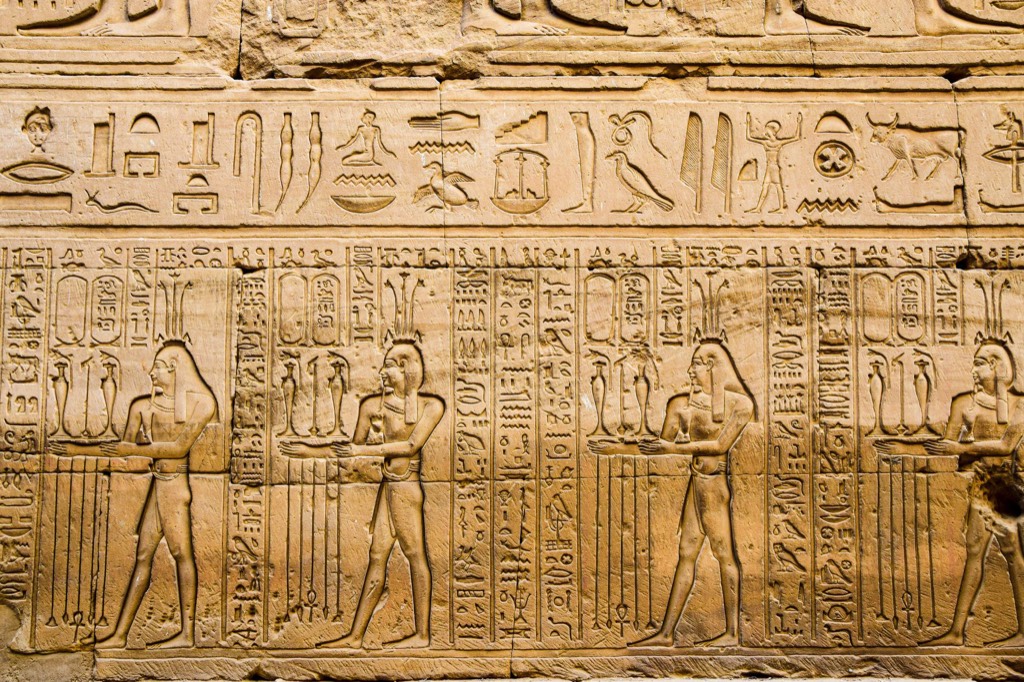
We tend to file the ancient Egyptians under pyramids and mummies, as if their genius stopped at the tomb door. But a surprising amount of your ordinary day runs on ideas they worked out thousands of years ago, along the banks of the Nile.
Some of these they clearly invented. Others they refined, popularized, or simply used earlier and better than anyone else — and where the record is fuzzy, it’s only fair to say so. Here are eight things the Egyptians handed down that you still reach for today.
Eye Makeup
Kohl and the painted eyeThat dark, dramatic line around the eyes you see on every Egyptian portrait wasn’t just for show. Rich and poor alike wore kohl — a paste ground from minerals like galena — rimming the eyes in bold black and green.
They believed it warded off the harsh sun’s glare and even guarded against eye disease, and modern researchers have found the lead salts in it may actually have had a mild antibacterial effect. Either way, the eyeliner in your bathroom drawer traces a straight line back to the banks of the Nile.
The 365-Day Calendar
A year you'd recognizeLong before Julius Caesar, the Egyptians split the year into 365 days — twelve months of thirty days, plus five extra days tacked on at the end. They timed it to the flooding of the Nile and the yearly reappearance of the star Sirius in the dawn sky.
It wasn’t perfect; without a leap day, it slowly drifted out of step with the seasons. But the basic shape of it — a solar year of 365 days — is the calendar you live by, passed down through Rome and into our own.
Paper
Papyrus, more or lessThe very word “paper” comes from papyrus, the reed that grew thick along the Nile. The Egyptians sliced its stem into strips, pressed them into crossed layers, and pounded them into smooth, durable sheets you could write on and roll up.
Strictly speaking, papyrus isn’t true paper — that came later, from China. But as a lightweight, portable surface for writing, papyrus was the ancient world’s answer for millennia, and it’s the ancestor every notebook and paperback quietly owes.
Toothpaste and Breath Mints
Fresh breath, 3,000 BCA diet heavy on coarse, grit-flecked bread wore Egyptian teeth down badly, so they fought back with the earliest known tooth-cleaning powders — gritty mixtures of things like crushed eggshell, ash, and ground ox hooves, rubbed on to scrub the teeth clean.
They also chewed pellets of honey, myrrh, and spices to sweeten their breath — an early breath mint by any other name. The recipes were rough, but the impulse behind that tube in your medicine cabinet is exactly the same.
A surprising amount of your ordinary day runs on ideas worked out thousands of years ago, along the banks of the Nile.
The Lock and Key
Pins in a wooden boltAround four thousand years ago the Egyptians built one of the first real locks — a wooden device fixed to a door, using a set of loose pins that dropped into a bolt and held it fast until the right key lifted them clear.
If that sounds familiar, it should. The pin-tumbler principle is exactly how the lock on your front door still works today; we’ve swapped wood for metal and shrunk it down, but the clever idea underneath is pure ancient Egypt.
Black Ink
Writing that lastsTo fill all that papyrus, the Egyptians needed something to write with, so they cooked up a durable black ink by mixing soot or charcoal with a gum binder and water. It flowed from a reed pen and dried into a mark that could survive for thousands of years.
We know it lasted because we can still read it — scrolls written in that carbon-black ink are legible to this day. Every pen and printer cartridge in your home is a distant descendant of that first reliable, long-lasting recipe.
The Ox-Drawn Plow
Farming at scaleEgyptians weren’t the only ancient people to farm, but they were among the first to hitch the plow to oxen, letting animals do the brutal work of breaking the soil. Their tomb paintings show teams of cattle dragging plows across the fields.
That leap — from human muscle to animal power — is what let a farmer work far more land and feed far more people. It laid the groundwork for the kind of large-scale agriculture that still, in a mechanized form, puts food on your table.
Bowling
The disputed oneHere’s the one to hold loosely. Archaeologists digging at Narmoutheos, a settlement south of Cairo, uncovered a room with a long stone lane and a set of balls — which some believe was an early form of bowling, played more than 2,000 years ago.
Not everyone is convinced it’s the direct ancestor of your local lanes, and ball-and-pin games pop up in several ancient cultures. But it’s a fun reminder that the Egyptians didn’t spend every waking hour building monuments — sometimes they just wanted to knock something over for the fun of it.
Not all of these are clean “Egypt invented it” stories — papyrus isn’t quite paper, and the bowling lane is still argued over. But taken together they make a quieter point: the distance between an ancient civilization and your morning routine is a lot shorter than the pyramids make it look.
Sources
How much do you remember?
3 quick questions from the story above.
Enjoyed that? Play a full trivia quiz:
Play a History quiz