You’ve probably said the name a dozen times — Yellowstone, Yosemite, the Everglades — without stopping to wonder where it came from. But each of those names carries a story inside it: sometimes a complicated one, sometimes a funny one, and occasionally one that would surprise even the park’s most devoted visitors. Place names are like that. They look fixed and permanent, but underneath they’re really just words that people used once and that happened to stick.
These eight parks stretch from the Maine coastline to the California desert, and each of their names has a past worth knowing. A few trace back to Indigenous languages misheard or mistranslated by newcomers. Others carry the imprint of soldiers, French trappers, newspaper editors, and at least one Austrian botanist. And one was apparently named in a moment of sheer, gasping relief as a group of gold-rush emigrants finally crawled free of a killing desert — and looked back.
Yosemite
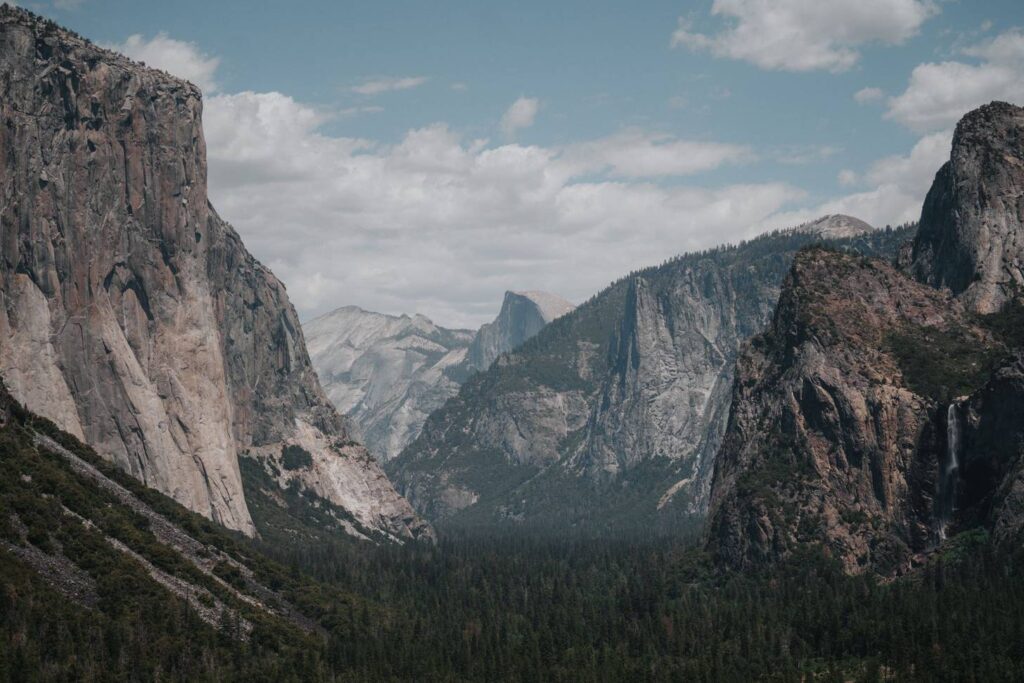
A name meaning killersWhen U.S. Army Captain John Boling led a battalion into the valley in 1851, he asked a local Miwok-speaking man for its name. The answer — something close to Yos.s.e’meti — was written down as “Yosemite,” and soldier Lafayette Bunnell proposed using it as the valley’s official name. Bunnell himself believed it meant “full-grown grizzly,” and that story has circulated ever since. But modern linguists who have gone back to the source — the Miwok vocabulary — find something quite different: the word almost certainly described the people who lived there, not the landscape. The stem verb yohe means “to kill,” and the suffix is a collective plural. The neighboring Miwok-speaking groups were essentially calling the valley’s residents “those who kill.”
The Ahwahneechee people themselves called their home Ahwahnee, meaning “the place of the gaping mouth” — a reference to the valley’s dramatic opening. So what we call Yosemite is actually an outsider’s label for the valley’s residents, mangled through transcription and then attached forever to the waterfalls and granite domes those residents had lived among for generations. The name is a small act of historical overwriting hiding inside one of the most-photographed landscapes in America.
Yellowstone
Volcanic rock told the taleThe Yellowstone River takes its name from the bright yellow, sulfur-tinged rhyolite cliffs along its banks in what is now eastern Montana — rock that glows almost amber in the afternoon sun. French-Canadian fur trappers working the region in the 18th century called the river Roche Jaune, meaning “Yellow Rock.” Early American explorers translated it straight into English, and when the park was established in 1872, the river’s name simply traveled upstream to become the park’s name.
Before that, the region was informally known as “Colter’s Hell,” after mountain man John Colter, who passed through around 1807 and came back with such stories of boiling mud pools and belching steam vents that his contemporaries largely assumed he was either lying or lost. When government surveyors finally confirmed the geysers were real, the more prosaic river name won out. Sometimes the geological truth is stranger than the tall tale.
Grand Canyon
Simply: it is bigSpanish soldier García López de Cárdenas became the first European to stand on the South Rim in 1540, but his party didn’t name it — they’d been sent to find a river crossing, which the canyon made impossible, and they turned back disappointed. Over the following centuries, Spanish maps used variations of cañón, simply meaning a gorge or channel. The modern name took hold largely through Major John Wesley Powell, whose 1869 river expedition through the canyon produced writing that gripped the American public. He called it “the Grand Canyon of the Colorado.”
That’s really it. Grand — from the French for large or impressive — and Canyon. No mythology, no mistranslated Indigenous word, no romantic story of a lone explorer moved to verse by the sunset. It is one of the most spectacular places on Earth, and the man who gave it its lasting name essentially said: well, it’s quite big. There is something both honest and quietly funny about that.
Everglades
Grassy water, forever misreadThe Miccosukee and Seminole peoples called this vast shallow river Pa-hay-okee, meaning “grassy water” — a name that captures what the Everglades actually is far better than the one English cartographers gave it. The English name first appeared on maps around 1823, probably from the word “glade,” an old term for an open, marshy clearing, combined with “ever” to suggest its seemingly endless expanse. But some linguists believe early mapmakers simply misread or miscopied an earlier British survey that labeled the region “River Glades.”
What those mapmakers were looking at — and what the name still obscures — is actually a slow-moving river, roughly 60 miles wide and sometimes just inches deep, flowing south toward Florida Bay. Naturalist Marjory Stoneman Douglas made that case beautifully in her 1947 book The Everglades: River of Grass, published the very year Congress established the national park. The Seminole got it right in fewer syllables.
Acadia
From ancient Greece to MaineWhen Italian explorer Giovanni da Verrazano sailed the Atlantic coast for France in 1524, he was reportedly so struck by the wooded, pastoral shoreline that he labeled part of it “Arcadia,” borrowing the name of the mythological Greek region where shepherds lived in perfect harmony with nature. Over time, the initial letter dropped, the French colony established in eastern Canada took the name Acadie, and the English eventually anglicized it to Acadia. The Mi’kmaq people of the region had their own related word — akadie, meaning roughly “a piece of land” or “fertile land” — and some scholars argue the French borrowed from them rather than from Homer.
The park itself wore two other names before settling on Acadia. It was created as Sieur de Monts National Monument in 1916, then renamed Lafayette National Park (the first national park east of the Mississippi), and only became Acadia in 1929. The final rename was partly a deliberate nod to that long Indigenous and French history — a reminder that this corner of Maine had been named and renamed long before the United States existed.
Shenandoah
Nobody agrees what it meansFew American place names have inspired as many romantic translations as Shenandoah. “Daughter of the Stars” is the most popular interpretation, first proposed by historian Joseph Doddridge in the 1850s, and it has since appeared in song lyrics, travel writing, and park gift shops from here to there. The problem: modern linguists who specialize in Iroquoian languages have found no support for it anywhere in the documented vocabulary. It appears to be, in the kindest reading, a poetic invention.
What the word actually means remains genuinely uncertain. Competing theories derive it from the Oneida name Skenondoah (related to a word for “deer”), while 19th-century ethnographers recorded translations as varied as “the sprucy stream,” “great plain,” and “river through the spruces.” The name had been on European maps since at least the 1730s, long before the national park was carved out of Virginia’s Blue Ridge Mountains in 1935. Whatever it once meant, it now means one specific autumn drive along Skyline Drive — and the smell of woodsmoke from a valley below.
Sequoia
A Cherokee genius, quietly honoredThe giant sequoias were so spectacularly large that 19th-century botanists couldn’t stop arguing about what to call them. British naturalists proposed Wellingtonia, honoring the Duke of Wellington — a suggestion Americans, still tender from recent history with Britain, declined with some firmness. The genus name Sequoia was assigned instead by Austrian botanist Stephen Endlicher in 1847. He left no written explanation for his choice, but most scholars believe he intended it as a tribute to Sequoyah, the Cherokee scholar who — in one of the more remarkable intellectual achievements of the 19th century — created a complete written syllabary for the Cherokee language in the 1820s entirely on his own, without having first learned to read any other language.
The national park, established in September 1890, took its name from those same trees, becoming only the second national park in the United States after Yellowstone. Its creation required years of campaigning by George Stewart, a newspaper editor in Visalia, California, who understood that the logging companies eyeing Giant Forest would not stop voluntarily. The trees are still there. Sequoyah’s name, quietly embedded in their Latin classification, still stands with them.
Death Valley
Named in a moment of reliefIn the winter of 1849–1850, a party of gold-rush emigrants took what they believed was a shortcut to California’s goldfields and found themselves trapped in a searing desert basin with dwindling water, dying oxen, and no clear way out. Most eventually found their way free, though by then they had endured weeks of punishing heat, brutal cold nights, and the particular kind of desperation that comes from running out of options in a landscape that doesn’t care. According to the most widely repeated version of the story, one of the survivors turned back as the group finally crested out of the valley and said: “Goodbye, Death Valley.”
The name spread rapidly through newspaper accounts and expedition reports — the kind of word-of-mouth that a near-death story guarantees. The Timbisha Shoshone, who had lived in the valley for centuries without any such reckoning, called their home Tümpisa, meaning “rock paint,” after the ochre-colored clay found there. The valley became a national monument in 1933 and a national park in 1994. It remains the hottest, driest, and lowest place in North America, and it has never stopped being called by the name a desperate stranger gave it one January morning when he was finally, gratefully, somewhere else.
Names stick for funny reasons — a desperate farewell, a botanist’s quiet tribute, a Seminole phrase that cartographers half-heard and half-guessed. These are the threads woven into places you can still drive to this weekend. Next time you say the name on a sign, you’ll know a little more of what’s underneath it.
Frequently asked questions
Why do so many American place names come from Indigenous languages?
Long before European explorers arrived, Indigenous peoples had named every river, mountain, and valley according to its features, history, or spiritual significance. When traders, soldiers, and settlers passed through, they asked locals for names and wrote down what they heard as best they could — frequently mangling pronunciation and stripping the original meaning in the process. The results stuck, which is why so many names on American maps are borrowed and transformed beyond recognition. If you find yourself curious about how language shape the world around us, our piece on where 10 everyday sayings really come from takes a similar look at hidden histories buried in ordinary words.
Is Death Valley really as dangerous as its name suggests?
Death Valley is the hottest and driest place in North America, and in high summer it can be genuinely life-threatening — the record air temperature of 134°F (56.7°C) was set there in 1913. That said, the Timbisha Shoshone lived in the valley for centuries without any such dramatic reckoning; it was the 1849 gold-rush emigrants, taking an ill-advised shortcut, who gave it its morbid name. Over a million visitors come each year, mostly in cooler months, and the vast majority leave without incident. The name cast a long shadow over a place that was, for its original inhabitants, simply home.
Which of these eight parks is the oldest?
Yellowstone, established in 1872, holds the distinction of being the first national park not only in the United States but in the world. Yosemite Valley was federally protected earlier — granted to California in 1864 — but it wasn’t designated a full national park until 1890, the same year Sequoia was established. Acadia, the youngest of the eight in terms of its current name, only received that designation in 1929, though it had been protected since 1916. Understanding how these protections came about incrementally, through politics and advocacy over decades, is a bit like learning how any big system gets built. For more on incremental systems that shaped the modern world, see our piece on why we have time zones.
Were any of these parks named after famous historical figures?
Sequoia comes closest: the park takes its name from the giant trees, and the trees were almost certainly named to honor Sequoyah, the Cherokee scholar who invented a complete writing system for his people in the 1820s — one of the very few people in recorded history to accomplish that feat alone. That kind of legacy — a name embedded in the living world long after the person is gone — echoes through many things we use every day without knowing their origins. Our piece on Roman inventions we still use today offers another look at how ancient contributions quietly shape the world you live in.
Sources
How much do you remember?
3 quick questions from the story above.
Enjoyed that? Play a full trivia quiz:
Play a Geography quiz