You know the rhythm of this night by heart. The porch light left on, the bowl of candy by the door, a plastic skeleton somebody’s grandkid insisted on, and that first small voice calling “trick or treat” just as the sky goes purple. Most of us grew up with all of it and never once asked where any of it came from. The costumes, the carved pumpkin on the step, the apples floating in a tub of cold water — we just did them, because that’s what you did on the last night of October.
It turns out a lot of these habits are far older than the candy aisle, and older than the word “Halloween” itself. Some trace back to an ancient Celtic harvest festival; some to medieval church calendars; one to a Roman goddess of fruit. And a fair amount of what people repeat every October is really folklore dressed up as history. So here are eight of the most familiar traditions, with the documented part kept honestly apart from the story part — because the real roots are stranger and better than the tidy versions.
The ancient festival of Samhain
where it all beginsLong before anyone said “Halloween,” the Celts marked the turn of the year with a festival called Samhain — pronounced, if you want to say it properly, something close to SAH-win. It fell at the end of the summer harvest, around the last day of October, when the warm half of the year gave way to the dark and cold. For a people who lived by the seasons, that was the real new year, and it carried a whiff of dread along with the relief of the crops being in.
The Celts believed that on this night the line between the living and the dead went thin, and that spirits could slip back into the world. So they lit great bonfires and put on costumes, hoping to keep the ghosts at a distance. Nearly everything that follows on this list grew, in one way or another, out of that one uneasy night.
Why it lands on October 31
all hallows’ eveThe calendar date isn’t an accident, and it isn’t random. In the eighth century, Pope Gregory III set November 1 as All Saints’ Day, a time to honor all the saints at once. An older name for a saint was a “hallow,” so the night before became All Hallows’ Eve. Say that out loud a few times, let the centuries wear it down, and you get “Halloween.”
That new Christian holy day landed right on top of the old Samhain, and the two never fully separated. November 2 brought All Souls’ Day, which kept alive the belief that the living and the dead could still, somehow, reach one another. So October 31 ended up carrying both things at once — a saints’ vigil and a much older night of spirits.
Costumes to fool the spirits
hide in plain sightThe idea of dressing up didn’t start with store-bought superhero suits. During Samhain, the Celts wore disguises for a practical, slightly nervous reason: if the dead were walking, you did not want to be recognized as one of the living. Wear a costume after dark, the thinking went, and a wandering ghost might take you for one of its own and leave you be.
It’s a strange thing to picture — grown people in animal skins hoping to pass for the departed — but the instinct behind it is the same one behind your grandchild’s mask tonight. You become someone else for an evening. The difference is only that the stakes used to feel a great deal higher.
Trick-or-treating and “souling”
knock, knockHere’s where honest history admits it isn’t certain. Historians point to a few threads that likely braided together into the doorstep ritual you know. One is the old practice around All Souls’ Day of the poor going door to door for small pastries called soul cakes, promising prayers for the household’s dead in return — a custom known as “souling.”
Another is the Scottish tradition of “guising,” where children in disguise went about collecting food or coins. A third points to German-American customs carried over by immigrants. No single one of these is trick-or-treating, exactly, but you can see the whole shape of tonight in them: a costume, a knock, and something handed over at the door.
The jack-o’-lantern and Stingy Jack
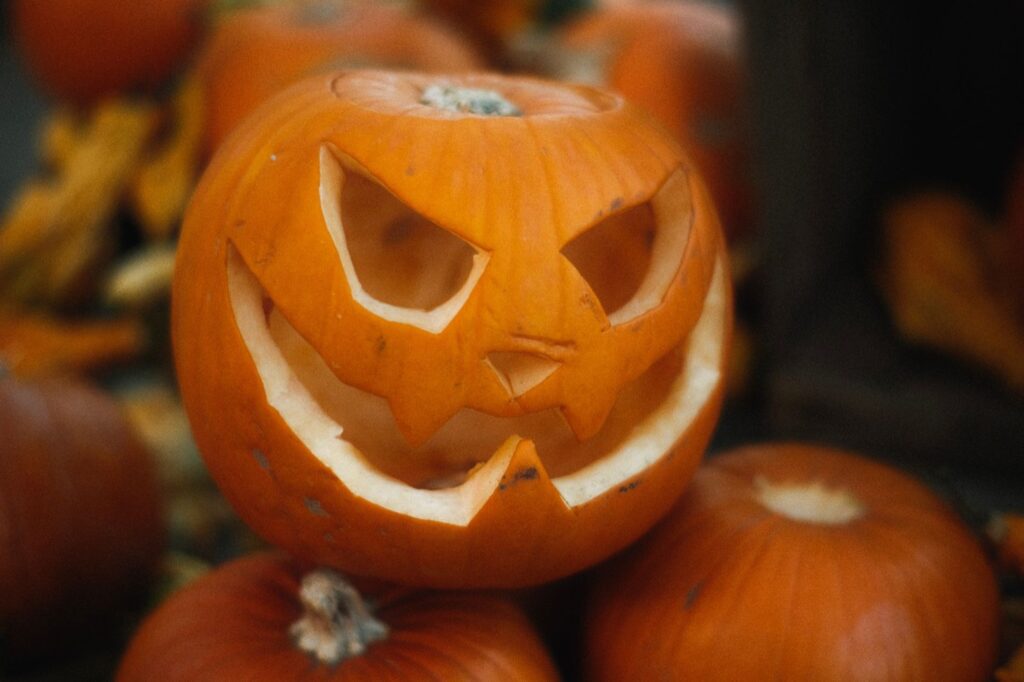
a turnip, not a pumpkinThe glowing face on your step has an Irish legend behind it, and it starts with a rogue called Stingy Jack. As the story goes, Jack tricked the Devil more than once — talking him into becoming a coin, then trapping him beside a cross; later pinning him up a tree by carving a cross into the bark until the Devil swore to leave him alone. Clever, but it cost him. When Jack died, Heaven wouldn’t have such a scoundrel, and the Devil, still sore and bound by his word, wouldn’t take him either.
Sent off into the dark with nothing but a burning coal, Jack is said to have tucked it inside a hollowed-out turnip and wandered ever since — “Jack of the Lantern,” then just Jack O’Lantern. In Ireland and Scotland people carved frightening faces into turnips (England favored big beets) to scare him and his kind away. When the Irish came to America, they found the native pumpkin far easier to carve, and the pumpkin we know today quietly took the turnip’s place.
Bobbing for apples and a Roman goddess
blame the RomansThat tub of water and floating apples has a surprisingly old pedigree, and it isn’t Celtic at all. It traces back to the Roman festival honoring Pomona, the goddess of fruit and abundance, whose symbol was the apple. When Rome conquered the British Isles in A.D. 43, the Roman festivals mingled with the local Samhain that fell around the same season.
Over the long centuries that followed, Pomona’s apples stayed in the mix, and the fruit became tangled up with games of courtship and fortune-telling — who would marry, and when. If you ever knelt over a cold tub as a kid, soaked to the collar and chasing an apple with your teeth, you were playing out something with Roman roots nobody at the party could have named.
Black cats and the fear of witches
a bad rapThe black cat crossing your path got its spooky reputation the hard way, through centuries of suspicion. In medieval Europe the animal came to be seen as a creature of the Devil. A church document issued by Pope Gregory IX in 1233, the Vox in Rama, cast the black cat as an incarnation of Satan, and the fear only deepened from there.
Before long people believed a witch could turn herself into a black cat, or send one out as a “familiar” to do her bidding. Puritan colonists carried those beliefs across the Atlantic, which is part of why the black cat still turns up on every Halloween decoration you own — a leftover of a genuinely dark chapter, pressed now onto a paper cutout taped to a window.
Why the colors are orange and black
harvest and the darkYou could pick Halloween’s two colors out of a lineup, and that pairing isn’t arbitrary either. It reaches back to the same seasonal turning point the Celts marked. Orange stands for the autumn harvest — the ripe fields, the bonfire light, the pumpkins piled on the porch. Black stands for the dark half of the year closing in, the long cold stretch on the far side of the feast.
So the decorations in every drugstore are quietly telling the oldest story on this list: a last bright gathering of the harvest, and then the dark. The Celts understood that balance in their bones. We mostly just reach for the matching napkins.
None of this needs to change a thing about tonight. Hand out the candy, admire the carved grin on the step, let the little ones parade past in their costumes. But when that first knock comes, you might feel the long tail of it — the harvest fires, the thin night, a rogue named Jack with his glowing turnip — standing just behind the porch light, where it has been waiting for a very long time.
Frequently asked questions
Why is Halloween on October 31?
The date lines up with the ancient Celtic festival of Samhain, which marked the end of the harvest and the start of winter. In the eighth century Pope Gregory III set November 1 as All Saints’ Day, so the night before became All Hallows’ Eve — eventually shortened to Halloween. It was never a random date on the calendar.
What is Samhain and how is it related to Halloween?
Samhain (pronounced roughly SAH-win) was a Celtic festival at the end of October when people believed the boundary between the living and the dead grew thin, so they lit bonfires and wore costumes to ward off spirits. Many Halloween customs — costumes, the focus on the dead, even the orange-and-black colors — grew out of it.
Did jack-o’-lanterns really start as carved turnips?
Yes. The custom comes from Irish and Scottish folklore about “Stingy Jack,” and people originally carved faces into turnips (and sometimes beets) rather than pumpkins. Irish immigrants switched to pumpkins in America because the native squash was larger and far easier to carve. This is one of several Halloween customs that, like many everyday sayings, turn out to have older roots than most people expect.
Why are black cats associated with Halloween?
In medieval Europe black cats were feared as creatures of the Devil — a 1233 church document, the Vox in Rama issued by Pope Gregory IX, even called them an incarnation of Satan. People later believed witches could turn into black cats or send them as “familiars,” and Puritan colonists carried those superstitions to America, where the black cat stuck as a Halloween symbol.
Sources
How much do you remember?
3 quick questions from the story above.
Enjoyed that? Play a full trivia quiz:
Play a History quiz