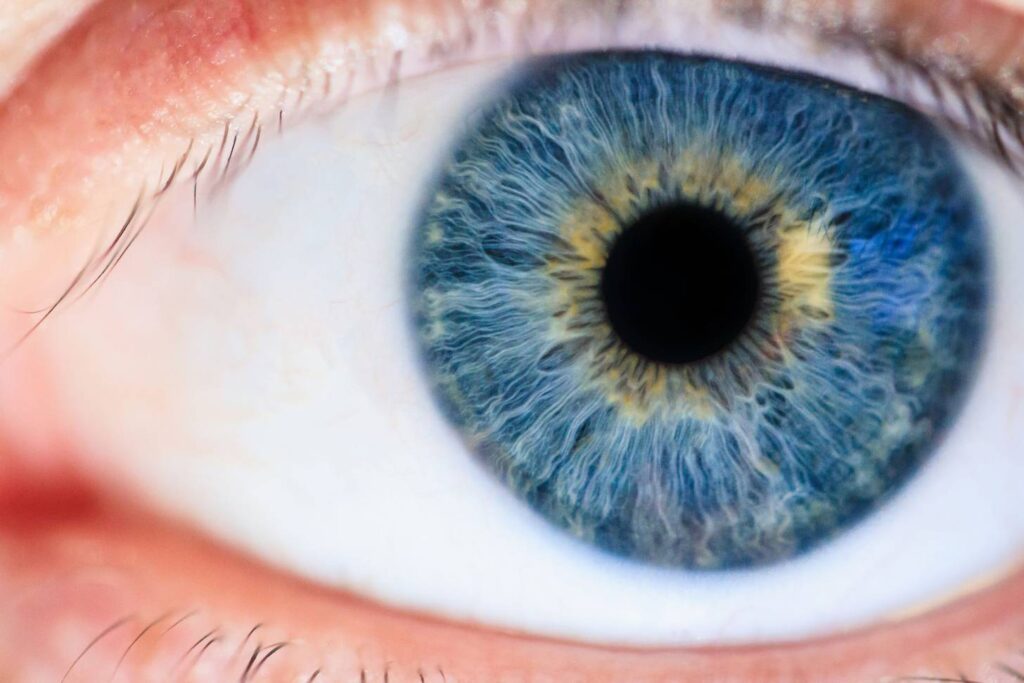
Right now, as your eyes move across this page, something remarkable is happening. Light is bending through a transparent dome, bouncing off a curved lens, landing on a sheet of tissue thinner than a sheet of paper — and in a fraction of a second, your brain is turning all of that raw data into a world. You have been doing this every waking hour of your life, and you have almost certainly never given it a second thought.
The human eye is one of the most studied organs in medicine, yet it still manages to surprise researchers. Much of what it does runs quietly in the background, invisible even to the person doing the seeing. Here are eight facts about your eyes that may well change how you think about the act of looking.
Your Retina Sees Everything Upside Down
Brain flips it backThe lens of your eye works much like the lens of a camera: it projects an inverted image onto the retina at the back of your eye. Everything you see — the face of a friend, the words on a page, the view from your kitchen window — lands on your retina flipped upside down. Light from the top of your visual field strikes the bottom of your retina, and light from the bottom strikes the top.
Your brain corrects this automatically, so completely that you never notice it. Researchers have tested this correction with special glasses that invert the visual field: wearers initially see everything upside down, but after several days the brain adapts and flips the image right-side-up again. Remove the glasses, and the world goes upside down once more until the brain re-adapts. It is a vivid reminder that what you experience as “seeing” is as much a construction of the mind as a report from the eye.
There Is a Hole in Your Vision You’ve Never Seen
Brain fills the gapEvery human eye has a blind spot — a small region of the visual field where there are no photoreceptor cells at all. It sits roughly 15 degrees to the side of wherever you are looking, and it covers an area about 7.5 degrees tall and 5.5 degrees wide in your visual field. That is not a tiny gap. It is roughly the size of about 17 full moons placed side by side, and it exists in each of your eyes.
The blind spot forms where the optic nerve exits the back of the eye, bundling up roughly 1.2 million nerve fibers to carry signals to the brain. At that exit point — the optic disc — there is simply no room for light-sensing cells. What keeps you from experiencing this gap as a constant dark patch? Your brain fills it in, using information from the surrounding visual field to paint in a plausible picture. It does this so convincingly that most people never discover their blind spot without a deliberate test.
Your Eyes Are Never Truly Still
Constant invisible jumpingEven when you are staring steadily at a fixed point, your eyes are moving. They make small, rapid jumps called saccades — two or three times every second, each lasting between 20 and 200 milliseconds — as they gather information from different parts of the scene. While reading, your eyes make these jumps roughly four or five times per line, darting across the page in short leaps rather than flowing smoothly.
During each saccade, your visual system does something clever: it largely suppresses your perception of the motion. Without this saccadic masking, you would experience a constant smearing blur every time your eyes moved. Instead, the brain stitches together the still images captured at each stopping point into what feels like seamless, continuous vision. The stopped-clock illusion — that moment when a clock’s second hand seems to pause just after you glance at it — is thought to be a side effect of this suppression stretching time ever so slightly.
You Have 120 Million Rods and Only 7 Million Cones
Night vision outnumbers colorYour retina contains two kinds of photoreceptor cells: rods and cones. Cones handle color and fine detail; they are concentrated in the fovea, the small central pit that gives you sharp central vision. The fovea covers just 0.01 percent of your total visual field — a region barely two degrees across — and yet it draws about ten percent of the optic nerve’s entire output. That is how valuable high-resolution color vision is to the brain.
Rods, meanwhile, far outnumber cones: roughly 120 million rods to about 7 million cones. Rods are exquisitely sensitive to dim light but perceive no color, which is why the world turns mostly gray after dark. Because rods are concentrated in the periphery rather than the center, the trick for seeing a faint star on a dark night is to not look directly at it. Looking slightly to the side aims the light at the rod-rich periphery instead of the cone-dense fovea, and the star suddenly appears.
Your Cornea Has No Blood Vessels — and Gets Oxygen From Your Tears
Transparency demands sacrificeBlood is red, and red is opaque. So the cornea — the clear dome at the front of your eye — faces a problem. It is a living tissue that needs oxygen, but any blood vessel running through it would block light and blur your vision. The solution your body arrived at is elegant: the cornea has no blood vessels at all. Instead, it absorbs oxygen directly from the tear film that coats it every time you blink.
This arrangement makes the cornea the most sensitive tissue in the human body. Its pain-receptor density is estimated at 300 to 600 times that of skin and 20 to 40 times that of dental pulp. That is why even a tiny speck of dust on the cornea feels so startlingly sharp. The cornea also provides roughly two-thirds of the eye’s total optical power — more than the lens itself — though its focus is fixed. All the fine-tuning for near and far objects is done by the lens behind it.
Your Peripheral Vision Is Nearly Colorblind
Color lives at the centerYour total visual field extends roughly 214 degrees horizontally, covering a wide arc around you. But color perception is not evenly spread across that field. The color-sensitive cone cells are densely packed in the fovea at the center of your vision, and their density drops sharply toward the edges. By the time you reach the outer periphery, almost all of your vision is handled by rods, which carry no color information at all.
In practice, this means that an object in your far peripheral vision will look almost entirely gray unless you turn to look at it. You can test this yourself: hold a colored card at arm’s length and slide it slowly into your side vision without looking at it. You will likely be able to detect motion and rough shape long before you can correctly name the color. The brain’s remarkable ability to blend the colorful center of your visual field with the gray periphery is what creates the convincing impression that the whole world is in full color.
Full Dark Adaptation Takes Half an Hour
Rods need their timeWalk from a brightly lit room into complete darkness and you will initially see almost nothing. Your pupils will dilate quickly — widening from about 2 millimeters in bright light to more than 8 millimeters in the dark — and that helps right away. But the deeper process of dark adaptation is far slower, because it depends on rods chemically regenerating a pigment called rhodopsin that bright light bleaches away.
About 80 percent of rod adaptation is complete after roughly 30 minutes in darkness. This is why Navy sailors once wore red goggles below deck before night watches: red light does not bleach rhodopsin, so their rods stayed primed while the rest of the ship’s lights were on. Stepping out into the dark, they could see almost immediately. It is also why a single burst of bright light — a car’s headlights, a flashbulb — can set your night vision back to nearly zero, requiring another slow recovery.
Your Tears Are a Three-Layer Structure
More than just waterTears are not simply saltwater. The tear film that covers your cornea between blinks is a precisely engineered three-layer structure. The outermost layer is an oily lipid film produced by the Meibomian glands along the edge of your eyelids; it slows evaporation and keeps the tear film from breaking up too quickly. Beneath that is a thick watery layer produced by the lacrimal glands — the layer most people think of as “tears” — which carries oxygen, antibodies, and proteins to the cornea. The innermost layer is a thin coat of mucin secreted by goblet cells in the conjunctiva, which helps the watery layer stick evenly to the corneal surface.
When any of these three layers is off — too little lipid, too little water, too little mucin — the result is dry eye syndrome, which affects tens of millions of Americans. The gritty, burning sensation of dry eye is not from dryness alone but from the cornea’s extraordinarily sensitive nerve endings registering the disruption of this careful layering. Next time your eyes feel tired after a long day on a screen, consider that you are essentially wearing down a structure built to millimeter-thin tolerances — one blink at a time.
The eye you were born with is doing something extraordinary every moment you are awake: assembling a world from light, filling in gaps, correcting inversions, and suppressing blur, all without a single conscious instruction from you. The more closely scientists look, the more they find that vision is less a window and more a construction — and a surprisingly personal one at that.
How much do you remember?
3 quick questions from the story above.
Enjoyed that? Play a full trivia quiz:
Play a Science quizFrequently asked questions
Why do I see floaters in my vision?
Floaters are tiny clumps of collagen or other debris drifting inside the vitreous humor, the gel-like fluid that fills the main chamber of your eye. They cast faint shadows on the retina, which you perceive as specks, threads, or cobwebs. They are very common and usually harmless, though a sudden shower of new floaters — especially if accompanied by flashes of light — warrants a prompt visit to an eye doctor, as it can signal a retinal tear. For more on how the eye builds the world you see, take a look at our piece on why the sky is blue — and red at sunset.
Is it true that reading in dim light damages your eyes?
No — reading in low light may cause eye strain and temporary fatigue, but it does not cause any lasting damage to your eyes. The strain comes from the extra effort your visual system makes to focus in poor conditions, not from any physical harm to the eye structures. Eye strain typically resolves quickly with rest. The idea that dim-light reading ruins your eyes is one of those persistent myths that has circulated for generations without any solid evidence behind it.
Why do your eyes water when you yawn?
When you yawn, the muscles around your eyes contract and put brief pressure on the lacrimal glands, squeezing out tears reflexively. It is a purely mechanical response with no emotional component, the same way pressing lightly around your eye socket can produce tears. The lacrimal glands sit just above and to the outer side of each eye, and they are sensitive enough that ordinary facial movement can trigger them.
What causes the red-eye effect in photographs?
Red-eye occurs when a camera flash fires directly into the eye in a darkened room. Because your pupils are dilated in low light, the flash travels deep into the eye and reflects off the blood-rich retina at the back — and the retina, with all its capillaries, is red. The light bounces straight back into the camera lens because the flash and the lens are so close together. Using a camera’s red-eye reduction mode fires a series of small pre-flashes to constrict the pupil before the main shot. For more on unusual light effects, see our article on why the sky turns red at sunset.