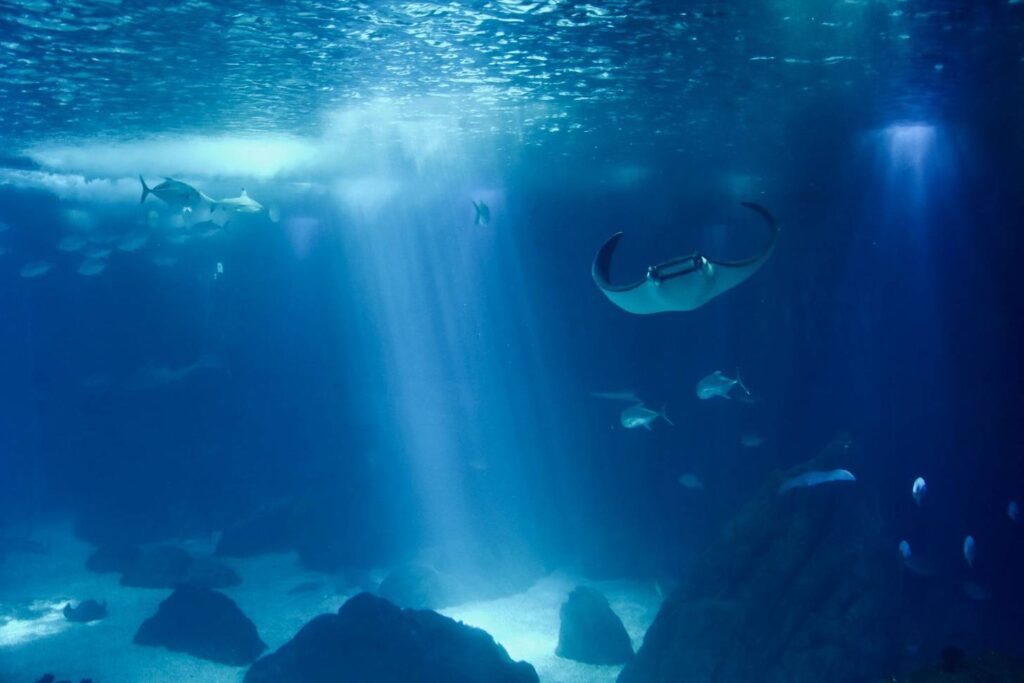
Oceanographers estimate that more than 80 percent of the ocean floor has never been directly observed. For most of human history, the deep sea—everything below 1,000 meters—was assumed to be a cold, featureless desert. It wasn’t until submersibles and remotely operated vehicles came into their own, in the last few decades, that researchers could actually see what was down there. What they found upended almost every assumption scientists had brought with them.
The pace of discovery has been genuinely startling. Each major expedition since the 1980s has returned with footage or specimens that prompt scientists to revise the textbooks. Some of the creatures below were formally unknown to science just a few years ago. Others had been glimpsed in damaged net samples but were only understood once someone got a camera close enough to see them whole. Here are eight that have surprised even the people whose full-time job is to expect the unexpected.
The Yeti Crab
Hairy arms, bacterial farmIn March 2005, the research submarine Alvin was exploring a hydrothermal vent field on the Pacific-Antarctic ridge, about 1,500 miles south of Easter Island, when it brought back something no one had ever catalogued. The creature looked something like a lobster but was covered in long, pale, feathery hairs along its arms—hairs that turned out to harbor dense colonies of bacteria. Scientists named it Kiwa hirsuta and placed it in an entirely new family, Kiwaidae. The genus name nods to Kiwa, the Polynesian goddess of shellfish.
What those hairy arms are for has been a source of ongoing fascination. The bacteria growing in the setae appear to be sulfur-oxidizing microbes that thrive near vent fluids, and researchers believe the crabs may actively cultivate and consume them—a kind of mobile garden in the dark. Near the warmest vent openings, densities of up to 700 yeti crabs per square meter have been recorded. It’s a thriving community that runs on chemistry, not sunlight.
The Barreleye Fish
Eyes hidden inside its headMarine biologists had technically known about the barreleye fish (Macropinna microstoma) since 1939, but every specimen they had ever studied had been pulled up in a net, dead on arrival. The delicate fluid-filled dome covering its eyes always collapsed during the ascent. For decades, illustrations of the fish showed a head with two upward-pointing eyes and a pair of spots that looked like nostrils—which, it turns out, actually are nostrils.
In the mid-2000s, researchers from the Monterey Bay Aquarium Research Institute (MBARI) captured the first live footage of a barreleye in its natural habitat. The dome was intact—clear and slightly greenish—and the eyes, it turned out, can rotate. Rather than staring fixedly upward, the fish can swivel them forward when moving in for a meal. Scientists now believe the transparent dome protects those sensitive eyes when the fish pokes its head into a siphonophore’s tentacles to steal caught prey.
The Hoff Crab
Antarctica’s unlikely residentIn 2010, British scientists piloting a remotely operated vehicle to the East Scotia Ridge in Antarctica—at about 2,600 meters depth—discovered that the ridge’s newly found hydrothermal vents were carpeted with a yeti crab no one had ever seen. The creature had an especially dense, golden thatch of bacteria-laden hairs on its chest, which immediately reminded researchers of a certain ’80s television actor known for a memorable chest. The nickname “Hoff crab” stuck. Its formal name, Kiwa tyleri, honors Paul Tyler, a pioneer in deep-sea research.
What made the discovery striking beyond the novelty is what it revealed about survival. Because the water cools rapidly just a few meters from the vents, the crabs are essentially trapped in a narrow ring around the heat source—their Goldilocks zone. Move too close and you’re scalded; move too far and you freeze. The crabs pack in so tightly that researchers counted hundreds per square meter. It was the first yeti crab found in Antarctic waters, confirming that life had found a way into one of the planet’s most hostile corners.
The Giant Squid
Five centuries of legend, confirmedSailors had been reporting encounters with enormous squid for centuries, and dead specimens had washed ashore often enough that scientists knew the animal was real. But no one had ever photographed one alive in its natural habitat until September 2004, when Japanese zoologist Tsunemi Kubodera and his team deployed a baited camera line near the Ogasawara Islands. The images that came back showed a living giant squid—roughly 25 feet long—that seized the bait and lost one of its arms in the struggle.
The first actual moving footage, shot in its natural deep-sea environment rather than at the surface, came from a 2012 collaboration between NHK and the Discovery Channel. The team spent some 400 hours attempting to film the creature before finally capturing it at about 900 meters. What they found wasn’t the sluggish, dim-eyed monster of sailor’s tales but an active, shimmering predator, its skin flickering with what appeared to be bioluminescent light. The giant squid (Architeuthis dux) turned out to be faster and more agile than anyone had anticipated.
The Dumbo Octopus
Accidentally caught, formally namedThe genus Grimpoteuthis—nicknamed Dumbo octopuses for the ear-like fins they use to propel themselves—had been known in a general way since the mid-20th century. But in 2016, a German research vessel’s deep-sea trawl accidentally brought up a specimen that had never been formally described. It was a large, pale animal with fin placement and body proportions unlike any of its relatives. Researchers named it Grimpoteuthis imperator.
What makes the Dumbo octopuses as a group distinctive is how much they differ from their shallow-water cousins: no ink sac (there are no predators to escape from at 4,000 meters), a gelatinous body suited to withstand crushing pressure, and those wings—used to hover, turn, and descend with an elegance that makes them look less like sea creatures than like something a child drew. G. imperator was recorded from depths of about 4,000 meters in the North Pacific.
The Mariana Snailfish
Deeper than anyone expectedIn 2017, researchers described a new species from the Mariana Trench that set the record for deepest-living fish ever confirmed. Pseudoliparis swirei—the Mariana snailfish—was found at depths between 6,900 and nearly 8,000 meters, with video footage placing individuals at around 8,178 meters. The species was named for Herbert Swire, a 19th-century officer aboard HMS Challenger, the ship that first charted the trench during the 1872–1876 expedition.
The fish is small, pale, and scaleless, with a slightly gelatinous quality that lets it tolerate pressures more than 800 times those at sea level. It feeds on tiny amphipod crustaceans that tumble down into the trench. What surprised researchers most was not just how deep it lived, but how well it appeared to be doing there—abundant, active, and apparently thriving in conditions that would destroy most living tissue within seconds of exposure.
The “Casper” Octopus
Ghostly, nameless, broodingIn early 2016, a NOAA expedition using a remotely operated vehicle near Necker Island, Hawaii, descended to about 4,290 meters when the cameras picked up something that immediately set scientists talking. The small octopus sitting on a rock was completely white—no pigment whatsoever, with no musculature visible through the skin. It had the appearance, more than a few researchers noted, of a friendly cartoon ghost. The internet named it “Casper.” Its actual scientific name has yet to be formally assigned.
What made the discovery scientifically notable beyond its appearance was where and how it was sitting. The octopus was resting on the stalk of a dead sponge in a posture that researchers believe may have indicated egg-brooding behavior. If correct, that would mean the animal lays its eggs on sponge stalks and guards them—at a depth and in a habitat no one had previously associated with octopus reproduction. It was the deepest observation of this type of octopus behavior ever recorded.
The Giant Siphonophore
Perhaps the longest animal aliveIn 2020, researchers with the Schmidt Ocean Institute were mapping the Ningaloo Canyons off Western Australia when their underwater vehicle caught something extraordinary on film at around 600 meters: a spiral-shaped creature so long that it took a moment to understand what they were looking at. Using footage analysis, the team estimated the specimen at approximately 45 meters from one end to the other—making it a candidate for the longest animal ever measured, surpassing even the blue whale.
A siphonophore is not, strictly speaking, a single animal. It is a colony of genetically identical zooids, each of which has a specialized job—swimming, feeding, reproducing—and none of which could survive on its own. What the cameras captured was likely a new species from the genus Apolemia. Looking at it, it’s easy to see why early oceanographers, catching glimpses of these colonies in damaged condition, reached for mythology to explain what they had seen. The reality, it turns out, is at least as strange.
Most of these discoveries happened within the last 20 years, which means the deep ocean is still giving up its secrets in real time. Researchers who have spent careers in this field often describe the same feeling after a major expedition: they found more than they expected, and what they found was stranger than anything they had predicted. For anyone who worries that there are no more genuine discoveries left to be made, the deep sea is a reliable corrective.
How much do you remember?
3 quick questions from the story above.
Enjoyed that? Play a full trivia quiz:
Play a Science quizFrequently asked questions
How deep does the deep sea actually begin?
The deep sea is generally considered to start at about 200 meters, where the continental shelf drops away and sunlight becomes too dim to support photosynthesis. The abyssal zone, home to many of the creatures in this article, begins around 4,000 meters. These cold, pressurized regions were once thought to be lifeless—the discoveries of recent decades proved otherwise, much as early scientists who assumed life required sunlight were surprised by discoveries like hydrothermal vents and chemosynthesis. For more on how past assumptions turned out to be wrong, see our story on 9 Roman inventions we still use every day.
What is a hydrothermal vent, and why does life thrive there?
A hydrothermal vent is a crack in the ocean floor where geothermally heated water escapes, often at temperatures above 400°C (though it doesn’t boil because of the pressure). These vents support entire ecosystems powered by chemosynthesis—bacteria convert hydrogen sulfide into energy, and everything above them in the food chain, from the yeti crab to the tube worm, feeds off that process rather than off sunlight. The discovery of vent ecosystems in the late 1970s fundamentally changed how scientists think about where life can survive, including on other planets.
Why do so many deep-sea creatures produce their own light?
Bioluminescence is estimated to be present in up to 90 percent of deep-sea species. Down where no sunlight penetrates, generating light serves many purposes: attracting prey, startling or confusing predators, communicating with potential mates, or even counterilluminating a silhouette to blend with faint light from above. It’s one of biology’s most striking examples of convergent evolution—dozens of unrelated animal groups independently arriving at the same solution. For another example of how nature finds the same answer through different paths, see our piece on why the sky turns red at sunset.
How much of the ocean floor has been mapped in detail?
According to the National Oceanic and Atmospheric Administration (NOAA), only about 25 percent of the global ocean floor had been mapped in high resolution as of recent estimates—far less coverage than we have of the surface of the Moon or Mars. Advanced sonar systems, autonomous underwater vehicles, and remotely operated submarines have rapidly expanded that coverage in recent years, but the ocean remains the least-explored part of our own planet. The creatures described in this article represent only the discoveries we know about.