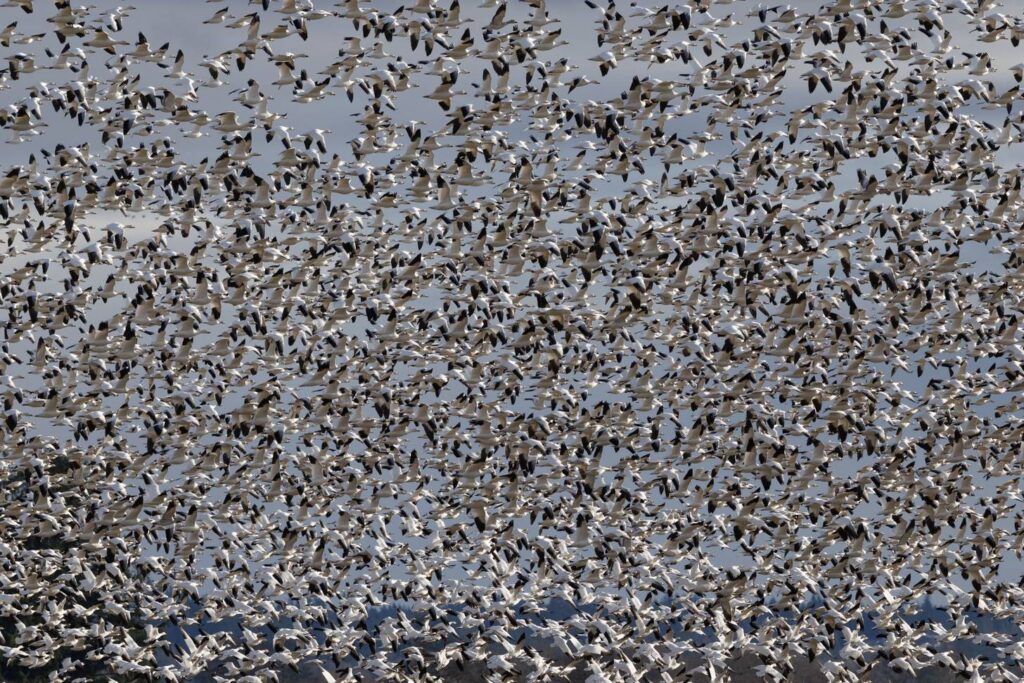
Right now, somewhere over the Atlantic, a bird barely heavier than a handful of change is flying from one end of the Earth to the other. Somewhere in central Mexico, a forest so dense with orange wings it hums has just received millions of travelers from Canada and the northern United States. You probably noticed when the geese flew over your yard this fall — a moment of noise, then quiet. What’s harder to grasp is the sheer scale of what they’re part of: one of the oldest, most relentless forces in the natural world.
Every year, animals cross continents, oceans, and mountain ranges in movements so precise they’ve survived for millions of years without GPS, maps, or rest stops. Scientists with satellite tags have been piecing together the full picture only in recent decades — and what they’ve found keeps getting more astonishing. Here are eight migrations that might make you see the world a little differently.
Arctic Tern
Pole to pole, every yearThe arctic tern doesn’t just migrate. It commutes between the two poles of the planet, every single year, for thirty years or more. Tracking studies have clocked the round trip at about 71,000 kilometers — roughly 44,000 miles — though newer, more precise tags push that figure higher, with some birds recorded near 80,000 km annually. Add it up over a long life and a single tern may cover the equivalent of three round trips to the Moon.
What the numbers can’t quite capture is the route: not a straight line but a great zigzag through the Atlantic, swinging wide to catch the best winds, following the sun from one polar summer into the next. Because the Arctic and Antarctic summers don’t overlap, an arctic tern essentially chases daylight for its entire life — seeing more hours of sun than any other creature on Earth. It weighs about 113 grams. Four ounces.
Monarch Butterfly
3,000 miles on gossamer wingsThere is something specifically humbling about the monarch butterfly’s journey. A creature weighing less than a paper clip, with a wingspan of about four inches, travels up to 3,000 miles from southern Canada and the northern United States to a handful of mountain forests in central Mexico — forests at nearly 10,000 feet elevation that its grandparents and great-grandparents also used, though no individual monarch has ever made that trip before.
Navigation involves a sun compass calibrated to an internal clock, and possibly a magnetic sense that kicks in on overcast days. The migrating generation — the one that actually makes the crossing — lives eight or nine months, long past the two-to-five-week lifespan of the summer breeders. Something in the biology shifts. Scientists have traced it to specific proteins sensitive to ultraviolet light. They’re still working out exactly how it all fits together.
Wildebeest
A million hooves, one great circuitIf you close your eyes and think of the word “migration,” there’s a reasonable chance you picture this: a churning dark mass crossing a river, the water boiling with crocodiles, the thunder of more than a million hooves. The great wildebeest migration follows a roughly 1,000-to-1,250-mile clockwise circuit through Tanzania’s Serengeti and Kenya’s Masai Mara, driven not by any single leader or map but by something simpler — the smell of rain, and the green grass that follows it.
The Mara River crossings are the most dramatic moments. Researchers estimate an average of 6,250 wildebeest drown or are taken by crocodiles during crossing season. The herd crosses anyway — hesitating, retreating, then suddenly surging. Zebras and gazelles travel alongside. The whole migration involves approximately 1.5 million animals moving in one long, rolling, continent-sized pulse.
Bar-tailed Godwit
11 days, no stop, no foodThe bar-tailed godwit is built for something close to impossible. Every autumn, it flies nonstop from Alaska to New Zealand or Australia — roughly 11,000 kilometers, with no rest, no food, and no water. In 2022, a juvenile tagged in Alaska and nicknamed “B6” completed a flight of 8,435 miles (about 13,560 kilometers) to Tasmania in eleven days. Scientists tracked it the entire way. It never landed.
Before departure, godwits gorge so intensively that their digestive organs actually shrink to make room for fuel. The liver, intestines, and kidneys reduce in size. By the time the bird lands, it has burned through roughly half its body weight. Then it spends weeks in New Zealand’s estuaries rebuilding before the northward journey begins again. The body essentially redesigns itself twice a year.
Humpback Whale
Feeding cold, singing warmHumpback whales spend their summers in cold, food-rich polar waters — feeding, fattening — then swim thousands of miles to warm tropical seas to breed and calve, without eating along the way. The longest migration recorded between a breeding and feeding ground covered 8,300 kilometers, from Costa Rica to Antarctica, completed by seven individuals. A female tracked from Brazil to Madagascar swam more than 10,000 kilometers: the farthest single-trip migration ever documented for any mammal.
On the breeding grounds, males sing — long, layered, evolving compositions that carry for miles underwater. The songs change as the season progresses, and populations borrow phrases from each other’s repertoires. Researchers tracking a whale nicknamed “Frodo” found it had crossed multiple ocean basins in a journey that went well beyond what’s considered typical even for humpbacks, which speaks to how much individual variation is hiding inside these migrations.
Christmas Island Red Crab
Tens of millions, one destinationChristmas Island is an Australian territory in the Indian Ocean, about 1,550 kilometers south of Java — and every October or November, it becomes the site of one of the most visually astonishing migrations on land. Tens of millions of bright-red crabs emerge from the rainforest and walk to the sea, about 9 kilometers for most, timed precisely to high tides that fall between the last quarter and new moon. Roads close. Special tunnels and bridges have been built to keep the crabs moving.
Females carry up to 100,000 eggs in their brood pouches and release them into the ocean in one coordinated moment. Larvae drift at sea for roughly a month before tiny juveniles — sometimes 50 million or more in a single year — return to the island and begin the slow march inland. A 2010 study found that a hormone surge, triggered by glucose, is what powers the trek. The crabs were doing this long before anyone asked why.
Sockeye Salmon
Born here, back here, then goneSockeye salmon are born in cold freshwater lakes and streams, spend up to four years at sea — some traveling nearly 3,700 kilometers out into the North Pacific — then find their way back to the exact stretch of water where they hatched. The return trip for Snake River sockeye in Idaho covers more than 1,500 kilometers upstream, past eight hydroelectric dams, against the current, the whole way.
They navigate using two systems that scientists have been able to confirm: an inherited magnetic map, and the smell of their birth stream, which they registered once as juveniles and apparently never forgot. When they reach their spawning grounds, they stop eating. They spawn, and they die — but not without consequence. Their ocean-fattened bodies dissolve into the riverbanks, feeding the bears, the eagles, the trees. Entire forests are partly built from the sea, carried there by fish.
Leatherback Sea Turtle
Ancient, wide-ranging, still hereThe leatherback sea turtle has been on Earth for roughly 100 million years, and it still travels like it has somewhere important to be. Pacific leatherbacks nest on beaches in Indonesia, Papua New Guinea, and the Solomon Islands, then swim across the entire Pacific Ocean to feed off the coasts of California, Oregon, and Washington — a crossing of more than 10,000 kilometers. Atlantic leatherbacks average about 3,700 miles each way between nesting beaches and feeding grounds.
They navigate — somehow — without fine visual detail, without landmarks, without anything researchers have been fully able to explain. The leading hypothesis is that they read Earth’s magnetic field as a kind of map, possibly carrying a memory of the magnetic signature of their birthplace. They dive past 1,200 meters. They maintain body temperatures well above the surrounding water, an unusual ability for a reptile. They are ancient and improbable, and they are still making the crossing.
Satellite tags have let scientists trace these journeys in real detail only in the last few decades. But these animals have been traveling these routes through ice ages, mass extinctions, and everything in between — doing the math in magnetic fields and starlight and smell. Somewhere right now, one of them is on the move.
How much do you remember?
3 quick questions from the story above.
Enjoyed that? Play a full trivia quiz:
Play a Science quizFrequently asked questions
What is the longest animal migration on Earth?
The Arctic tern holds the record, completing a round trip of about 71,000 kilometers — and sometimes more — between the Arctic and Antarctic every year. Over a lifetime of 30 or more years, a single bird may cover the equivalent of three round trips to the Moon. If you’re curious about other extraordinary animal abilities, you might enjoy reading about animals with astonishing real-life superpowers.
How do monarch butterflies know where to migrate if they’ve never made the journey before?
Monarchs navigate using a sun compass calibrated to their internal circadian clock, keeping them oriented toward overwintering forests in central Mexico. They also appear to have a magnetic sense that helps on cloudy days. No individual monarch completes the full round trip — they navigate to a place their grandparents and great-grandparents knew, guided by a biological inheritance scientists are still piecing together.
How do migrating animals navigate across thousands of miles without landmarks?
Different species use different overlapping systems. Bar-tailed godwits and sea turtles appear to read Earth’s magnetic field as a map. Sockeye salmon combine magnetic cues with the remembered smell of their birth stream. Monarchs use the sun and an internal clock. Most researchers believe the reliability of migration over millions of years depends on having multiple redundant systems rather than just one. For more on what animals can sense that we cannot, see 8 incredible animal senses that put ours to shame.
When does the wildebeest migration happen?
The great wildebeest migration is a year-round clockwise loop through Tanzania’s Serengeti and Kenya’s Masai Mara, driven by rainfall and the growth of fresh grass. The Mara River crossings — the most dramatic and dangerous moments — generally occur from July through early November, when more than a million animals must cross crocodile-filled water in both directions.
Sources
- World’s Longest Migration Found: Arctic Tern — National Geographic
- Monarch Butterflies Migrate 3,000 Miles — National Geographic
- Tracking the Wildebeest Migration — National Geographic
- Christmas Island Red Crab — National Geographic
- Sockeye Salmon — National Geographic
- Humpback Whale’s Record-Breaking Migration — National Geographic
- What Are the Toughest Animal Migrations? — National Geographic