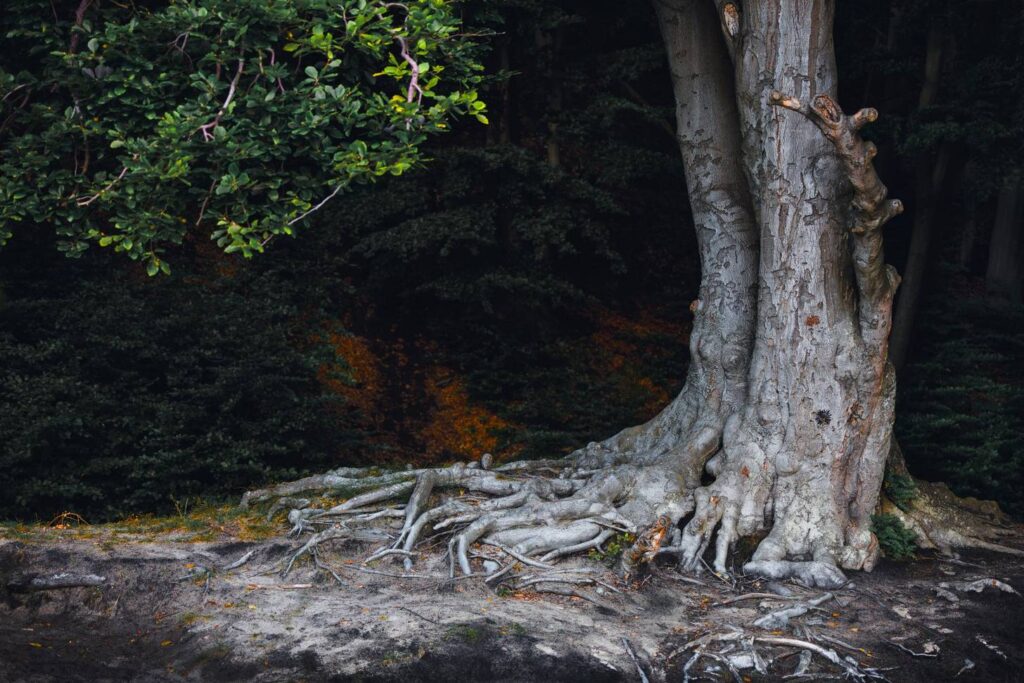
Walk into any forest—even pause by a stand of trees in a city park—and the scene looks still. Plants seem absorbed in their own quiet business: turning sunlight into sugar, spreading roots, growing imperceptibly toward the sky. Nothing is said. Nothing, as far as you can tell, is exchanged. Yet under your feet and drifting on the air, a conversation is already underway—one that has been running for hundreds of millions of years without a single word.
Over the past four decades, plant scientists have dismantled the idea of the silent, solitary plant. What’s emerged is something far stranger and more wondrous: a world of underground fungal superhighways carrying carbon and chemical warnings between trees, of invisible gas-cloud alarm signals that set whole meadows on edge, of electrical pulses that move through leaves the way nerve signals move through your own hand. The research is still young—some of it contested—but the picture it’s painting is genuinely astonishing.
The Wood Wide Web
A fungal underground internetBeneath nearly every forest floor lies a network so dense and so far-reaching that scientists have taken to calling it the “wood wide web.” It’s built by mycorrhizal fungi—microscopic threads that weave around and into tree roots, forming a living web that can link dozens of different species across several acres. The trees feed the fungi sugars; the fungi extend the trees’ reach into soil, pulling in water and minerals the roots alone could never find.
But the network does something else entirely, too. Forest ecologist Suzanne Simard at the University of British Columbia spent decades tracing how carbon—tagged with a radioactive isotope so she could follow it—traveled from mature Douglas firs down through the fungal web and into the tissue of struggling seedlings nearby. Trees weren’t just sharing accidentally. The older trees sent more carbon to seedlings that were shaded and stressed, as if responding to need. Her work helped establish that a forest isn’t simply a collection of competing organisms—it can function more like a community.
Chemical Air Mail
Distress signals on the breezeWhen a caterpillar bites into a leaf, that plant doesn’t suffer in silence. Within hours, it begins releasing volatile organic compounds—VOCs—into the surrounding air: invisible plumes of chemical signal that neighboring plants can detect and decode. Remarkably, the neighbors respond by ramping up their own defenses before any insect has touched them. They start producing tannins, alkaloids, and other bitter or toxic compounds that make their leaves harder to eat.
This airborne warning system has been documented in dozens of plant species, from sagebrush to lima beans to corn. The chemistry is specific: different attackers trigger different blends of VOCs, and nearby plants can apparently distinguish a caterpillar attack from a fungal infection and respond accordingly. Some species even release compounds that attract the natural predators of the insects attacking them—essentially calling in reinforcements from the air.
Electrical Pulses Like Nerve Signals
Nature’s original nervous systemYou already know one famous example of plant electricity: the Venus flytrap. Touch one of the trigger hairs inside its open trap, and an electrical action potential fires—a wave of charged ions moving across the cell membranes, not so different in principle from the nerve impulse in your fingertip. Touch the trap again within about thirty seconds, and a second action potential triggers the trap to snap shut. It takes two signals to close, an elegant fail-safe against false alarms from windblown debris.
The flytrap is just the most dramatic example of a system plants share broadly. When a tomato plant is wounded—whether by an insect or a gardener’s pruning shear—electrical signals travel through its tissue at speeds up to a centimeter per second, reaching distant leaves and triggering them to begin producing defensive compounds. The signals move through specialized vascular cells, and researchers have shown they carry real information: the plant’s response differs depending on whether the signal originated from wounding, heat, or cold.
The Poison Gardener
Chemical warfare undergroundNot every plant message is a neighborly warning. Some species are sending a very different kind of signal: stay away. Black walnut trees (Juglans nigra) release a compound called juglone through their roots, hulls, and fallen leaves. In the soil, juglone is toxic to a surprising number of plants—tomatoes, apples, blueberries, and rhododendrons, among others—which is why gardeners quickly learn not to plant a vegetable bed under a walnut tree.
This process is called allelopathy—the use of chemicals to suppress the growth of competing plants—and it’s far more widespread than the walnut example suggests. Garlic mustard, an invasive European species now spreading through North American forests, releases chemicals into the soil that disrupt the mycorrhizal fungi native trees depend on, essentially attacking the underground communication and nutrition network. Sunflowers, rye grass, and many others also produce allelopathic compounds. The plant world, it turns out, has plenty of aggressive players alongside the cooperative ones.
Mother Trees That Feed the Forest
Elders nurturing the next generationSimard’s research introduced the term “mother tree” to describe the largest, oldest trees in a forest—trees whose roots have formed connections to dozens or hundreds of neighbors through the mycorrhizal web. These elders don’t just participate in the network; they anchor it. A single mother tree may be connected to more than forty other trees, sending out carbon and chemical signals across a web that younger trees and seedlings tap into.
One of Simard’s more haunting findings involved what happens when a mother tree is dying. She observed that trees near the end of their lives appear to flood the network with a pulse of carbon—as if releasing their reserves into the community before they go. Whether this constitutes anything like intent is a philosophical question science can’t yet answer, but the measurable transfer is real. Seedlings that were connected to a dying mother tree received significantly more carbon than those that weren’t. What the tree loses, the forest may gain.
Underground Soil Signals
Whispers through the dirtWhile the mycorrhizal network gets most of the headlines, it isn’t the only underground channel plants use. Roots themselves release volatile compounds directly into the soil—and those compounds don’t need a fungal highway to travel. They move through the tiny air pockets between soil particles, diffusing outward from a plant’s root zone like a slow-spreading chemical cloud. Reviews of the literature have found that soil VOCs constitute their own rich chemical language, connecting not just plant to plant but also plants to bacteria, fungi, nematodes, and other soil organisms.
Different threats produce different soil chemical signatures. A plant dealing with drought stress releases different root compounds than one under attack by root-feeding insects, and neighboring plants appear to read those signals and respond in kind—upregulating drought tolerance or pest resistance before they’ve experienced either problem directly. It’s a kind of collective early-warning system, distributed across the soil community rather than centralized in any single organism.
Roots That Respond to Sound
Listening with their root tipsResearcher Monica Gagliano at the University of Western Australia conducted an experiment that raised eyebrows across the botanical world: she placed young corn seedlings in a Y-shaped tube, with one arm running toward a water source and one arm running toward a speaker emitting a sound in the frequency range of flowing water. The roots grew consistently toward the sound—even though no water was present. The vibrations alone were enough to guide them.
In separate experiments, Gagliano found that corn roots also produce their own clicking sounds at around 220 Hz, and that other roots nearby orient their growth in response to those clicks. Whether “hearing” is the right word for what plants do remains a lively debate among scientists—the mechanisms are almost certainly different from an ear—but something in the root tip is exquisitely sensitive to vibration. In a world where finding water or avoiding a competitor’s root system can mean survival, a vibrational signal traveling through dense soil has obvious advantages over chemical messages that must diffuse slowly.
The Inner Alarm System
Hormones that mobilize the whole plantBefore a plant ever sends a message to its neighbors, it first has to broadcast an alarm internally—coordinating its own defense across thousands of cells that can’t see or reach each other directly. When a leaf is wounded by a feeding insect, the damaged cells release jasmonic acid and salicylic acid: two hormones that function as a kind of internal all-points bulletin. These molecules travel through the plant’s vascular system, reaching cells throughout the stems and leaves within minutes.
Each receiving cell reads the signal and begins marshaling its own defenses: producing bitter protease inhibitors that gum up an insect’s digestive enzymes, thickening cell walls, generating antimicrobial compounds against fungal invasion. Salicylic acid, in particular, can trigger “systemic acquired resistance”—a plant-wide immune priming that makes the entire organism more resistant to future attack for days or even weeks afterward. It’s strikingly analogous to the way your immune system builds memory after an infection. The plant doesn’t have white blood cells or antibodies, but the underlying logic—mount a response, then stay primed—looks remarkably familiar.
The silence of a forest was always an illusion. The deeper you look—into the soil, into the chemistry of a leaf, into the physics of a root tip—the more clearly you can see a living world in constant communication. We’re late arrivals to that conversation, and we’re only just beginning to understand its grammar.
Frequently asked questions
How do scientists actually prove that trees share nutrients through fungal networks?
Researchers like Suzanne Simard at the University of British Columbia used radioactive carbon isotopes to trace molecules as they moved between trees. By tagging a mature tree’s carbon and then detecting that isotope in nearby seedlings connected by fungal threads, scientists could confirm the carbon actually traveled through the network rather than through the soil or air. It’s the same basic technique doctors use when they inject a radioactive tracer to follow blood flow through the body—watch where the tag goes, and you map the system.
Can all plants send and receive chemical signals, or only trees?
Nearly all plants produce and respond to chemical signals. The mycorrhizal fungal network is most studied in forests, but airborne VOC signaling has been documented in grasses, garden vegetables, and wildflowers as well. If you’re curious about the chemistry behind natural wonders, you might enjoy our articles on why the sky changes color at sunset and on ancient inventions still shaping daily life—both involve chemistry hiding in plain sight.
Is plant communication the same as plant intelligence or consciousness?
Scientists are careful to separate the two questions. Plant communication—the measurable transfer of chemical, electrical, or vibrational signals between plants—is well documented. Whether that constitutes anything like awareness or intent is a much harder philosophical and empirical question, and most plant biologists are cautious about the word “intelligence.” The signals are real; what the plants “experience” when sending or receiving them remains genuinely unknown. For more on how scientists think about time and coordination in natural systems, see our piece on why we have time zones.
Do plants communicate differently in a garden versus a wild forest?
Yes, significantly. A wild old-growth forest has had centuries to build dense, mature mycorrhizal networks connecting many species. A garden or monoculture farm, by contrast, often has shallow networks, fewer fungal partners, and plants of the same species or age that haven’t had time to form extensive connections. Tilling soil can also disrupt fungal threads. Airborne VOC signals still work in garden settings, but the underground social network of a mature forest is far richer and more complex than anything found in a tidy vegetable bed.
Sources
How much do you remember?
3 quick questions from the story above.
Enjoyed that? Play a full trivia quiz:
Play a Science quiz