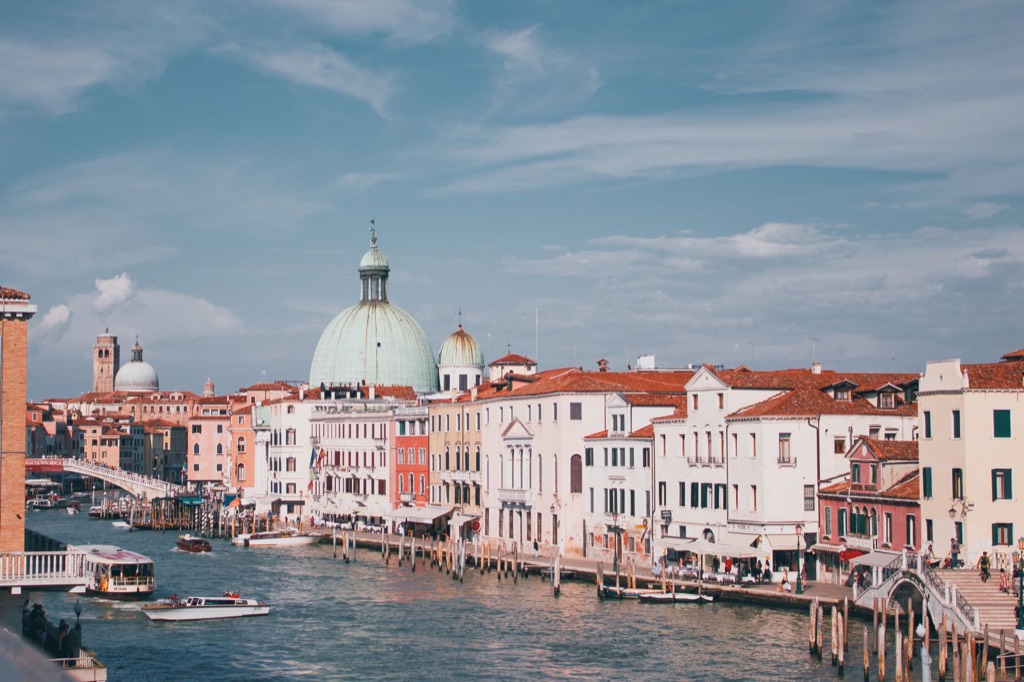
Cities feel permanent. You walk the same streets your grandparents walked, past buildings that were old before you were born, and it’s easy to assume the ground under all of it will simply stay put. For a surprising number of the world’s great cities, it won’t. They are sinking — a few millimeters here, a few inches there, year after year.
Some of it is nature doing what nature does. A lot of it, though, is us — pumping out the groundwater beneath our own feet, or piling weight onto soft ground that was never meant to carry it. Here are nine cities living with the slow arithmetic of subsidence, and the real reason behind each one.
Venice
ItalyNo city is more famous for the water creeping up its walls. Venice was built on wooden pilings driven into a muddy lagoon, and over the twentieth century it sank measurably as those sediments compacted — helped along, for decades, by industry pumping groundwater from beneath it.
The pumping was stopped, which slowed the worst of it, but the sea is still rising to meet the city. The seasonal high tides Venetians call acqua alta now flood St. Mark’s Square routinely, which is why the city built the MOSE flood barriers to hold the Adriatic back on the highest days.
Jakarta
IndonesiaJakarta may be the most dramatic case on Earth. Parts of the Indonesian capital have dropped by more than two meters over recent decades, and stretches of the north of the city now sit below sea level, held back by walls.
The cause is mostly straightforward: with unreliable piped water, millions of residents and businesses have pumped groundwater from the aquifer, and the emptied ground collapses in on itself. The problem is severe enough that Indonesia has begun moving its capital to a new city, Nusantara, on the island of Borneo.
New Orleans
United StatesMuch of New Orleans already sits below sea level, wedged between the Mississippi River and Lake Pontchartrain. It got that way in part by design: to make the swampy delta livable, engineers drained the marshes, and the dried-out soils compacted and sank.
The levees that keep the water out also keep the river’s replenishing sediment from spreading over the land, so the ground keeps settling. Hurricane Katrina in 2005 showed, tragically, what happens when the defenses around a sinking bowl fail.
Mexico City
MexicoMexico City has a peculiar problem: it was built on top of a drained lake. The Aztecs founded Tenochtitlan on an island in Lake Texcoco, and the Spanish and their successors gradually drained the basin to make dry land.
The city now sits on that old lakebed — soft clay that shrinks as the metropolis pumps out the groundwater beneath it. Some districts have sunk many meters over the past century, cracking buildings and buckling streets at wildly uneven rates across the city.
Bangkok
ThailandThailand’s capital spreads across a flat river delta only a meter or two above the sea, and for years it sank steadily as factories and homes drew heavily on groundwater.
Regulations curbing that pumping have slowed the descent, but the city still sits low and wet, squeezed between subsidence from below and a rising Gulf of Thailand. Serious flooding, like the disastrous 2011 floods, remains a recurring threat.
Most of the world’s sinking cities aren’t victims of some slow disaster. They’re paying, a few millimeters a year, for the water we pumped out from under them.
Rotterdam
NetherlandsThe Dutch didn’t so much fight the low ground as move in and organize it. Rotterdam, like much of the western Netherlands, sits below sea level, on soft peat and clay reclaimed over centuries and drained by an endless network of dikes, canals, and pumps.
The peaty soils keep compacting and slowly sinking, so the pumps never stop. What’s remarkable is how well it works: the Netherlands has turned living below the waterline into ordinary engineering, and cities like Rotterdam and Amsterdam are studied worldwide as models for how to do it.
Miami
United StatesMiami’s problem is a little different — the land here isn’t dropping much, but the sea is climbing to meet it, and the city sits barely above the waterline to begin with.
What makes it tricky is the ground itself: South Florida rests on porous limestone, so seawater can seep up from below rather than only over a seawall. On sunny days with especially high tides, water now bubbles up through drains in some neighborhoods — so-called “sunny day flooding.”
Tokyo
JapanTokyo belongs on this list mostly as a success story. Through the mid-twentieth century, parts of the low-lying east of the city sank dramatically — by several meters — as heavy industry pumped out groundwater during Japan’s rapid growth.
Then Japan clamped down, restricting groundwater extraction in the 1960s and 70s, and the sinking largely stopped. It’s the clearest proof that this kind of subsidence, caught in time, can be reined in — though the ground that already dropped stayed down, protected now by floodgates and levees.
Dhaka
BangladeshBangladesh’s capital sits on the world’s largest river delta, a vast low plain built from silt where several great rivers meet the sea — about as flat and water-prone a place as a city can be.
As Dhaka has swollen into a megacity, heavy groundwater pumping has helped pull the ground downward, even as the delta’s soft sediments naturally settle. Combined with a rising Bay of Bengal, it leaves one of the world’s most crowded cities squeezed from both directions.
The thread running through nearly all of these is the same, and it’s oddly hopeful: the fastest sinking almost always traces back to pumping too much water out of the ground, and Tokyo showed that when you stop, the sinking mostly stops too. The sea will keep rising regardless, but the part we caused is the part we can slow down. Cities may feel permanent, yet the ground beneath them turns out to be a running conversation between what nature does and what we ask of it.
Sources
How much do you remember?
3 quick questions from the story above.
Enjoyed that? Play a full trivia quiz:
Play a Geography quiz