You don’t have to leave the planet to feel like you’ve left the planet. Somewhere out there, right now, are salt flats that turn into a perfect mirror, mountains striped like a paint chart, and forests full of trees that look drawn by someone who’d never actually seen a tree.
All of it is real, all of it is Earth, and every bit of it has a plain scientific reason behind the strangeness. Here are eight places that look like another world entirely — and why they got that way.
Salar de Uyuni
BoliviaThe world’s largest salt flat stretches out flat and white for more than 4,000 square miles, so level that it almost hurts to look at. After it rains, a thin sheet of water sits on top and the whole thing turns into a mirror so clean you can’t tell where the ground stops and the sky begins.
It’s the dried-up floor of ancient lakes that evaporated long ago, leaving behind a salt crust several feet thick. Because the surface is so remarkably even, that shallow film of rainwater reflects the clouds almost perfectly — no horizon, no up or down, just you walking around inside the sky.
Socotra
YemenOff the coast of Yemen, this island looks like a film set for an alien planet. Its most famous residents are the dragon’s blood trees — squat trunks that flare out into a dense, upturned umbrella of branches, as if someone stood a bunch of green mushrooms on end.
Socotra has been cut off from the mainland for millions of years, and isolation is a powerful engine for weirdness. Left alone, its plants evolved down their own path, and roughly a third of them grow nowhere else on Earth. The tree’s odd umbrella shape helps it catch mist and shade its own roots in a bone-dry climate.
Danakil Depression
EthiopiaIf you want to see what a hostile planet might look like, go to the Danakil. Neon-yellow and green mineral crusts ring bubbling acid pools, salt stretches to the horizon, and the ground itself hisses. It is one of the hottest inhabited places anywhere.
This is one of the spots where three tectonic plates are slowly pulling apart, so magma sits close to the surface and heats groundwater into those steaming, acidic springs. The lurid colors come from sulfur, iron salts, and heat-loving microbes — the same kind of life scientists point to when they wonder what might survive on other worlds.
Pamukkale
TurkeyFrom a distance it looks like a hillside buried in snow, or a frozen waterfall that forgot to melt. Up close you find a cascade of blinding-white terraces, each one holding a shallow pool of warm turquoise water stepping down the slope.
The name means “cotton castle,” but there’s no cotton and no snow. Warm springs here are loaded with dissolved calcium carbonate; as the water spills down the hill and cools, that mineral settles out and hardens into travertine, building the white ledges up over thousands of years — the same process that grows stalactites in a cave, just out in the open air.
Cappadocia
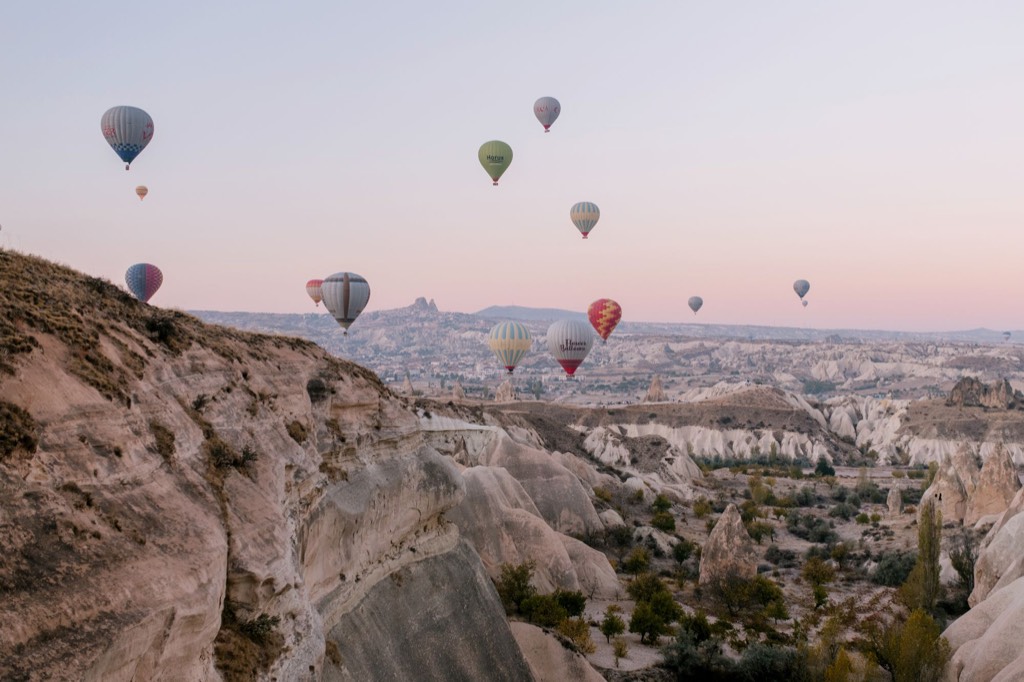
TurkeyCappadocia is a valley full of stone spires, cones, and mushroom-capped pillars, and people have been carving homes, churches, and whole underground cities straight into the soft rock for centuries. At dawn, dozens of hot-air balloons drift over it, which somehow makes it look even less like Earth.
Old volcanic eruptions blanketed the region in soft ash that hardened into a rock called tuff, capped in places by a harder layer. Wind and rain wore the soft stone away over millions of years, but the tougher caps protected the columns directly beneath them — leaving the “fairy chimneys,” each with its stubborn little hat of hard rock on top.
All of it is real, all of it is Earth — and every bit of the strangeness has a plain, physical reason behind it.
Zhangye Danxia
ChinaThe “rainbow mountains” of Gansu look like someone tipped over a giant box of pastels. Whole hillsides run in bands of red, orange, yellow, and green, the stripes tilted and folded so the color seems to pour down the slopes.
Those layers are ordinary sandstone and mineral deposits laid down over tens of millions of years, each band stained a different shade by iron and other minerals — rust-red where iron oxidized, paler where it didn’t. Later, the collision that raised the Himalayas tilted the flat layers up on their side and erosion sliced them open, turning quiet geology into a light show.
Atacama Desert
ChileParts of the Atacama are so dry that some weather stations have never recorded a drop of rain. The ground is cracked and rust-colored, the air is thin and clear, and the whole place stands in so convincingly for Mars that researchers test rovers and Mars-mission gear out here.
Its extreme dryness is no accident of bad luck: mountains on either side block moisture, and a cold ocean current offshore keeps rain from forming. The result is one of the driest deserts on Earth — and, on a clear night, some of the darkest skies anywhere, which is why the world’s great telescopes cluster here.
Lake Hillier
AustraliaOn a small island off Western Australia sits a lake that is, unmistakably, bubblegum pink. Not pink in a certain light — flat, solid, cotton-candy pink, sitting right beside the deep blue of the ocean, separated only by a thin strip of trees.
The color almost certainly comes from life, not chemistry gone wrong. Salt-loving microbes and algae in the very briny water produce reddish-pink pigments, and in water that salty they thrive and tint the whole lake. Scoop some into a glass and it stays pink, which tells you the color is really in the water, not a trick of the sky above it.
The strange thing about all of these is that none of them broke the rules. Salt settles, minerals stain, wind wears away the soft stuff and leaves the hard — the same quiet processes that shaped your own backyard, just given odd ingredients and an enormous amount of time. Which is the real lesson of the “alien” places: you don’t need another planet to find one. You just need to look at this one a little harder.
Sources
How much do you remember?
3 quick questions from the story above.
Enjoyed that? Play a full trivia quiz:
Play a Geography quiz