You’ve probably driven through, flown over, or maybe even lived in one of America’s great cities without ever stopping to wonder: how did this place actually start? Not the official founding date stamped on a bronze plaque — but the real, messy, sometimes accidental story of why someone decided to plant a flag right here and nowhere else.
From a French soldier eyeing a narrow river strait to a Civil War veteran spotting ancient ditches in the Arizona desert, the origins of America’s cities are full of ambition, happenstance, and the occasional outright blunder. These eight stories won’t just change how you see a familiar skyline — they’ll remind you that every city began as someone’s big, improbable idea.
Detroit, Michigan
Named for a narrow straitOn a warm July morning in 1701, a French military officer named Antoine de la Mothe Cadillac led about a hundred men in a fleet of canoes along a ribbon of water connecting Lake Huron to Lake Erie. When he found the spot he wanted — a bluff on the north shore where he could see boats coming from both directions — he stepped ashore and planted New France’s flag. He called the post Fort Pontchartrain du Détroit, borrowing the French word détroit, meaning “strait.” The city that grew from that bluff kept the last word.
Cadillac’s goal wasn’t just exploration — he wanted to block British traders from squeezing into the region’s lucrative fur trade and to build a colony that could actually sustain itself through farming. He had lobbied the French crown for two years before getting the go-ahead. The Anishinaabe people had lived in this river country for centuries before Cadillac arrived, and they would shape the settlement’s early character as much as any European plan.
New Orleans, Louisiana
Built where it shouldn’t beWhen Jean-Baptiste Le Moyne, Sieur de Bienville, picked the site for La Nouvelle-Orléans in 1718, his engineers told him it was a terrible idea. The land sat in a curve of the Mississippi Delta, much of it at or below sea level, regularly swamped by the river and the lake. Bienville pushed ahead anyway. Control of the Mississippi meant control of the entire interior of the continent, and this bend in the river was the key to that.
The city was named for Philippe II, the Duke of Orléans, who was regent of France at the time. Its original French Quarter still sits on the natural levees — the slightly higher ground deposited by centuries of flooding — while later growth spread into the lower bowl. That engineering bet has been renewed and renegotiated every hurricane season for three hundred years.
Denver, Colorado
Named for a man who’d already resignedIn the fall of 1858, a prospector named William Larimer arrived at the junction of Cherry Creek and the South Platte River and found a cluster of rough camps buzzing with gold fever. He promptly staked out a town, named it Denver City — after Kansas territorial governor James W. Denver — and began selling lots. There was just one problem: Governor Denver had already resigned his post. Larimer didn’t find out until after the name was set, and by then it had stuck.
The camps around Cherry Creek were a chaotic patchwork of rival settlements. Auraria, across the creek from Denver City, was founded by the same Green Russell party whose gold discoveries had started the Pike’s Peak rush in 1858. By 1860 the two towns had merged. The gold that sparked it all turned out to be modest, but Denver had already become the supply hub for the entire Rocky Mountain mining world — a role that mattered far more in the long run than any single strike.
Phoenix, Arizona
Rebuilt on ancient ruinsIn 1867, a one-armed Civil War veteran named Jack Swilling was riding through the Salt River Valley when he noticed something peculiar in the desert floor: long, straight ridges of earth that didn’t look natural. They were the remnants of an elaborate irrigation canal system built by the Hohokam people, who had farmed this valley for over a thousand years before their civilization collapsed sometime in the 1400s. Swilling formed an irrigation company, hired workers to dig out the old channels, and within months the desert was growing wheat.
When the new settlement needed a name, a well-traveled Englishman named Darrell Duppa suggested Phoenix — the mythical bird that rises from ashes — because a new civilization was literally being built on the bones of an old one. The name was formally adopted in 1870. Today Phoenix sits atop one of the ancient world’s most sophisticated water engineering systems, most of it still buried under the city’s streets.
Pittsburgh, Pennsylvania
Where two empires collidedIn the mid-1750s, the spot where the Allegheny and Monongahela rivers meet to form the Ohio was the most strategically valuable piece of land in North America — and both France and Britain knew it. The French got there first, throwing up Fort Duquesne in 1754 after chasing away a half-built British fort. Four years later, British General John Forbes led an army through the Pennsylvania wilderness, the French blew up their own fort rather than let it fall, and Forbes named the site Pittsburgh for William Pitt, the British prime minister.
Fort Pitt followed on the same ground, and a town grew up around it. What nobody fully anticipated was the geology: the confluence of three rivers made Pittsburgh a natural funnel for coal and iron ore, the raw ingredients of steel. Andrew Carnegie built his first steel mill here in the 1870s. The name Forbes gave it in honor of a politician turned out to fit an industrial titan instead.
Salt Lake City, Utah
A desert chosen on purposeIn the summer of 1847, a wagon train of 148 Mormon pioneers crested the Wasatch Mountains and looked down into a vast, treeless valley ringed by more mountains and drained into a salt lake with no outlet. Most travelers would have kept moving. Their leader, Brigham Young — who viewed the scene from a wagon bed, sick with Rocky Mountain spotted fever — reportedly said, “This is the right place.” They stopped.
The choice was intentional. Young wanted a place far beyond the jurisdiction of the United States, where his community could practice their faith without interference. (Within a year, the Mexican-American War made the Salt Lake Valley American territory anyway, but Young had already laid out a grid of broad streets centered on Temple Square.) The city that emerged was a planned settlement in the most literal sense — streets wide enough to turn a four-horse wagon, blocks oriented to the compass, and water rights mapped out before the first winter.
Las Vegas, Nevada
Sold by the railroad, in an afternoonLas Vegas — “the meadows” in Spanish, named for the artesian springs that once made it a watering stop on the Old Spanish Trail — was largely empty desert until May 15, 1905, when the San Pedro, Los Angeles and Salt Lake Railroad held a land auction on the dusty flat. In a single afternoon, investors bought up 1,200 lots. A town materialized almost overnight around the railroad junction.
The gambling halls and hotels that define Las Vegas today came decades later, after Nevada legalized casino gambling in 1931 and the construction of Hoover Dam brought thousands of workers to the region. The original settlers of 1905 were mostly railroad workers and small businessmen who had no idea their tidy grid of lots would eventually become the entertainment capital of the world. What they did know was that if you controlled the water and the tracks in the Nevada desert, you controlled everything else.
San Francisco, California
The town that gold buriedIn January 1847, a small Mexican settlement called Yerba Buena — “good herb,” named for a wild mint that covered the hills — officially changed its name to San Francisco, hoping to claim the identity of the magnificent bay it sat beside. At the time, the population was somewhere around 200 people. Then, in January 1848, gold was discovered at Sutter’s Mill, about 130 miles away.
Within two years, the population of San Francisco had exploded past 40,000. Ships arrived and were simply abandoned in the harbor when their crews jumped ship to go prospecting — some of those hulls were later buried under landfill and became part of the city’s foundation. The sleepy village of Yerba Buena was buried too, not by earth but by the sheer velocity of a city that arrived all at once, from everywhere on earth, chasing the same impossible dream.
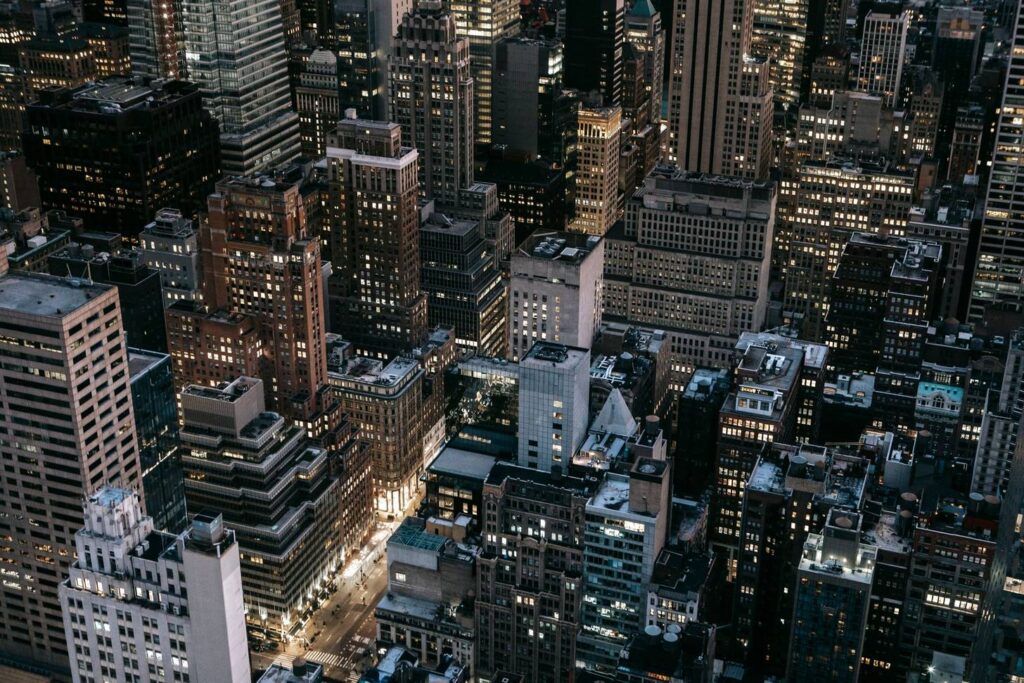
Look at the skyline of any of these cities and you’re really looking at the end result of a chain of accidents, ambitions, and sometimes very stubborn people who decided that here was the right place — for water, for trade, for faith, for gold, or just because someone offered the right price at an afternoon auction. The cities that endure are rarely the ones that were planned most carefully. They’re the ones that found a reason to keep being.
Frequently asked questions
Why did early settlers build New Orleans in such a flood-prone location?
Control of the Mississippi River was the key to controlling trade across the entire interior of the continent, and the bend where New Orleans sits was the best strategic position available. French colonial administrators judged the commercial advantage worth the flooding risk — a calculation that shaped the city’s relationship with water for three hundred years. For more on the unexpected logic behind historic settlements, see our look at the ancient world’s greatest engineering projects.
How did the Gold Rush change San Francisco so quickly?
When gold was discovered at Sutter’s Mill in January 1848, San Francisco was a village of a few hundred people. By the end of 1849 the population had surged past 40,000, with ships arriving from around the world and their crews abandoning them in the harbor to go prospecting. The speed of that transformation — almost an entire city materializing in two years — was unlike anything North America had seen. You can read more about how a single discovery reshapes the world in our piece on accidental inventions.
Did the Mormon pioneers know the Salt Lake Valley was about to become American territory?
No — that was very much the point. Brigham Young chose the valley in 1847 precisely because it was technically Mexican territory, far outside the reach of the United States government. The Mexican-American War changed that within months of their arrival, when the 1848 Treaty of Guadalupe Hidalgo transferred the entire region to the US. Young had barely finished laying out the city’s grid when it found itself inside the country he was trying to leave.
Is Detroit really named for the water strait it sits beside?
Yes. When Antoine de la Mothe Cadillac arrived in 1701, he named the fort Fort Pontchartrain du Détroit — “Fort Pontchartrain of the Strait” — after both his royal patron and the narrow channel connecting Lakes Huron and Erie. The détroit part of the name outlasted the fort, the French empire, and eventually became the city’s name on its own.
Sources
How much do you remember?
3 quick questions from the story above.
Enjoyed that? Play a full trivia quiz:
Play a Geography quiz