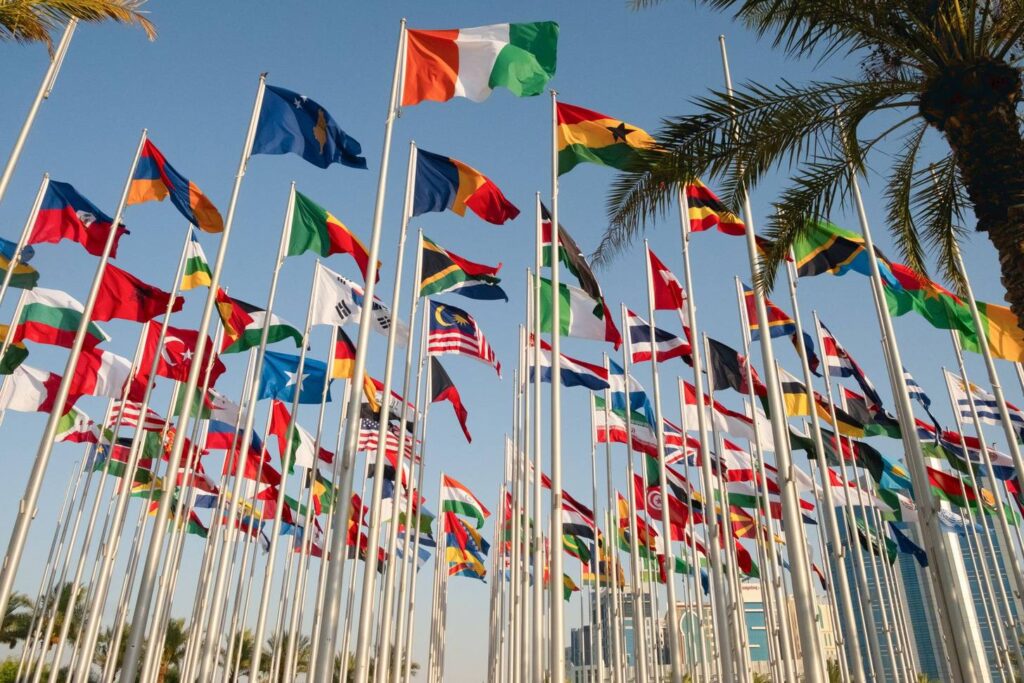
Every country has its official symbols—the animals, flags, and emblems that stand in for a whole nation on coins, passports, and ceremonial occasions. You might expect these choices to be stately and obvious: a proud eagle, a noble lion, a sturdy oak. But look a little closer at the world’s national symbols, and you’ll find a mythical horse in silver chains, a flag said to have fallen from heaven, and a living dragon you can actually visit. The stories behind them are far stranger—and more revealing—than you’d guess.
Each of these nine symbols carries a piece of real history—battles fought, empires formed, independence won. Some trace back nearly a thousand years. Others are surprisingly recent. All of them say something about what their countries have wanted to remember, and what they’ve chosen to keep alive.
Scotland — The Unicorn
Chained, for good reasonScotland’s national animal isn’t the Highland cow or the golden eagle—it’s the unicorn. The choice dates to the 12th century, when King William I incorporated the creature into the Scottish royal coat of arms. In medieval European tradition, the unicorn was considered the natural enemy of the lion—which happened to be England’s symbol. Adopting the unicorn was, among other things, a quiet political statement.
Look closely at how Scotland’s unicorn is depicted, though: it’s chained. Medieval lore held that the unicorn was so wild and powerful it had to be restrained to remain near the king. The chain, paradoxically, became a symbol of strength. Only the greatest of rulers could hold one. Scotland’s unicorn has been wearing that chain for roughly 800 years, and it doesn’t look like it plans to take it off.
Denmark — The Dannebrog
The flag that fell from heavenDenmark’s red-and-white cross flag holds the Guinness World Record for the oldest national flag in continuous use—officially recognized as the national flag in 1625, with documented use stretching back to the 14th century. But the legend pushes the date even further. According to tradition, the Dannebrog fell from the sky during the Battle of Lyndanisse in Estonia on June 15, 1219, at the moment Danish King Valdemar II and his army were on the verge of defeat. The soldiers saw it as a sign from God, rallied, and won.
Whether or not a banner literally dropped from the heavens, its design has had a remarkable afterlife. The same red-and-white cross became the model for the flags of Sweden, Norway, Finland, and Iceland—making the Dannebrog one of the most influential symbols in Scandinavian history. All five Nordic flags share that same diagonal stripe in common… though Denmark, quite rightly, got there first.
Canada — The Beaver
A near-panic over New YorkCanada’s national animal is the beaver. This became official on March 24, 1975, when the National Symbol of Canada Act received royal assent—but the timing involved a certain urgency. One account suggests Canada moved quickly because New York State was reportedly pursuing the beaver as its own state animal, and Canada didn’t want to lose first claim on Castor canadensis. The race added an almost comic quality to an otherwise solemn act of Parliament.
The beaver’s deeper roots lie in the fur trade. For much of the 17th and 18th centuries, beaver pelts were the economic engine of pre-Confederation Canada, traded by Indigenous peoples and European colonists alike. The Hudson’s Bay Company placed the beaver on its official seal in 1678. It took nearly three centuries more to make the honor formal. The dam-building rodent had, by then, more than earned it.
Bhutan — The Thunder Dragon
The country wears its nameBhutan’s flag features a white dragon clutching four jewels across a diagonal field of yellow and orange. The dragon is called the Druk—meaning “thunder dragon”—and it doesn’t just appear on the flag. It gives the country its own name. Bhutan calls itself Druk Yul, or “Land of the Thunder Dragon,” a name that dates to the 13th century when the kingdom was unified and a monastery founder reportedly heard thunder he took as a dragon’s roar.
The flag’s symbolism is layered in a way few national flags attempt. The yellow half represents secular royal authority; the orange half represents Buddhist spiritual tradition. The dragon’s white color stands for purity of inner thought and deed. The jewels in its claws stand for national wealth and the protection of the Bhutanese people. The snarling mouth symbolizes the protection of the deities. It is, by almost any measure, one of the most symbolically complete flags in the world.
Mozambique — The AK-47
History too important to hideMozambique’s flag, in its current form since 1983, is widely considered the only national flag in the world to feature a modern assault rifle. Specifically, it shows an AK-47 with a bayonet, crossed with a hoe, set atop an open book, above a gold star. The rifle represents defense and national vigilance; the hoe stands for agriculture; the book stands for education. The design is deliberately layered.
The context matters. Mozambique gained independence from Portugal in 1975 after a decade of armed struggle by the Frelimo liberation movement, and the AK-47 was the weapon carried by the fighters who won it. Keeping the rifle on the flag was an intentional choice—a refusal to soften or erase that history. Debates about redesigning the flag have occasionally surfaced, but so far the flag remains as it was. Some symbols, a country decides, should stay exactly where they are.
New Zealand — The Kiwi
From bird to entire peopleNew Zealand’s kiwi is a nocturnal, flightless bird roughly the size of a chicken. It’s also the only bird known to have nostrils at the very tip of its beak, which it uses to sniff out worms and insects underground. By almost any measure, it is an unlikely national symbol. Yet the kiwi is so completely owned by New Zealand that “Kiwi” is now the informal name for the people themselves.
The transition happened gradually through popular culture. A New Zealand newspaper cartoonist used the bird to represent the country as early as 1904, and by 1908 it was the go-to symbol in sporting cartoons. During World War I, New Zealand soldiers were being called Kiwis by their allies—and the nickname crossed back with them when they came home. Today the kiwi appears on coins, military cap badges, and the logos of countless businesses. The bird had an 800-year head start on being famous. The people simply caught up.
Wales — The Red Dragon
Officially recognized in 1959The Y Ddraig Goch—the Red Dragon—on Wales’s flag has one of the longest symbolic histories in the British Isles. It appears in Arthurian legend, in 12th-century Welsh chronicles, and in poetry predating both. The Tudor kings used the dragon in their royal arms when Henry VII came to power in 1485. Then James I removed it from the royal coat of arms in 1603 when he united England and Scotland’s crowns, and the dragon spent more than two centuries as an unofficial symbol.
The Red Dragon returned as a royal badge for Wales in 1807, and the current flag—dragon on a green-and-white field—was officially recognized by royal warrant on September 23, 1959, following a recommendation from the Gorsedd of Bards. It was the last of the four UK nations to receive formal recognition for its flag. Given that the dragon had been flying over Welsh culture for nearly a millennium, the paperwork was considerably overdue.
Belize — The Tapir
The mountain cow of the jungleBelize’s national animal is Baird’s tapir, which Belizeans call “the mountain cow.” It’s the largest land mammal in Central America, weighing up to 800 pounds, and it looks something like a cross between a pig, an elephant, and a rhinoceros—which, evolutionarily, is roughly what it is. Tapirs are ancient animals; their basic body plan has changed remarkably little over the past 35 million years.
What they lack in glamour they make up for in ecological importance. Tapirs are strong swimmers, crossing rivers with ease, and they play a vital role in dispersing seeds through Belize’s rainforests. Designating the tapir as a national symbol was, in part, an act of conservation: a signal that Belize considers its forests and native wildlife worth protecting. It also results in one of the most refreshingly unexpected animal symbols on any nation’s books—a giant, prehistoric-looking forest creature that’s been quietly doing its job since long before humans arrived.
Indonesia — The Komodo Dragon
The only real dragon in the worldMost countries that feature dragons in their national symbolism are drawing on mythology. Indonesia is not. The Komodo dragon—Varanus komodoensis—is the world’s largest living lizard, native to a handful of Indonesian islands, and it is completely real. Adults can grow to ten feet in length and weigh up to 150 pounds. They hunt deer, wild boar, and water buffalo. Scientists confirmed in 2009 that, in addition to their powerful bite, they use venom to immobilize prey.
Indonesia designated Komodo Island as a national park in 1980, partly as a conservation effort and partly as a recognition of the dragon’s extraordinary status. Today, Komodo National Park is a UNESCO World Heritage Site visited by tens of thousands of tourists annually. Unlike Scotland’s unicorn or Bhutan’s thunder dragon, Indonesia’s is a symbol you could theoretically stand twenty feet from, on an actual island, and watch it happen to be alive. That distinction—a national symbol with real breath and real teeth—makes it unlike almost any other in the world.
What a country chooses as its symbol tells you something about the stories it wants to keep alive. Whether it’s a chained unicorn from the 12th century, a flag said to have fallen from the sky, or the animal that built an entire colonial economy, these symbols have lasted because they carry real weight. The next time you spot one on a coin, a passport, or a stadium’s turf, it’s worth pausing for a moment and asking: what was the story behind that choice?
Frequently asked questions
Why did Scotland choose a mythical creature as its national animal?
The unicorn appeared in Scottish heraldry as far back as the 12th century, when King William I used it on the royal coat of arms. In medieval European tradition, the unicorn was considered the natural enemy of the lion—England’s symbol—giving Scotland’s choice a pointed political edge. The idea that nations assign meaning to their chosen symbols is as old as civilization itself; you can see the same instinct at work in our article about the Seven Wonders of the Ancient World.
Why is Mozambique’s flag the only one to feature an AK-47?
Mozambique gained independence from Portugal in 1975 after a decade of armed struggle, and the AK-47 was the weapon carried by the Frelimo fighters who won that independence. The flag, adopted in 1983, kept the rifle as a deliberate reminder of what independence cost—a refusal to sanitize a hard history. The choice reflects a broader truth about national symbols: they often preserve the moments a country most needs to remember.
How did “Kiwi” become the nickname for New Zealanders?
The kiwi bird was used in New Zealand newspaper cartoons as a symbol for the nation from around 1904. By World War I, Allied soldiers were calling New Zealand troops “Kiwis”—and the nickname traveled home with them. The informal symbol proved stickier than any official decree. It’s a reminder of how language and popular culture often do the work of national identity better than legislation, in the same way that everyday phrases carry history in our article on where everyday sayings really come from.
Is the Komodo dragon actually dangerous to people?
Yes—Komodo dragons are apex predators. Scientists confirmed in 2009 that they use venom as well as their powerful jaws. Attacks on humans are rare but have occurred. Visitors to Komodo National Park in Indonesia are accompanied by rangers and must maintain a safe distance. The dragon’s very real danger is part of what makes it so remarkable as a national symbol: unlike most dragons, this one actually exists, and it does not disappoint.
Sources
How much do you remember?
3 quick questions from the story above.
Enjoyed that? Play a full trivia quiz:
Play a Geography quiz