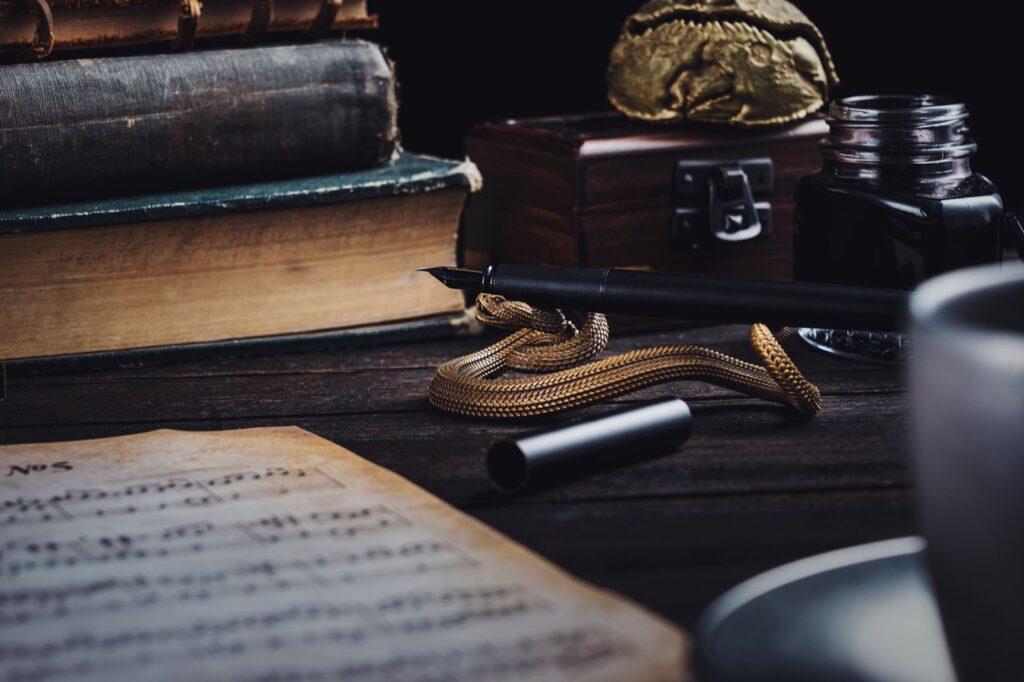
If you have ever sat down to write something—a letter, a speech, a long-overdue note to a friend—you know how slippery the words can be. You sharpen the pencil, you square up the paper, and then you suddenly remember you really ought to do the dishes. The great writers felt that same pull. The difference is that some of them built strange little rituals to outsmart it, and a few of those rituals were strange enough that we still talk about them a century or two later.
What follows are eight working habits that are genuinely documented—drawn from letters, interviews, and the memories of people who were there—rather than the apocryphal kind that gets passed around online. A couple of them have grown a few tall-tale feathers over the years, and where that’s true we’ll say so. But each one is a real window into how an actual human being coaxed the words out, one peculiar morning at a time.
Victor Hugo locked away his own clothes
No pants, no excusesFacing a brutal deadline for The Hunchback of Notre-Dame, Victor Hugo decided the only way to stop himself from wandering off into Paris was to make leaving physically impossible. So he had a servant take away his clothes, leaving him nothing presentable to go out in. According to an account from his wife, he wrapped himself in a huge grey knitted shawl and simply wrote, day after day, until the book was done—ahead of schedule, no less.
You may have heard the racier version, that Hugo wrote stark naked. That part is more legend than fact; the clothes-locked-away-in-the-wardrobe story is the one with real support behind it. Either way, the man essentially grounded himself like a teenager to get the work finished, and it worked.
Agatha Christie plotted murders in the bathtub
Apples and alibisThe queen of the whodunit did some of her best thinking lying back in the water. Christie favored an old-fashioned tub with a wide rim, and she liked to sit there working through a murder—who did it, how, and how the detective would unravel it—while munching apples and lining the rim with the cores. The warm water, the quiet, and the steady crunch of an apple were apparently all she needed to build a locked-room mystery in her head.
She later grumbled that modern bathtubs, the sleek sort you can’t perch anything on, had ruined the whole arrangement. If you have ever had your clearest idea in the shower, you already understand exactly what she was after.
Charles Dickens walked off his restlessness
Miles before bedtimeDickens kept a strict writing schedule, but when the words stopped coming—or when the day’s work left him too wound up to sleep—he walked. And we don’t mean a turn around the block. He thought nothing of covering fifteen or twenty miles through the dark streets of London, and once set off at two in the morning to walk the thirty-odd miles to his country home in Kent.
He also had a quieter quirk: he insisted on sleeping with his bed pointed north, convinced that lining himself up with the earth helped his creativity. He reportedly carried a compass so he could reposition the bed in any hotel room. Whether or not the compass helped the writing, the walking almost certainly did—he worked out his stories on his feet.
Maya Angelou rented a bare hotel room
Strip it downAngelou didn’t write at home. Instead she rented a plain hotel room by the month, had every picture and bit of decoration taken off the walls, and asked the staff never to come in and tidy up—not even to change the sheets, in case they threw away a scrap of paper she still needed. She would arrive around half past six in the morning and lie across the bed with a yellow legal pad.
Her kit was famously spare: the legal pads, a dictionary and a thesaurus, a Bible, a deck of cards for solitaire, and a bottle of sherry. She never actually slept in the room. It was a bare little workshop she rented purely to keep the ordinary world from leaking in.
Vladimir Nabokov wrote standing up, on index cards
Shuffle the storyNabokov didn’t write his novels front to back on long sheets of paper. He drafted them in pencil on small index cards, one scene or passage per card, writing whatever part of the book was alive in his mind that day. When he had enough cards, he shuffled and arranged them until the story fell into its final order—a jigsaw puzzle he was both cutting and assembling.
He often did this standing at a lectern rather than sitting at a desk, and parts of Lolita were drafted on cards in the back seat of the family car while his wife, Véra, drove him across the American West on butterfly-hunting trips. The whole system let him build a book out of order and still make it feel seamless.
Benjamin Franklin took a daily “air bath”
Window wide openFranklin—printer, statesman, and the writer behind so many of those famous almanac sayings—swore by what he called an air bath. Most mornings he would sit by an open window for up to an hour, with no clothes on, reading and writing while the cool air washed over him. He described the routine in an often-quoted 1768 letter and was convinced it kept him healthy.
He had no particular shame about it either, and would carry on receiving the occasional startled visitor mid-bath. The medical theory behind it was nonsense, but as a way to wake up and clear the head before a morning of writing, you can see the appeal.
Friedrich Schiller kept rotting apples in his desk
The smell of geniusThe German poet and playwright Friedrich Schiller apparently couldn’t write without the smell of decaying apples. He kept a drawer of them going soft and brown in his desk, and claimed he needed the odor to work. The story comes down to us because his friend Goethe stopped by one day, caught the stench, traced it to the drawer, and heard from Schiller’s wife that it was entirely on purpose.
It sounds revolting, and it was. But plenty of us have a particular smell or sound that flips some switch in the brain—coffee, cut grass, an old book. Schiller’s switch just happened to be a drawer of fruit left to turn.
Dan Brown hangs upside down to break a block
Blood to the brainA modern entry, and proof that the strange-habit tradition is alive and well. When Dan Brown, author of The Da Vinci Code, hits a wall in a plot, he straps himself into a set of inversion boots and hangs upside down. He says letting the blood—and, he hopes, the ideas—flow to his head helps shake a problem loose by shifting his whole perspective.
He pairs it with an old-fashioned hourglass on his desk, breaking roughly every hour for push-ups and sit-ups. It’s a long way from a drawer of rotten apples, but the instinct is exactly the same: do something odd with your body and trick the words into coming.
What ties these eight together isn’t the weirdness, really—it’s that each writer figured out one small thing that got them past the part where they’d rather do anything but write. Maybe your version is a certain chair, or the radio off, or a cup of coffee that has to go in the same mug. If it works, you’re in excellent company, apple cores and all.
Frequently asked questions
Did Victor Hugo really write naked?
Probably not. The popular “wrote in the nude” version is more legend than fact. The better-documented story is that he had his clothes taken away and locked up so he couldn’t leave, then worked wrapped in a large shawl until he met his deadline.
Why did Charles Dickens walk so much?
Dickens was a restless insomniac who used long night walks—often fifteen to twenty miles—to work through his stories and tire himself out. Many of his characters and plots took shape while he paced the streets of London.
What other odd things do famous authors have in common?
A love of language is one. Several of the writers here helped shape everyday English, from Franklin’s almanac sayings to the many everyday phrases that came straight from Shakespeare. A few of these same authors also wrote books that courts and school boards later tried to ban, including several beloved books that were once banned.
Did Maya Angelou write her books in a hotel?
Yes. Angelou rented a plain hotel room by the month, had the walls stripped of decoration, and asked that no one tidy it. She wrote lying across the bed on yellow legal pads, keeping a dictionary, a thesaurus, a Bible, and a deck of cards close at hand.
Sources
How much do you remember?
3 quick questions from the story above.
Enjoyed that? Play a full trivia quiz:
Play a Literature quiz