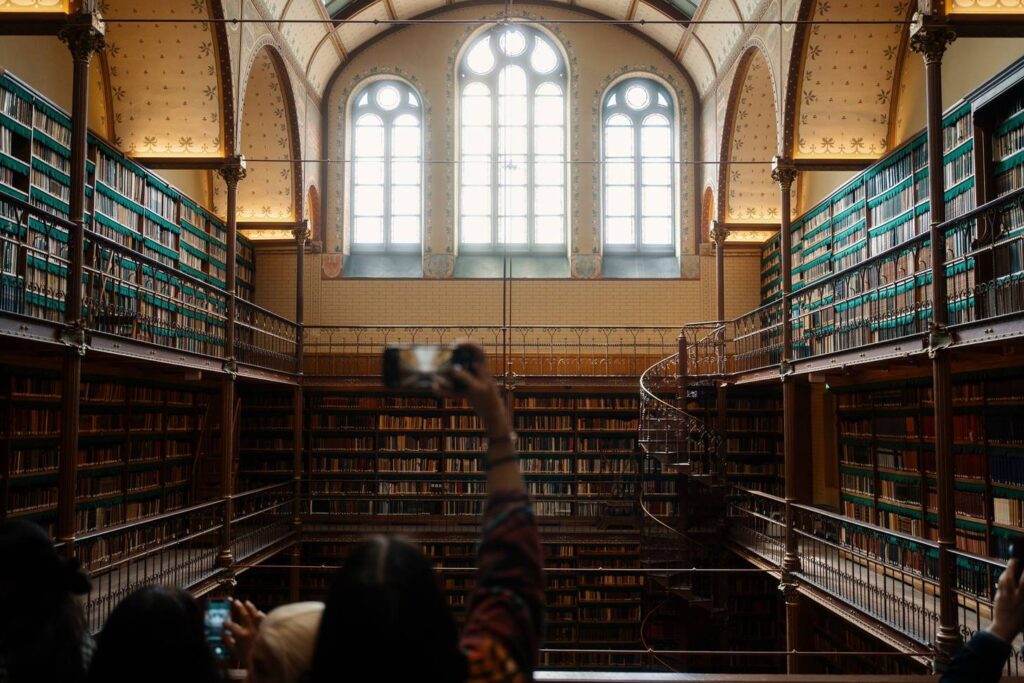
Before cloud storage, before microfilm, before the printing press, there were rooms. Rooms where monks copied manuscripts by candlelight, where scholars argued over translations, where the collected thought of centuries sat on wooden shelves or pressed into clay. These were the world’s first libraries — not quiet places of hushed reverence, but living institutions, often as competitive and politically charged as anything we’d recognize today. Rulers funded them to project power. Scholars traveled weeks to reach them. Rival cities stole books from each other.
Some burned. Some were deliberately ransacked by invaders who understood that destroying a people’s books was a way of erasing their history. A few survived long enough to leave a legacy we still draw from. What follows is a look at eight of them — places that once held the world’s accumulated knowledge, and the stories, sometimes triumphant, sometimes heartbreaking, of how they rose and in most cases fell.
Library of Alexandria
The greatest that ever wasFounded around 283 BCE by Ptolemy I Soter in Egypt and built up by his successors, the Library of Alexandria may have held as many as half a million scrolls covering history, poetry, philosophy, medicine, law, and science. Scholars believed to have worked there include Euclid, Eratosthenes — who calculated the circumference of the earth with remarkable accuracy — and Archimedes. A smaller daughter library was established around 235 BCE just to hold the overflow. It was less a quiet archive than an active research institution, attached to a temple-like complex called the Mouseion.
The popular story of a single catastrophic fire erasing it overnight is, historians now agree, a myth. The library declined slowly, damaged by Julius Caesar’s fire in 48 BCE that consumed warehouses near the harbor, weakened by later political upheavals in the 3rd century CE, and gradually starved of funding as the center of Roman power shifted. There was no one dramatic last day — just a slow dimming, which in some ways feels even sadder.
Library of Ashurbanipal
Baked by fire, saved by itThe Neo-Assyrian king Ashurbanipal (668–631 BCE) assembled roughly 30,000 cuneiform clay tablets in his palace at Nineveh, near modern Mosul in Iraq. He took his collection seriously in a way few rulers had before — tablets bear his personal royal stamp, and he sent agents across the empire to copy texts. Among the holdings was the Epic of Gilgamesh, the world’s oldest surviving great work of literature, with its ancient flood story that predates the biblical version by over a thousand years.
When Nineveh was sacked and burned in 612 BCE, something unexpected happened: the fire that destroyed the palace baked the clay tablets harder, preserving them instead of destroying them. They sat buried for over two millennia until the British archaeologist Austen Henry Layard’s team found them in 1850. Most of the collection is now in the British Museum, where the Ashurbanipal Library Project spent four years cataloguing what survived.
Library of Pergamon
Alexandria’s upstart rivalBuilt under King Eumenes II (197–159 BCE) on the acropolis of Pergamon in Asia Minor — modern western Turkey — this library sat beside the Temple of Athena and held an estimated 200,000 scrolls, according to the ancient biographer Plutarch. The competition between Pergamon and Alexandria was fierce enough that the two cities tried to outbid each other for the best scholars and the most accurate copies of Homer. Ancient accounts even claim Egypt cut off papyrus exports to Pergamon, forcing the city to develop parchment — made from animal skins — as an alternative writing material.
The library’s later history reads like a story of diplomatic gifts and political complications. Mark Antony reportedly gave the entire collection to Cleopatra, who brought it to Alexandria. Augustus later returned some scrolls to Pergamon, though not all. Whatever remained likely declined when the city was eventually abandoned around 1300 CE. The ruins of ancient Pergamon, including the library site, became a UNESCO World Heritage Site in 2014.
House of Wisdom
Where East met West in inkThe Bayt al-Hikma in Baghdad grew into one of history’s great intellectual centers under the Abbasid caliphs, particularly Harun al-Rashid (786–809 CE) and his son al-Ma’mun (813–833 CE). Scholars from across the Islamic world, as well as Christians, Jews, and others, worked there translating Greek, Persian, and Indian texts into Arabic — preserving ancient science and philosophy during the European Dark Ages and adding substantially to it. An observatory was added in 829. The House of Wisdom helped transmit algebra, astronomy, and medicine westward into medieval Europe.
The Mongols under Hulagu Khan sacked Baghdad in 1258, and the House of Wisdom was destroyed. The story passed down through the centuries — that soldiers threw so many books into the Tigris River the water ran black with ink — is likely embellished, but it captures something true about the scale of the loss. Centuries of translated knowledge, gathered in one place, were gone in days.
Library of Nalanda
Nine stories of palm leavesFounded around 427 CE in what is now Bihar, India, Nalanda was one of the ancient world’s great centers of Buddhist learning, drawing scholars from China, Korea, Sri Lanka, and Central Asia. Its library — called the Dharmaganja, or Treasury of Truth — was said to occupy three separate buildings, the tallest reaching nine stories. The manuscripts, mostly written on palm leaves, covered grammar, medicine, astronomy, logic, and theology, among other subjects. At its peak, Nalanda housed thousands of students and hundreds of teachers.
Around 1193, forces under the commander Bakhtiyar Khilji burned the complex. Accounts of how long the library burned vary — some say weeks, some say months — but very few manuscripts survived. The monks who had kept those texts for centuries were killed or dispersed. The surviving ruins, excavated by archaeologists in the 19th and 20th centuries, are now a UNESCO World Heritage Site, and a new Nalanda University opened nearby in 2014.
Imperial Library of Constantinople
Keeper of the Greek flameEstablished around 357 CE by Emperor Constantius II in Constantinople — modern Istanbul — this imperial library may have held as many as 100,000 volumes at its height, though the exact number is uncertain. Its importance is hard to overstate: the majority of ancient Greek texts that we have today — the plays, the philosophy, the histories — survived because Byzantine scholars in Constantinople kept copying and preserving them through the medieval centuries when much of that tradition had been lost in the West.
The library suffered a fire in 473 CE, then took serious damage during the Latin sack of Constantinople in 1204, when soldiers from the Fourth Crusade pillaged the city. A remnant was reconstituted at Nicaea around 1222, and some holdings returned to Constantinople afterward, but the library never fully recovered its former scope. When the Ottomans took the city in 1453, whatever remained was absorbed or scattered.
Bodleian Library
A great library rebuilt from scratchOxford’s university library has roots going back to around 1320, when Bishop Thomas de Cobham donated 281 manuscripts to the university. But the institution you can visit today was effectively started over. In 1550, commissioners under Edward VI stripped the original library of its books — Catholic texts were unwelcome in the new Protestant England — and the shelves were dismantled. For decades, the room sat empty. Then the diplomat and scholar Thomas Bodley stepped in. He spent his own money restocking the collection, persuaded friends and patrons to donate, and the library reopened on November 8, 1602.
A 1610 agreement gave the library legal deposit rights, entitling it to a free copy of every book printed in England. That agreement — and its successors — turned a refounded collection into one of the world’s great repositories. Today the Bodleian holds more than 4.2 million printed volumes and around 50,000 manuscripts. It is, in a real sense, a library that came back from the dead.
Libraries of Timbuktu
Hidden in the Saharan dustTimbuktu, in what is now Mali, was a major center of Islamic scholarship from the 13th century onward, when it flourished as a trading hub on the trans-Saharan caravan routes. Its libraries were not grand public institutions but mostly private collections, passed from generation to generation within families. The manuscripts covered theology, mathematics, astronomy, history, medicine, and law, most written in Arabic, some in local languages including Songhai and Tamashek. Estimates of how many survive range from 200,000 to 700,000 documents — no one has managed a firm count.
Timbuktu’s libraries have been threatened repeatedly: Moroccan troops sacked the city in 1591 and burned collections. In 2012–2013, Islamist militants occupied the city and set fire to the Ahmad Baba Institute and other sites. But word had spread ahead of the occupation, and local families quietly moved tens of thousands of manuscripts to safety in Bamako, hiding them in trunks, vegetable crates, and private homes. Much survived because ordinary people decided it was worth the risk.
These eight places share something beyond their age: each was built on the conviction that ideas were worth preserving, whatever the cost. The stone erodes, the papyrus turns to dust, the clay gets buried under centuries of rubble. But the impulse to gather what we know and hold it safe — that part hasn’t changed much.
How much do you remember?
3 quick questions from the story above.
Enjoyed that? Play a full trivia quiz:
Play a History quizFrequently asked questions
Was the Library of Alexandria really destroyed in a single fire?
No — that’s one of history’s most persistent myths. Historians now believe the library declined gradually through multiple damaging incidents over centuries, including fires, political neglect, and shifting funding priorities. No single catastrophic blaze ended it overnight. For more on the ancient world’s lost wonders, see The Seven Wonders of the Ancient World and What Became of Them.
What happened to the manuscripts of Timbuktu?
When Islamist militants occupied Timbuktu in 2012–2013, local families quietly moved tens of thousands of manuscripts out of the city before serious burning began. Some were lost at the Ahmad Baba Institute, but the bulk survived thanks to those grassroots preservation efforts. Many remain in private family collections across Mali, though access to modern preservation resources is limited.
Which ancient library is most responsible for preserving Greek classical texts?
The Imperial Library of Constantinople, maintained by Byzantine emperors from around 357 CE until the city fell in 1453, copied and preserved most of the Greek texts we read today. Without Byzantine scribes working through the medieval centuries, much of what we know about ancient Greek literature, philosophy, and science would be lost. You might also enjoy 8 Myths About the Middle Ages That Aren’t True.
Did ancient Egypt contribute to the development of libraries and writing?
Egypt’s contributions to written knowledge were immense, from papyrus production to early forms of record-keeping that influenced the entire ancient world. The Library of Alexandria itself grew from Egyptian intellectual culture under the Greek Ptolemaic dynasty. To learn more about Egyptian innovations, see 8 Things the Ancient Egyptians Invented That We Still Use.