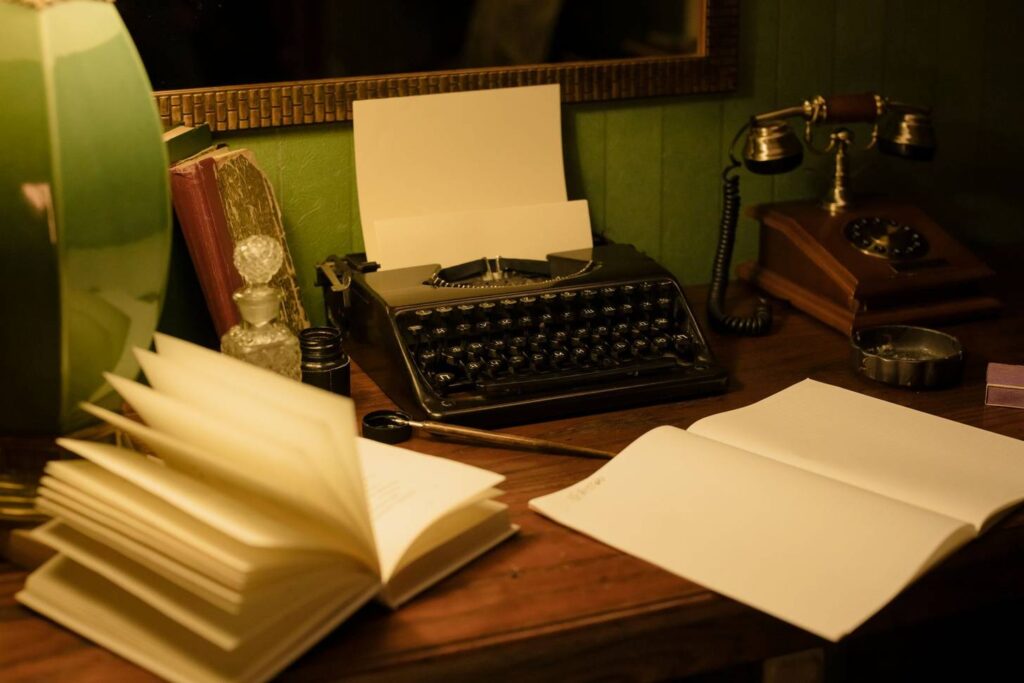
There’s a version of the writer’s life that looks very tidy from the outside—a quiet study, a good lamp, maybe a cup of tea going cold on the edge of the desk. The reality, at least for some of the most celebrated novels in the English language, was considerably stranger. Books get written wherever life happens to put you: in exile, in a hospital bed, on a night shift, in a borrowed villa while the sky turns the wrong color.
Whether stranded indoors by volcanic ash drifting across a Swiss summer, hunched over a typewriter in a power plant coal bunker between midnight and four in the morning, or scribbling in a corner cafe while a baby slept in a pram, these writers found a way. What follows are eight stories of where—exactly where—some beloved novels came into the world.
Frankenstein
Volcanic ash, a ghost-story dareIn June 1816, an eighteen-year-old Mary Godwin (soon to be Shelley) arrived at the Villa Diodati on the shore of Lake Geneva with the poet Percy Shelley and a small, combustible party that included Lord Byron and his physician John Polidori. The summer should have been beautiful—but the eruption of Mount Tambora in Indonesia the previous year had pumped so much ash into the atmosphere that temperatures across Europe plummeted and the sky turned an eerie copper. Rain kept the group indoors for days.
Byron suggested they each write a ghost story. Mary began what would become Frankenstein on June 16, 1816. She later described the image that started it all: a pale student kneeling over the creature he had assembled and then recoiling from it in horror. The manuscript grew through that strange, sunless summer and into the autumn. Published anonymously in 1818, when she was just 20, it remains one of the most remarkable literary débuts in history—born from bad weather and a dare.
Ulysses
Three cities, one exiled IrishmanJames Joyce left Dublin as a young man and barely returned. By the time he finished Ulysses—a novel set over a single June day in 1904 Dublin—he had written it across three cities he adopted out of necessity rather than preference. He began conceiving the book in Trieste, the Adriatic port he called his “second country,” where he taught English and scraped by. When World War I began, the family decamped to Zurich, and it was there, in a city that sheltered exiles from every direction, that most of the novel took shape.
After the war, Ezra Pound persuaded Joyce to try Paris for a while. He stayed for the next twenty years. Sylvia Beach, owner of the bookshop Shakespeare and Company, published Ulysses in 1922—banned in the United Kingdom and the United States, it appeared only in France. At the end of his manuscript, Joyce wrote three words: “Trieste–Zurich–Paris.” It was a quiet acknowledgment that the book had no single home, any more than its author did.
On the Road
A 120-foot scroll, typed nonstopIn April 1951, Jack Kerouac sat down at his typewriter in his apartment at 454 West 20th Street in Manhattan and began typing fast. To avoid the interruption of feeding new paper into the machine, he had taped together sheets of tracing paper into a single continuous scroll, 120 feet long. He typed at roughly 100 words a minute, by one account. A few weeks later he had a draft. When a talk-show host asked in 1959 how long it took to write the book, Kerouac said three weeks—which is more or less true for that particular sprint.
What the answer left out is the years before: Kerouac had been gathering the material since 1947, crossing the country by bus and hitchhike, filling notebooks, accumulating what the book would eventually become. The scroll itself sold at auction in 2001 for $2.43 million. On the Road wasn’t published until 1957, six years after that furious typing session in Manhattan, and it went on to define a generation’s sense of movement and possibility.
The Old Man and the Sea
A Cuban fishing village, a borrowed captainHemingway spent much of his later life at his estate, Finca Vigía, just outside Havana, and it was the small fishing village of Cojímar—a short drive up the coast—that gave him the material for his last major novel. He kept his boat, the Pilar, at the village marina. His captain was Gregorio Fuentes, the man Hemingway admitted was his model for the old fisherman Santiago—someone who knew those waters the way the novel’s protagonist does, intimately and without sentiment.
When Hemingway died in 1961, the fishermen of Cojímar collected brass fittings from their own boats and melted them down into a bronze bust of the author, which still stands in the village. The Old Man and the Sea won the Pulitzer Prize in 1953 and was cited when Hemingway received the Nobel Prize in Literature the following year. The village that inspired it remains small, and the bust of Hemingway faces the sea.
As I Lay Dying
Night shift in a coal bunkerIn the fall of 1929, William Faulkner was working the overnight shift at the University of Mississippi’s power plant—a job that mostly meant keeping watch on the generators from six in the evening until six in the morning, with demand dropping to near nothing after midnight. He found himself with several quiet hours and nowhere to be. In a coal bunker just beyond the wall where a dynamo hummed, he found a wheelbarrow, turned it upside down, and used it as a desk.
In roughly six weeks of those stolen hours, he wrote As I Lay Dying—fifteen narrators, including a dead woman, carrying a coffin across Mississippi toward a burial that keeps getting interrupted. “I set out deliberately to write a tour de force,” he later said. Whether that was confidence or something more complicated is hard to say. It was the last paying job outside of writing that Faulkner would ever hold, and he finished the manuscript before anyone at the plant knew it existed.
A Farewell to Arms
An Italian hospital, real woundsIn July 1918, a nineteen-year-old Ernest Hemingway was serving as a Red Cross ambulance driver near the Isonzo River in northern Italy when a mortar shell exploded near him, driving more than two hundred metal fragments into his legs. He was evacuated to a Red Cross hospital in Milan. During the months he spent recovering, he fell for his nurse, Agnes von Kurowsky. She was older, charming, and ultimately sent him a letter ending things after he returned to the United States.
A decade later, Hemingway turned those months into A Farewell to Arms—the Italian landscape, the retreat, the hospital, the romance, all of it deepened and darkened. He began the novel in 1928, and it was published in 1929, becoming his first major best-seller. For the real courage he showed under fire in 1918, the Italian government awarded him the Silver Medal of Military Valor. The novel’s ending, which he rewrote dozens of times, is harder than anything Agnes put in her letter.
Harry Potter and the Philosopher’s Stone
Edinburgh cafes, a sleeping babyThe story you’ve probably heard—J.K. Rowling, destitute, warming herself over a single cup of coffee in the Elephant House cafe—is mostly myth. Rowling moved to Edinburgh in December 1993 with three chapters of the book already written, and she was on government benefits and raising her daughter alone, which was genuinely difficult. But the cafe she actually wrote in was Nicolson’s, on Nicolson Street, partly owned by her brother-in-law. She would settle at a table with her daughter Jessica in a pram alongside her and write while the baby slept.
Of Nicolson’s, Rowling has confirmed: “That one’s true! I used to write in Nicolson’s all the time.” The Elephant House, which opened in 1995 after the manuscript was already well underway, has branded itself the “birthplace of Harry Potter”—a claim Rowling gently corrected: “I’d been writing Potter for several years before I ever set foot in this cafe… but I did write in there so we’ll let them off!” The first book was published in 1997 and changed everything, including the myth.
The Bridge of San Luis Rey
A New Hampshire writers' retreatIn July 1926, Thornton Wilder arrived at the MacDowell Colony in Peterborough, New Hampshire—a wooded campus of individual studios where artists could work without interruption, meals left at the door so they needn’t stop. Wilder was in his late twenties and teaching at a boarding school; he had just published his first novel. At MacDowell, he began the book that would make him famous.
The Bridge of San Luis Rey is set in 18th-century Lima, Peru, and concerns five people who die when a rope bridge collapses—and the friar who tries to understand whether God intended their deaths. It was published in 1927 and won the Pulitzer Prize the following year, becoming one of the best-selling novels of the 20th century. Wilder would return to MacDowell many times over the decades. The first pages of that Lima story were written somewhere in the New Hampshire woods, with supper left quietly outside the studio door.
None of these writers chose their circumstances for atmosphere. They wrote where life—war, exile, poverty, odd-hour employment, volcanic weather—put them, and the work came through anyway. Which may be the most stubborn thing about all of it: the desk doesn’t have to be the right one.
How much do you remember?
3 quick questions from the story above.
Enjoyed that? Play a full trivia quiz:
Play a Literature quizFrequently asked questions
Did J.K. Rowling really write Harry Potter in an Edinburgh cafe while living in poverty?
Partly. Rowling was on government benefits and raising her daughter alone in Edinburgh—genuinely difficult circumstances—but the destitution myth has been overstated. She wrote much of Harry Potter and the Philosopher’s Stone at Nicolson’s cafe, partly owned by her brother-in-law, where she could sit with her baby in a pram. The famous Elephant House cafe didn’t open until 1995, after the manuscript was already well underway. For more on novels tied to real circumstances, see 8 Classic Novels Inspired by Real People and Events.
Were any of these classic novels rejected by publishers before they became famous?
A Farewell to Arms and Harry Potter and the Philosopher’s Stone both had bumpy roads to publication—Rowling’s manuscript was famously rejected by multiple publishers before Bloomsbury took it. If you enjoy those stories, 8 Classic Books Publishers Rejected Before They Became Hits goes deeper into the pattern of brilliant manuscripts that almost didn’t make it.
What are some other unusual writing habits of famous authors?
Unusual working conditions are hardly unique to the writers here. Many celebrated authors developed strange rituals or worked in peculiar circumstances—some standing at a lectern, others writing in bed or on index cards. The Strange Writing Habits of 8 Famous Authors covers some of the more memorable examples from literary history.
Has any of these novels ever been banned?
Ulysses was famously banned in both the United Kingdom and the United States for decades due to perceived obscenity, which is part of why Sylvia Beach had to publish it in Paris in 1922. A Farewell to Arms and Harry Potter have also appeared on challenged and banned book lists at various points. For a broader look at books that faced censorship, see 8 Beloved Books That Were Once Banned and Why.