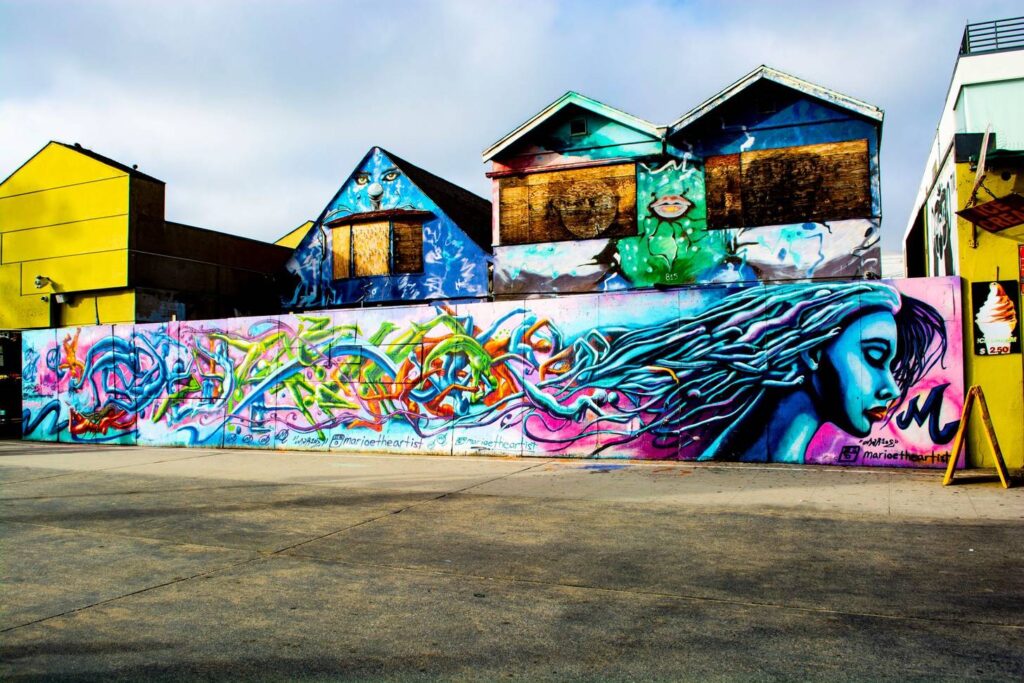
The walls of cities have always had stories to tell. But sometime in the late twentieth century, a new kind of storyteller started working in broad daylight—or slipping out after dark—to turn blank concrete into something you couldn’t look away from. These weren’t commissioned murals painted above bank lobbies. They were unauthorized, confrontational, occasionally illegal—and almost always unforgettable.
Some of the artists behind them went on to fill museums and auction houses. Others stayed anonymous, known only by what they left on the wall. Together, they rewrote what “art” could be—and where it could live. Here are eight whose work changed how you think about the spaces you move through every day.
Banksy
Stencils that ask questionsNobody knows Banksy’s real name. The artist emerged from the underground scene in Bristol, England, in the 1990s, initially working freehand before switching to stencils—faster to apply, harder to catch in the act. The signature style pairs crisp, almost cartoon-clear images with pointed political commentary: a child releasing a heart-shaped balloon, a soldier spray-painting a peace sign, rats holding protest signs in a subway tunnel.
What makes Banksy genuinely hard to dismiss is the timing. When a piece appeared on the separation barrier in the West Bank, or on the rubble of bombed buildings in Ukraine in 2022, it didn’t feel like decoration—it felt like an act. Banksy has also played games with the art world itself, most famously when a canvas shredded itself moments after selling at Sotheby’s for more than a million pounds. The market blinked. Then it shrugged and kept bidding.
Jean-Michel Basquiat
Street poet turned gallery starBefore he was filling canvases in museums, Jean-Michel Basquiat was scrawling cryptic phrases across lower Manhattan walls as part of the graffiti duo SAMO—a tag that stood, sardonically, for “Same Old Shit.” Born in Brooklyn in 1960 to a Haitian father and Puerto Rican mother, Basquiat never attended art school. He slept in cardboard boxes in Tompkins Square Park and sold hand-painted postcards to make ends meet.
His breakthrough came quickly. By 1981 he was showing in galleries; by 1982, at just twenty-one, he was the youngest artist in the Documenta exhibition in Kassel, Germany. His paintings kept the energy of street work—rough, dense, layered with text and crossed-out words—while pulling in anatomy diagrams, jazz history, and the names of Black heroes he felt history had overlooked. He died in 1988 at twenty-seven. His work now sells for tens of millions.
Keith Haring
Chalk figures, open heartIn 1980, Keith Haring noticed something nobody else had bothered to look at: the blank black panels used to cover expired advertisements in New York’s subway stations. He bought white chalk and started drawing. Over the next five years, he made hundreds of these subway drawings—radiant babies, barking dogs, figures dancing or straining against chains—seen by tens of thousands of commuters a day. People stopped. People photographed. People sometimes peeled the panels off the wall.
Haring grew up in Pennsylvania and moved to New York in 1978. He was always clear that art should be for everyone, not just gallery-goers. His figures moved from subway tunnels to mural commissions in Philadelphia, Amsterdam, and Melbourne. When he learned in 1988 that he had AIDS, he established the Keith Haring Foundation to fund AIDS education and support organizations. He died in February 1990, at thirty-one. The bold, joyful figures he invented are still everywhere you look.
Shepard Fairey
A sticker became a movementIn 1989, Shepard Fairey was a student at the Rhode Island School of Design when he made a crude sticker featuring the face of wrestler André the Giant with the words “Andre the Giant Has a Posse.” He had no grand plan. The sticker spread. It mutated into the cleaner black-and-white OBEY Giant icon, and it kept spreading—to walls, trucks, and street signs in more than forty countries. Fairey said the campaign was deliberately unexplained. If it made you stop and wonder what it meant, it had done its job.
In 2008, Fairey created the red-and-blue “HOPE” portrait of Barack Obama, working on his own initiative before the campaign adopted it as a symbol. A version now hangs in the Smithsonian’s National Portrait Gallery. His visual style blends Soviet Constructivist graphics, Cold War poster design, and skateboard culture—a language that feels equally at home plastered on a dumpster or framed behind glass.
JR
Photographs bigger than buildingsJR is a French artist who found an abandoned camera on the Paris Métro at seventeen and never really stopped using it. He calls himself a “photograffeur”—a blend of photographer and the French word for graffiti artist. His method is deceptively simple: take large black-and-white portraits, print them enormous, and wheat-paste them to walls, rooftops, bridges, and train carriages. The scale changes everything. A face easy to ignore at passport size becomes impossible to walk past when it’s fifty feet tall.
His Women Are Heroes project pasted images of women affected by conflict onto buildings in war zones and Brazilian favelas. His 2011 TED Prize launched the Inside Out Project, a participatory effort that has placed more than 300,000 portraits in 140 countries. In 2017 he co-directed a documentary with the legendary French director Agnès Varda. JR’s identity stays largely private—the opposite of everything else about his work.
Invader
Pixels tiled across the worldSomewhere in Paris in the late 1990s, an anonymous French artist began installing small tile mosaics of the pixelated aliens from the classic 1978 arcade game Space Invaders. He called himself Invader. He called each installation an “invasion.” He described cities as levels in a video game, and the goal was to clear them. He has since appeared in more than sixty cities on five continents—Paris, Los Angeles, Hong Kong, Tokyo, Karachi—working at night, masked, placing his brightly colored tiles on walls, bridges, and the facades of official buildings.
The tiles are made to last—weather-resistant ceramic, not spray paint—which is part of the point. Many of his early pieces are still in place decades after installation. He maps each city’s invasion in hand-drawn reference books and tracks his score online. In 2015, he launched a piece into low Earth orbit on a weather balloon. Invader has never given an interview under his real name. The work speaks, and then the artist disappears.
Os Gemeos
Twin brothers, shared dreamsOtavio and Gustavo Pandolfo were born in 1974 in the Cambuci district of São Paulo. They took up breakdancing first, then graffiti, beginning around 1987. The characters they developed—elongated figures with yellow skin and wide, searching eyes—came partly, they’ve said, from the yellow tint that colors their shared dreams. Limited access to spray cans early on pushed them toward house paint and rollers, which gave their work a looser, more painterly quality than most graffiti of the era.
Their style absorbs Brazilian folklore, family memory, and the social conditions of São Paulo’s streets—at once fantastical and politically grounded. A 1993 encounter with American artist Barry McGee opened doors to international contacts and collaborations. Today their practice has expanded to sculpture, installation, and gallery work shown in major institutions worldwide. Their canvases fetch significant prices at auction. But São Paulo’s walls remain their first language.
Eduardo Kobra
History in kaleidoscope colorEduardo Kobra grew up in São Paulo and began painting the city’s walls as a teenager. He eventually found commissions—including a contract to paint the walls of a major Brazilian amusement park—and developed the signature style that would make him one of the most recognizable muralists working today. His faces are built from repeating geometric shapes, triangles and diamonds stacked into a kaleidoscope, each portrait vibrating with color you can see from half a block away.
His subjects tend toward the quietly heroic: Anne Frank, Nelson Mandela, Jimi Hendrix, indigenous faces from communities rarely seen on city walls. His mural Etnias in Rio de Janeiro, painted for the 2016 Olympics, is often described as the world’s largest graffiti wall. He has since painted in New York, Paris, Moscow, and Tokyo. In 2026, he completed Cleveland’s largest mural. Each wall is a brief, and Kobra always delivers something worth standing in front of.
What all eight of these artists share is an impatience with the idea that art belongs only indoors. They found their canvas in the city itself—on the gray concrete and blank walls most of us pass without a second glance—and turned them into something worth stopping for. Some of what they made was illegal. Some of it later sold for millions. All of it changed how you see a wall.
Frequently asked questions
What is the difference between graffiti and street art?
The line between the two has blurred considerably over the decades. Graffiti traditionally refers to text-based writing—tags, throw-ups, and lettering—rooted in hip-hop culture and New York City subway culture of the 1970s and ’80s, while street art more often involves images, stencils, or full murals aimed at a broader public. Many artists, including Basquiat and Os Gemeos, started in graffiti and moved fluidly into what critics now call street art. The distinction matters less than the result: both have produced some of the most striking public images of the last fifty years. If you enjoy stories about how creative traditions take root and spread, you might also like 9 everyday phrases that came straight from Shakespeare.
Has Banksy’s identity ever been revealed?
Banksy has never publicly confirmed their identity. Over the years, journalists and investigators have pointed to Robin Gunningham, a Bristol artist, as the most likely candidate—and some accounts have noted connections to 3D of Massive Attack. But nothing has been officially confirmed, and Banksy has maintained the anonymity as a deliberate choice. The argument, at least implicitly, is that knowing who the artist is would change how you respond to what’s on the wall—and Banksy prefers to keep your attention there.
What happened to Keith Haring’s foundation after his death?
The Keith Haring Foundation, which Haring established in 1989 after his AIDS diagnosis, has continued his work since his death in 1990. It supports organizations that provide services to children and to AIDS patients and research—the two causes Haring cared most about. The foundation also licenses and manages his image, ensuring that his visual vocabulary keeps circulating in schools, hospitals, and public spaces. For more on artists whose legacies outlasted their lifetimes, see 8 beloved books that were once banned and why.
Is street art legal?
It depends entirely on where and how it is made. Commissioned murals are completely legal and are funded by cities, businesses, and cultural institutions worldwide. Unauthorized work—placing art on someone else’s property without permission—is typically a crime under vandalism laws, and many of the artists in this article have faced arrest or legal action. The distinction between sanctioned and unsanctioned work is part of what gives street art its edge: the best of it was made with the knowledge that it might be painted over or prosecuted tomorrow.
Sources
How much do you remember?
3 quick questions from the story above.
Enjoyed that? Play a full trivia quiz:
Play a Art quiz