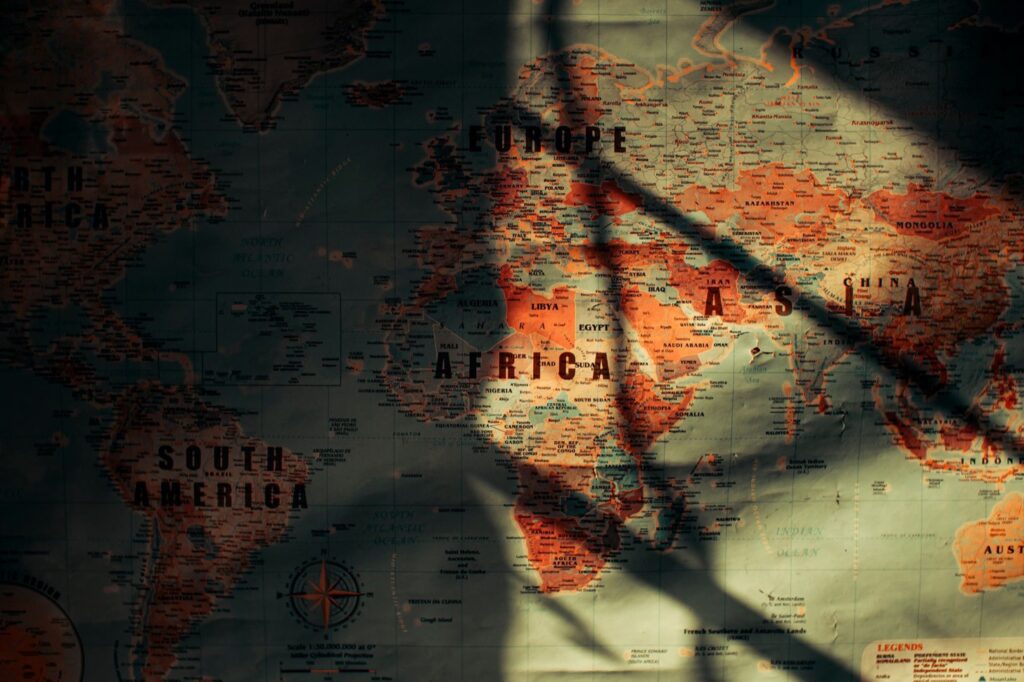
Think back to the classroom maps you traced as a kid — that pull-down atlas over the chalkboard, the globe someone always spun too hard. You learned to say the names long before you ever thought about where they came from. Argentina, Japan, Canada: they were just sounds attached to shapes, and you filed them away without a second look.
But almost every one of those names is a tiny story that someone chose, and often argued over, centuries ago. Some come from a joke a sailor made about the view. Some are Latin left over from Roman dreaming. One is an acronym invented by a student with a cause. Here are nine you’ve said a thousand times, and what they were really trying to tell you all along.
Ecuador
right on the lineThis one hides in plain sight, and once you see it you can’t unsee it. Ecuador is simply the Spanish word for equator — the country sits astride that invisible line where the globe is widest and the days and nights run close to even all year.
The full official name is the República del Ecuador, the Republic of the Equator. It took the name in 1830 when it broke away from Gran Colombia. The word itself goes all the way back to a medieval Latin phrase meaning the “equalizer” of day and night — a lovely bit of old astronomy tucked inside a modern passport.
Argentina
silver that never cameArgentina means silvery, or the land of silver, from the Latin argentum — the same root that gives silver its chemical symbol, Ag. If you ever took high-school chemistry, you’ve met this country’s name before without knowing it.
The irony is that the silver was mostly a rumor. Spanish and Portuguese explorers pushing up the Río de la Plata, the “River of Silver,” had heard tales of a mountain of the stuff ruled by a shadowy king. The great hoards turned out to be elsewhere, but the hopeful name stuck to the whole region and never let go.
Venezuela
little VenicePicture a European sailor in 1499, rounding a warm coast and seeing villages of houses built on stilts out over the water. According to the popular account, that sight reminded Amerigo Vespucci — the same Amerigo who lent his name to two whole continents — of the canals of Venice back home.
So he called it Venezuela, “little Venice.” The stilt homes belonged to the Indigenous Añu people, and they were a world away from any Italian palace, but the nickname carried. There’s a quieter theory that the name came from a local word instead, though the Venice story is the one most people still tell.
Pakistan
a name built from lettersMost country names grow slowly over centuries. This one was more or less invented on purpose. In a 1933 pamphlet called Now or Never, a student named Choudhry Rahmat Ali stitched together an acronym from the regions he hoped would form a homeland: P for Punjab, A for Afghania, K for Kashmir, S for Sindh, and the -tan ending of Balochistan.
There was a second gift hidden in it. In Persian and Urdu, the pieces also read as “land of the pure.” An extra i slipped in to make it easier to say, and a name that started as a clever abbreviation became the name of a nation of hundreds of millions.
Australia
the land that had to existLong before anyone from Europe had seen it, ancient geographers were sure there had to be a big landmass down south to balance all the land up north. They gave this imagined place a Latin label: Terra Australis, the “Southern Land,” from australis, meaning southern.
For a long stretch the real continent went by the Dutch name New Holland. It was the explorer Matthew Flinders, who sailed all the way around it, who pushed hard for Australia — and the name he popularized was adopted officially in the decades that followed. A hunch from the old world ended up printed on the map of the new one.
Japan
where the sun beginsYou’ve heard Japan called the Land of the Rising Sun, and that is the name read straight off the page. In Japanese the country is Nippon or Nihon, written with two characters: one for sun and one for origin. Put them together and you get “the origin of the sun.”
The reason is simple geography seen from a neighbor’s doorstep. Looking east from China, Japan lay out toward the sunrise, and an early letter to a Chinese emperor spoke of the ruler of the land where the sun rises. That red disc on the flag isn’t decoration — it’s the whole name, drawn in a single circle.
Canada
a very big villageHere’s a name born from a small misunderstanding that got wonderfully out of hand. In 1535, French explorer Jacques Cartier was near present-day Québec City when two Indigenous youths pointed him toward kanata — a Huron-Iroquois word meaning simply “village” or “settlement.” They meant the nearby town of Stadacona.
Cartier took the word to mean the whole region, and the label kept spreading. From one settlement, “village” grew to cover a territory, then a colony, and finally the second-largest country on Earth. It became the official name of the new nation in 1867.
Liberia
the whole point in a wordSome names describe a landscape; this one describes a promise. Liberia comes from the Latin liber, meaning “free,” and it was chosen to say exactly what the place was meant to be.
The country was founded in the early 1800s as a home for freeborn and formerly enslaved Black Americans, with help from the American Colonization Society. Its capital, Monrovia, was named for U.S. President James Monroe, and Liberia declared itself an independent republic in 1847. You can hear the word “liberty” sitting right inside it.
Sierra Leone
the mountains that roaredThe name means “Lion Mountains,” and it comes from the ridge of hills that rings the harbor at the capital, Freetown. The Portuguese explorer Pedro de Sintra is usually credited with calling the range Serra Lyoa in the 1460s, and the version we use today came through a later Italian spelling.
Why lions? Nobody kept a tidy record. Some said the hills looked like a crouching lion or a mouth of teeth; others swore the thunderstorms rolling over the peaks sounded like a roar. There’s even a hint the name was floating around before de Sintra ever arrived. Whatever the true spark, you end up with one of the more vivid names on the map.
So the next time your finger lands on a country — on a globe, a jigsaw puzzle, the back of an airline magazine — try saying the name slowly and asking what it was trying to tell you. Behind a lot of those familiar sounds is a sailor’s guess, a scholar’s dream, or a stranger pointing toward a village he never expected the whole world to remember.
Frequently asked questions
Why is Ecuador called Ecuador?
Ecuador is simply the Spanish word for “equator.” The country sits directly on the equatorial line, so its full name is the República del Ecuador — the Republic of the Equator — adopted in 1830. For more geography puzzles like this, see the story of how we split the day into time zones.
Is Pakistan really an acronym?
Yes. The name was coined in a 1933 pamphlet by student Choudhry Rahmat Ali from the initials of regions — Punjab, Afghania, Kashmir, Sindh and the “-tan” of Balochistan. It also happens to mean “land of the pure” in Persian and Urdu.
What does Canada mean?
Canada comes from kanata, a Huron-Iroquois word meaning “village” or “settlement.” In 1535 two Indigenous youths used it to point Jacques Cartier toward the village of Stadacona, and the name gradually grew to cover the whole country.
Why is Sierra Leone called the Lion Mountains?
The name means “Lion Mountains” and refers to the range of hills around the harbor at Freetown. Portuguese explorer Pedro de Sintra is usually credited with the name in the 1460s, though accounts differ on whether it describes the shape of the hills or the sound of storms over them.
Sources
How much do you remember?
3 quick questions from the story above.
Enjoyed that? Play a full trivia quiz:
Play a Geography quiz