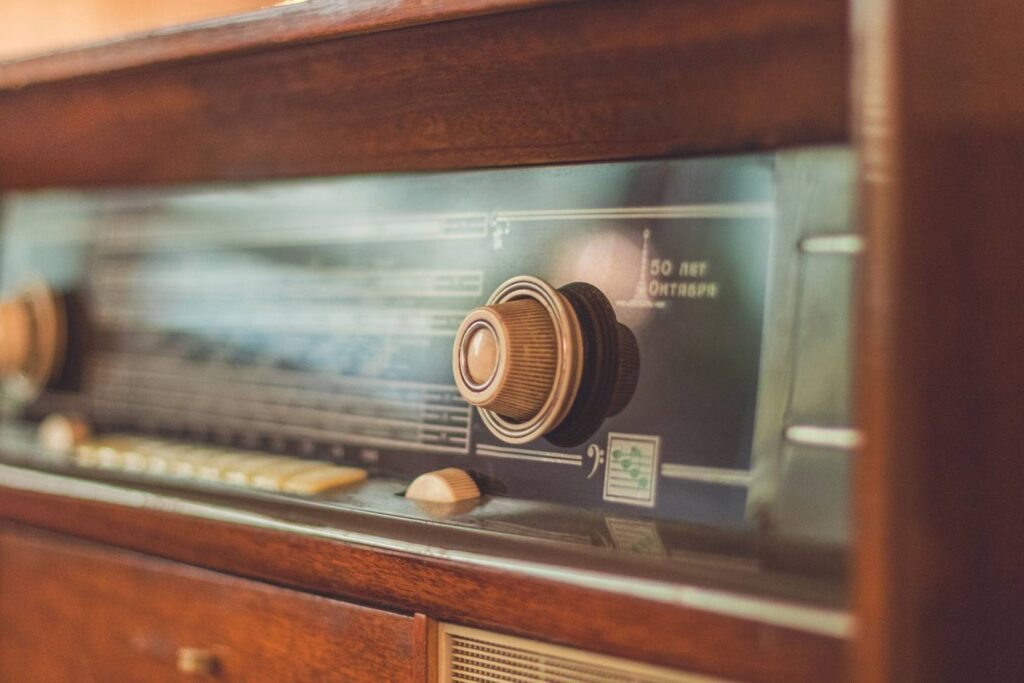
There was a ritual to it. Dinner dishes cleared, the family settled in around the living-room console, someone adjusted the dial until the static thinned and a voice came through clean, and for the next half hour nothing else in the world mattered. From the early 1930s through the mid-1950s, radio wasn’t just entertainment—it was the shared national heartbeat, the thing that made a farm family in Iowa feel connected to a shopkeeper in Brooklyn. The Golden Age of Radio gave us westerns, mysteries, comedies, and at least one broadcast that sent a city into genuine panic.
If you’re of a certain age, you may actually remember gathering around the set as a child, or you might have grown up hearing your parents describe the experience with something close to reverence. Either way, these eight programs shaped American culture in ways that rippled right through television, film, and podcasting. Here they are—not ranked, just celebrated.
The Lone Ranger
Hi-yo, Silver, away!It all started at a small Detroit station called WXYZ, somewhere around January 30, 1933, when a masked rider galloped into living rooms across America to the thundering finale of Rossini’s William Tell Overture. The show’s creators—writer Fran Striker and station owner George Trendle—had no idea they were launching a phenomenon. The Lone Ranger’s hoofbeats were actually produced by a sound-effects crew stamping rubber plungers into a trough of sand, but nobody listening ever doubted for a second that Silver was real.
Over its 22-year run, the program was broadcast 3,268 times and carried by more than 400 stations across the country. Generations of kids pressured their parents for Lone Ranger lunch pails, and the show’s silver bullets became a symbol of justice so potent that even today you can conjure the whole mythology with two words: “Kemo Sabe.”
The Jack Benny Program
Cheapest man on airJack Benny’s radio career began with a guest spot on Ed Sullivan’s fifteen-minute program in 1932, and by the end of the 1934–35 season he was already third in the national ratings. His long-running Sunday 7 p.m. slot—sponsored first by Jell-O, later by Lucky Strike—turned out to be the best half-hour in radio. Between 1934 and 1954 the show ranked number one three different times, and Benny never once fell out of the top five over those two decades.
The genius of the show was character comedy built on a single joke stretched across years: Jack Benny was the vainest, most tight-fisted man alive, perpetually 39 years old, and absolutely terrible at the violin. His cast—announcer Don Wilson, singer Dennis Day, bandleader Phil Harris, and the irreplaceable Rochester—played off his pretensions with such warmth that audiences felt they actually knew these people. You didn’t just tune in to laugh; you tuned in to check in on old friends.
Fibber McGee and Molly
Don't open that closetThe show launched on April 16, 1935, and spent its early years struggling for ratings before something clicked around 1940. Within three years of that turnaround, it was the top-rated program in all of American radio—a sitcom set at 79 Wistful Vista, the home of lovable blowhard Fibber McGee and his sensible, long-suffering wife Molly. The real genius of the format was its consistency: you tuned in every week knowing exactly what was going to happen and wanting it to happen anyway.
The most famous running gag in radio history was the hall closet. Whenever Fibber reached for that door, listeners at home braced themselves—because out would pour an avalanche of junk, a full minute of crashing, clanging, shattering chaos that the sound-effects team had to rebuild every single week. The gag never got old. It ran for more than two decades, and if your grandparents heard the words “Fibber McGee’s closet,” their eyes probably lit up.
Amos ‘n’ Andy
Comedy coast to coastWhen Freeman Gosden and Charles Correll launched Amos ’n’ Andy on Chicago’s WMAQ on March 19, 1928, no one had quite seen anything like it: a serialized nightly comedy following the misadventures of two friends navigating urban life. Within a year NBC was broadcasting it coast to coast, and its popularity reached a pitch that department stores began piping the program through their speakers so shoppers wouldn’t have to go home to hear it.
By 1943 the show had aired more than 4,000 quarter-hour episodes—a staggering run—before reformatting as a half-hour weekly comedy, closer to the sitcom model that television would later perfect. The show’s legacy is genuinely complicated: it drew enormous audiences but relied on racial caricature, and by the television era the NAACP had begun protesting its stereotypes. Still, as a sheer feat of radio storytelling and audience devotion, it remains one of the medium’s defining achievements.
Burns and Allen
The original odd coupleGeorge Burns and Gracie Allen were already a vaudeville sensation when they brought their act to radio in 1934 with a show initially called The Adventures of Gracie. It ran—bouncing between NBC and CBS—until 1950, and for most of that run it was one of the most reliably funny half-hours on the air. The secret was the same as the stage act: George played straight to Gracie’s magnificent illogic, setting up the jokes and then stepping back to let her demolish the setup.
Gracie Allen’s comic persona was built on a kind of inspired wrongheadedness—she took every idiom literally, followed every metaphor off a cliff, and somehow made you feel that the world she described made perfect sense. George’s slow burns and raised eyebrows translated perfectly to audio: you could hear the weariness in his voice, and it was hilarious. When the show moved to television in 1950, they carried the same chemistry effortlessly into the new medium.
The Shadow
Evil lurks—but not for long“Who knows what evil lurks in the hearts of men… The Shadow knows!” That opening line, delivered over a sinister laugh, was enough to make children scramble closer to the radio and adults straighten up in their chairs. The Shadow character first appeared as a radio narrator in 1930, grew into his own pulp magazine series in 1931, and then anchored a weekly drama that premiered on September 26, 1937, on the Mutual Broadcasting System.
For the show’s first year, the role of Lamont Cranston—the wealthy man-about-town with the power to cloud men’s minds—was played by a 22-year-old Orson Welles, with Agnes Moorehead as Margo Lane. Welles left in September 1938, just six weeks before he would terrify another audience with an entirely different broadcast. The Shadow ran for 17 years in total, ending in December 1954, and its legacy lives on in every caped crime-fighter who’s come along since.
The Abbott and Costello Show
Who’s on First?Bud Abbott and Lou Costello broke into radio in 1941 as guests on The Chase and Sanborn Hour, and the audience response was immediate enough that they launched their own weekly program on October 8, 1942, sponsored by Camel cigarettes. The comedy was broad and gleefully physical—which is a strange thing to say about a radio show—but Costello’s baffled squawking and Abbott’s exasperated authority came through the speaker with full force.
The centerpiece of the act was already a legend before the radio show began: the “Who’s on First?” baseball routine, which the duo had honed in vaudeville and which is still widely regarded as one of the greatest comedy bits ever performed. On radio, you couldn’t see the props or the mugging, but you didn’t need to. The rhythm and the escalating confusion were enough to leave listeners helpless. The show moved to ABC in 1947 and kept drawing crowds until well into the early 1950s.
The War of the Worlds
The night radio panicked AmericaOn October 30, 1938—Halloween eve—Orson Welles and his Mercury Theatre on the Air broadcast an adaptation of H. G. Wells’ novel as a series of fake news bulletins, complete with “on-the-scene” reporters breathlessly describing a Martian invasion of New Jersey. Welles was 23 years old. The show had no commercial breaks, which made it feel relentlessly real. The Trenton police department fielded 2,000 calls in under two hours; in Newark, families reportedly fled their homes with wet handkerchiefs over their faces against the imaginary gas.
Historians have since complicated the panic narrative—the hysteria was probably less widespread than early newspaper accounts suggested, and those papers had their own reasons to make radio look dangerous. But the broadcast still stands as radio’s most dramatic single moment: proof that the medium had become so trusted, so vivid in the national imagination, that a 60-minute drama could make millions of people question what was real. Nothing before or since has demonstrated quite so forcefully what a powerful, intimate thing it was to have a voice coming through the living-room speaker.
The Golden Age of Radio ended quietly, crowded out by television through the 1950s, but it never entirely disappeared—you can hear its influence in every podcast, every serialized audio drama, every comedian who learned that silence before the punchline is half the joke. If any of these shows sparked a memory, dig them up: recordings of most survive, and they hold up better than you might expect.
How much do you remember?
3 quick questions from the story above.
Enjoyed that? Play a full trivia quiz:
Play a Entertainment quizFrequently asked questions
Where can I listen to old-time radio shows today?
Many Golden Age radio recordings have been digitized and are freely available through the Internet Archive (archive.org), which hosts thousands of episodes from The Shadow, The Lone Ranger, Jack Benny, and others. The Old Time Radio Researchers Group has also catalogued and preserved a huge library of surviving broadcasts. If you enjoy nostalgia-driven pop culture, you might also enjoy our look at where 10 everyday sayings really come from—some of them trace straight back to this era.
Did the War of the Worlds broadcast really cause mass panic?
The panic was real but probably less widespread than newspapers reported at the time. Early accounts described widespread hysteria, and the Trenton police did receive thousands of calls, but later historians found that many newspaper stories relied on unverified anecdotes and may have exaggerated the chaos to make radio look dangerous. Scholars estimate that only about one in twelve listeners actually believed the Martians had landed. The broadcast’s legendary status says as much about radio’s power and trustworthiness as it does about any real mass panic.
How did radio shows differ from podcasts today?
Golden Age radio shows were produced live or on tight schedules for massive simultaneous audiences—tens of millions of people hearing the same thing at the same moment, which gave them a communal quality modern podcasts rarely match. They were also shaped by sponsors in ways that directly influenced content, with brands like Jell-O and Camel cigarettes embedded into the fabric of shows like Jack Benny. You might be surprised how much of the language and slang from that era stuck around; our piece on everyday phrases that came straight from Shakespeare shows how language layers accumulate across centuries.
Why did the Golden Age of Radio end?
Television, plain and simple. Commercial TV broadcasts resumed in earnest after World War II, and by the early 1950s the major networks were shifting their resources and their biggest stars—including Jack Benny and Burns and Allen—to the new visual medium. Radio reinvented itself as a music and news platform rather than a drama and comedy one, and the great scripted shows faded by the late 1950s. The storytelling instincts never died, though; they live on in everything from prestige drama podcasts to the serialized audio fiction that’s thriving right now.