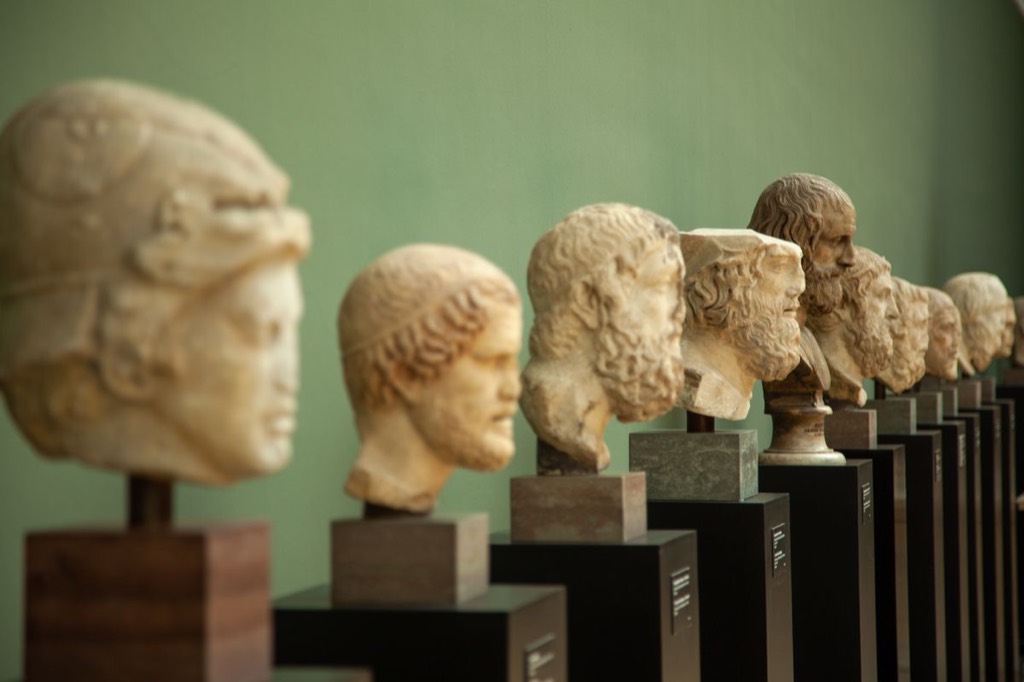
Close your eyes and picture an ancient Greek statue. You almost certainly see gleaming white marble — cool, pale, and pure. It’s the image on every museum poster and in every schoolbook. And it’s wrong.
The statues and temples of the ancient world were originally painted in loud, vivid color: red lips, golden hair, skin tones, patterned robes, bright blue and green backgrounds. The white marble we admire today is not the art the Greeks made. It’s what time left behind.
They were anything but white
To an ancient Greek, an unpainted statue would have looked unfinished. Sculptors and their workshops coated marble figures in paint — eyes, hair, clothing, even eyelashes — and often added details in gold and bronze. Temples were just as colorful, their carved friezes picked out in strong reds, blues, and yellows.
The effect would strike a modern eye as almost gaudy. But to them it was the point: color made the gods and heroes look alive.
How we know
This isn’t a guess. Faint traces of the original pigments still cling to many ancient pieces, invisible in ordinary light but clear under ultraviolet and other kinds of imaging. By studying where the paint wore away and what chemicals remain, researchers can map the original colors surprisingly well.
A German archaeologist named Vinzenz Brinkmann spent years doing exactly that, then built full-color reconstructions of famous statues. His traveling exhibition, “Gods in Color,” has startled museum-goers around the world — many of whom had no idea the marble was ever anything but bare.
The white marble we admire isn’t the art the Greeks made. It’s what time left behind.
Why we forgot
Two things stripped the color away. First, simple time: over two thousand years, exposed to weather and buried in soil, the paint faded and flaked until the marble showed through bare.
Then came a mistake of taste. When these pale statues were dug up during the Renaissance and later, artists and scholars fell in love with the “pure” white stone and decided it was the height of classical elegance. An influential 18th-century writer, Johann Winckelmann, praised whiteness as the ideal of beauty. The colorless look became the model that neoclassical artists copied — and the way we’ve pictured the ancient world ever since.
Seeing antiquity again
Once you know this, the marble halls of a museum look a little different. Those serene white figures were once as bright as a carousel, standing in temples painted like jewel boxes.
It’s a good lesson in how easily we mistake the worn-down version of something for the original — and how a single, elegant wrong idea can last for centuries before the evidence finally catches up with it.