Think about the last time a painting stopped you cold — not because it was technically perfect, but because it made you feel something you couldn’t quite name. That jolt has a history. Over the past six centuries, a handful of artists got so fed up with the rules of their time that they threw them out entirely, and the shock waves from those decisions are still rippling through every gallery, every art class, every Sunday museum visit you’ve ever taken.
These eight movements didn’t just change styles. Each one changed what people thought art was for — whether it should mirror the world exactly, crack it open to show the strange machinery underneath, or simply catch the light on a pond at 7 a.m. on a Tuesday in June. Here’s where those revolutions started and why they still matter.
The Renaissance
Rediscovering what people can beBeginning in Florence in the late 14th century and spreading across Europe through the 16th, the Renaissance — meaning “rebirth” in French — was less a single style than a new way of thinking. Artists and scholars turned back to ancient Greece and Rome, but what they were really after was a fresh account of what it meant to be human. Humanism placed the individual at the center of the story, and painters and sculptors responded by studying anatomy, perspective, and proportion with an almost obsessive intensity.
Leonardo da Vinci captured the idea in the Mona Lisa’s ambiguous half-smile and in the meticulous muscles he drew from cadavers he dissected himself. Michelangelo put it in marble with the David and onto the Sistine Chapel ceiling. Raphael brought a calm, almost weightless grace to the whole project. The technique of linear perspective — giving flat surfaces the illusion of depth — was so new that some viewers reportedly stepped back from the walls, not quite sure the archways they saw were painted.
Baroque
Drama, shadow, and raw nerveFrom roughly the 1580s into the early 1700s, the Baroque era turned the calm grandeur of the Renaissance inside out. Where Renaissance painters favored symmetry and serenity, Baroque artists leaned into turbulence. Caravaggio — who may have killed a man in a street brawl and painted saints who looked like dirty-footed peasants — developed a technique called tenebrism: figures wrenched from near-total darkness by a single harsh beam of light. The emotional effect was and still is stunning.
Gian Lorenzo Bernini brought the same intensity to sculpture. His Ecstasy of Saint Teresa (1651) captures a religious vision with the physical immediacy of a moment caught on camera. The Catholic Church commissioned much of the Baroque era’s work to counter the Protestant Reformation — art as persuasion, meant to make faith feel visceral and immediate. “Baroque” was originally a derogatory term, suggesting bloated excess. It didn’t stick that way.
Romanticism
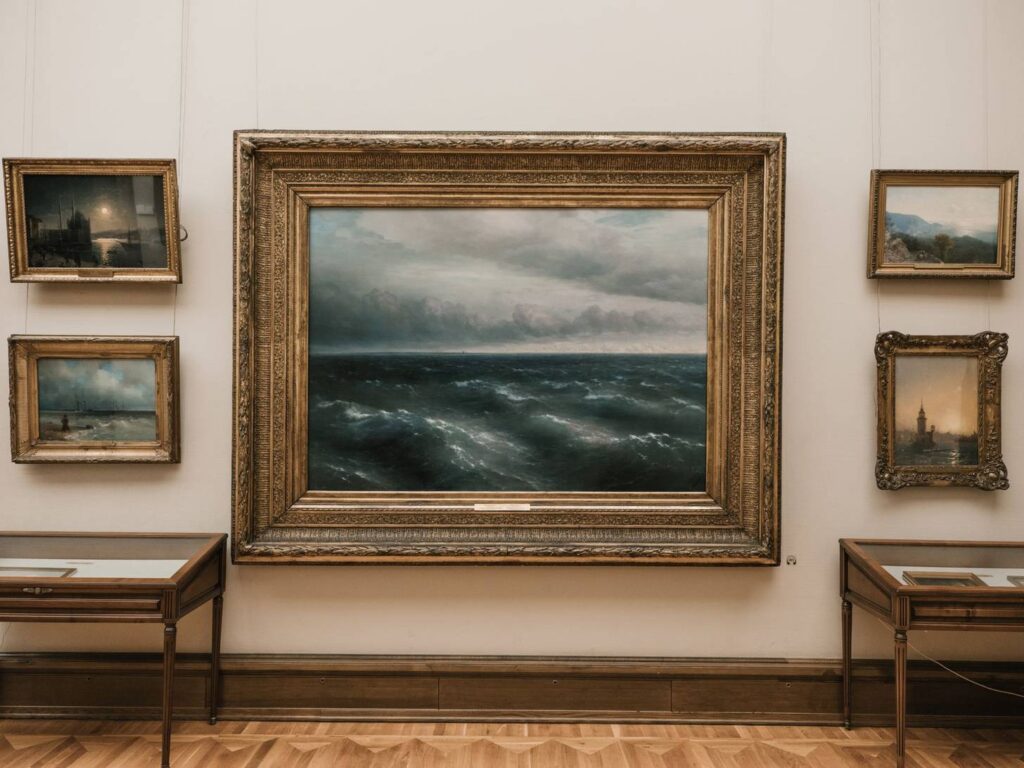
When feeling beat reasonBy the late 18th century, the Enlightenment’s faith in reason and order was running headlong into the Industrial Revolution’s smoke-belching reality, and a generation of artists had had enough. Romanticism — which flourished from roughly the 1780s through the 1850s — put emotion, individuality, and the raw power of nature at the center of everything. These painters weren’t interested in a well-lit drawing room; they wanted storms, shipwrecks, and mountain passes at dusk.
The English painter J.M.W. Turner practically dissolved his subjects in light and mist, depicting ships in a way that felt less like a scene and more like a sensation. Eugène Delacroix, in France, brought violent color and motion to historical and mythological scenes, his brushwork so loose that academic critics called it sloppy. Edmund Burke’s 1757 essay on “the sublime” — the idea that grandeur and terror together produce a uniquely powerful feeling — gave Romantic painters their philosophical foundation. They were trying to overwhelm you, deliberately.
Impressionism
Painting light, not objectsIn April 1874, about 30 artists staged an independent exhibition in a Paris photography studio as a deliberate rebuke to the official Salon, which had been rejecting their work. Critics hated it. One mocked Claude Monet’s Impression, Sunrise by calling the whole group “Impressionists” — meaning their paintings were nothing more than rough sketches. The artists kept the name. The movement officially began with that insult.
What Monet, Renoir, Degas, Pissarro, and their collaborators were actually doing was radical: instead of using outlines, they built form from dabs of color. Instead of painting in studios, they carried their canvases outside, chasing the way light changes minute to minute on water and leaves and laundry on a line. The portable paint tube — invented in 1841 — had finally made this practical. The question they were asking was simple and disruptive: what if you painted what your eye actually sees, not what you know is there?
Cubism
Every angle, all at onceIn 1907, Pablo Picasso finished a painting that almost no one who saw it liked, including his closest friends. Les Demoiselles d’Avignon showed five figures whose bodies were fractured and rearranged — faces seen simultaneously from the front and the side, limbs at impossible angles. Working alongside Georges Braque over the following years, Picasso developed this into Cubism: the first art movement to abandon the Renaissance idea that a painting should imitate a single viewpoint in a single frozen moment.
In its Analytical phase (roughly 1909–11), the palette went nearly monochrome — brown, grey, ochre — so that the fragmentation of form would be the only subject. In its Synthetic phase (1912 onward), Braque and Picasso introduced collage, gluing newspaper clippings and wallpaper onto canvas. Historians have called Cubism the most significant movement of the 20th century. It influenced architecture, literature, and music. It did not, as the jokes sometimes go, make it easier to lose your keys.
Surrealism
Dreams made visibleIn 1924, the French poet André Breton published the Manifesto of Surrealism, calling for art that bypassed rational thought entirely and tapped the unconscious mind. Breton had been deeply influenced by Sigmund Freud’s theories about dreams, and he believed that the irrational images the sleeping mind produced were more truthful than anything the waking, censoring intellect could create. Surrealism began as a literary movement but quickly drew in visual artists for whom Freud’s dreamscapes were simply too good to pass up.
Salvador Dalí’s The Persistence of Memory (1931) — those melting watches draped over a landscape as still and hot as a hallucination — is the movement’s most recognized image. René Magritte preferred quiet philosophical puzzles: The Treachery of Images (1929) shows a pipe with the caption “This is not a pipe,” because it isn’t — it’s a painting of one. Surrealism spread beyond galleries into film, fashion, and advertising, where its fingerprints are still all over the place.
Abstract Expressionism
America finds its own voiceAfter World War II, New York replaced Paris as the world’s center of modern art — and the movement responsible for that shift was Abstract Expressionism. Emerging in the late 1940s, it was the first major art movement born in America. Critic Robert Coates coined the term in 1945. Its artists — Jackson Pollock, Willem de Kooning, Franz Kline, Mark Rothko, Barnett Newman — had survived the Depression and the war, and their paintings carried the emotional charge of all of it, with none of the reassuring imagery.
Pollock’s drip paintings, made by pouring and flinging paint onto canvas laid on his studio floor, looked to many people like chaos. But they weren’t random: every gesture was an act of physical engagement between the painter and the surface. De Kooning kept a foothold in the figure even as he dismantled it, his brushwork violent and tender at once. Rothko’s floating rectangles of color — soft-edged, almost breathing — were meant to produce in viewers the kind of wordless emotional state usually associated with music or prayer. A lot of people have stood in front of one and cried. A lot of people are surprised by that.
Pop Art
The supermarket as museumBy the late 1950s, a generation of artists in the United States and Britain had grown up in a world of television commercials, movie magazines, comic books, and supermarket shelves stacked with brightly labeled cans — and they saw no reason why that world should be off-limits to serious art. Pop Art looked at consumer culture with an eye that was at once adoring and slightly cold. Andy Warhol silk-screened Campbell’s soup cans and Marilyn Monroe’s face with the same flat, repetitive process used to print product packaging. Was that a compliment or a critique? He never said.
Roy Lichtenstein borrowed the visual language of comic strips wholesale, painting his images in bold black outlines and the Ben-Day dots used in commercial printing. He was initially attacked for “mere copying.” The debate — is reproducing a mass-market image art? — was exactly the point. Pop Art collapsed the distance between high culture and low, between the museum and the grocery store, in a way that genuinely unsettled critics who had carefully maintained that distance. It also turned out to be commercially brilliant, which some found fitting and others found deeply uncomfortable.
What connects all eight of these movements is not a shared style or a common answer but a shared impatience: with the rules they inherited, with what was supposed to count as beautiful, with the limits of what art was allowed to do. If you’ve ever felt a painting hit you somewhere you didn’t expect, that’s the residue of someone else’s old argument, still doing its work.
How much do you remember?
3 quick questions from the story above.
Enjoyed that? Play a full trivia quiz:
Play a Art quizFrequently asked questions
What is the most expensive art movement in terms of auction prices?
Impressionist and Post-Impressionist works have historically dominated the top of the auction market, with paintings by Monet, Renoir, and their contemporaries regularly fetching hundreds of millions of dollars. Modern movements like Abstract Expressionism also command staggering prices. For a look at specific records, see 8 Record-Breaking Artworks and the Wild Prices They Fetched.
Are there famous artworks from these movements that were lost and later found?
Yes — art history is full of works that disappeared into private collections, wartime looting, or simple misattribution before surfacing decades later. Impressionist and Renaissance paintings are among the most frequently recovered. 8 Famous Artworks That Were Lost and Found Again covers some of the most dramatic recoveries.
Do famous paintings from these movements have hidden details most viewers miss?
Absolutely. Renaissance masters in particular loaded their works with symbolic detail, hidden figures, and visual jokes that weren't meant to be spotted at first glance. Baroque painters used shadow and light to conceal as much as they revealed. The Hidden Details Most People Miss in 6 Famous Paintings walks through some of the best examples.
Which of these movements sparked the most controversy when it first appeared?
Most of them did, in their own time. Caravaggio’s naturalistic saints scandalized the Church. The 1874 Impressionist exhibition was met with ridicule by critics. Pop Art was attacked for elevating commercial imagery into gallery spaces. Why Is It Art? 7 Works That Sparked Huge Debates explores how fiercely audiences have resisted art that challenged their expectations.