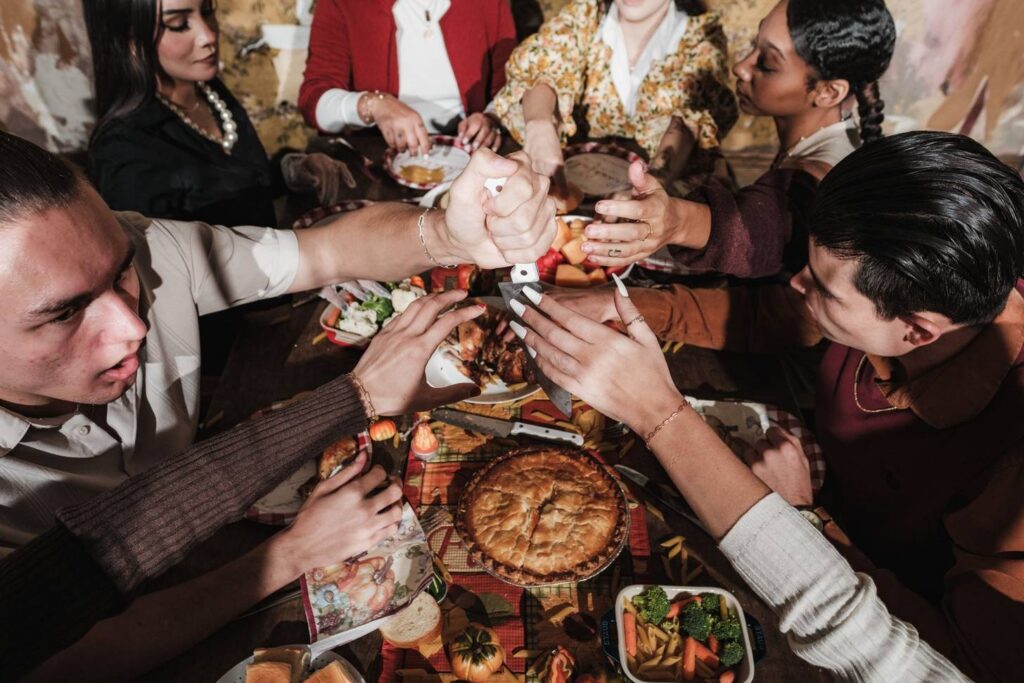
Every time you bite into a slice of apple pie or watch someone blow out birthday candles, you’re participating in a ritual with roots far stranger—and far older—than you might expect. American food traditions have a way of feeling timeless, as if they sprang fully formed from our national identity. But peel back the story, and you’ll almost always find a surprise waiting: a Depression-era marketing campaign, a Japanese immigrant in San Francisco, a Girl Scout handbook from 1927.
These eight traditions are so woven into everyday American life that most of us have stopped wondering where they came from. Pull up a chair. The real histories are better than the myths.
Thanksgiving Turkey
Lincoln changed everythingYou probably learned that the Pilgrims and Wampanoag people sat down together in 1621 and feasted on turkey. That part is mostly myth—the actual records mention “fowl,” which historians believe was more likely ducks or geese. What’s more, Thanksgiving wasn’t even a national holiday until Abraham Lincoln made it one in October 1863, right in the middle of the Civil War, partly as a gesture of national unity in a fractured country.
The turkey’s rise to centerpiece status is a story of practicality layered over symbolism. By the 19th century, chickens were too valuable to slaughter—they laid eggs—while beef was a year-round staple. Turkeys, raised specifically for meat, made economic sense for a big autumn feast. Sarah Josepha Hale, the woman who lobbied Lincoln for 17 years to make Thanksgiving a national holiday, also published turkey-heavy menus in her influential magazine, quietly cementing the bird’s place at the American table.
Apple Pie
Born in England, actually“As American as apple pie” is one of the great national self-deceptions. The earliest known apple pie recipe dates to 14th-century England—long before Europeans set foot in the Americas. That 1381 recipe didn’t even have sugar; it called for apples, raisins, figs, pears, and saffron packed into a pastry shell. The dish crossed the Atlantic with the first settlers, and Amelia Simmons included two apple pie recipes in American Cookery—the first cookbook written by an American, published in 1796.
The patriotic phrase itself is a 20th-century invention. It gained real traction during World War II, when American soldiers asked why they were fighting reportedly said “for mom and apple pie.” Advertisers pounced, and a borrowed British recipe became an American icon. The pie had been here for generations, of course—but calling it purely American required forgetting the English recipe books that made the voyage across the Atlantic first.
Green Bean Casserole
A Campbell’s invention, 1955Few dishes say “home cooking” more than green bean casserole—and yet it was invented in a corporate test kitchen. In 1955, a home economist named Dorcas Reilly was working at Campbell’s Soup Company in Camden, New Jersey, tasked with creating a quick, affordable recipe using two pantry staples: canned green beans and cream of mushroom soup. The whole thing came together in under an hour, topped with French’s fried onions for crunch.
The dish found its audience when Campbell’s began printing the recipe on its soup cans in the early 1960s. By the time most of us were growing up, it had acquired the warm aura of something grandmothers had always made. In 2002, Reilly donated the original handwritten index card recipe to the National Inventors Hall of Fame in Akron, Ohio. Today Campbell’s estimates that Americans make roughly 20 million green bean casseroles every Thanksgiving—all from a recipe that is barely 70 years old.
Fortune Cookies
Japan via San FranciscoWalk into any Chinese-American restaurant after a meal and you’ll be handed a fortune cookie—a custom so firmly associated with Chinese food that most diners never question it. Food historians have, and what they found is striking: the fortune cookie was almost certainly invented by Japanese Americans in California in the early 20th century, adapted from a cracker called tsujiura senbei sold at Shinto shrines in Japan. The cookie had nothing to do with China.
The most prominent origin story centers on Makoto Hagiwara, who managed the Japanese Tea Garden in San Francisco’s Golden Gate Park. He is widely credited with serving visitors a version of the cookie with small notes inside, beginning around 1914. A competing claim points to David Jung, a Chinese immigrant in Los Angeles. However the argument lands, the cookie’s Chinese-restaurant connection came after World War II: when Japanese-American businesses were shuttered during internment, Chinese-owned manufacturers stepped in to fill demand, and the fortune cookie quietly became “Chinese” in the American imagination.
Hot Dogs at the Ballpark
Charles Feltman started itThe beloved story goes like this: on a cold April day in 1901, concessions man Harry M. Stevens couldn’t sell ice cream at New York’s Polo Grounds, so he sent runners out for frankfurters and rolls and started shouting, “Get your red-hot dachshund sausages!” A cartoonist in the press box coined the term “hot dog” on the spot because he couldn’t spell “dachshund.” It’s a great story. It is also, historians say, largely a legend.
The word “hot dog” appeared in print at least six years before 1901. The cartoonist cited, Tad Dorgan, didn’t arrive in New York until 1903, and no one has ever found the cartoon in question. The more credible origin of the ballpark frankfurter belongs to Charles Feltman, a Coney Island pie vendor who began serving warm sausages in rolls around 1867. Stevens was a genuine innovator as a concessionaire—credited with creating the modern scorecard and popularizing peanuts at games—but the hot dog was already at the ballpark before he arrived.
S’mores
Girl Scouts, 1927If summer evenings for you ever meant a campfire and a long stick, s’mores probably hold a particular place in your memory. The recipe—toasted marshmallow and a square of chocolate sandwiched between graham crackers—first appeared in print in a 1927 Girl Scouts publication called Tramping and Trailing with the Girl Scouts, attributed to a Loretta Scott Crew. National Geographic’s reporting notes that earlier newspaper accounts from 1925 reference a treat called “some-mores” appearing around campfires in Alabama and elsewhere, suggesting the combination was already in circulation before anyone wrote it down.
The contraction “s’mores” itself—short for “some more”—didn’t appear in print until a 1938 camp guidebook. But the Girl Scouts publication gave the recipe national reach, and the name eventually stuck everywhere campfires burned. There is something fitting about a snack built around the desire for one more: s’mores became an American tradition precisely because nobody ever wants just one.
The BLT Sandwich
Postwar supermarkets made itFew sandwiches feel more specifically American than the bacon, lettuce, and tomato, and in fairness, America did make it what it is today. The earliest known recipe resembling a BLT appears in a 1903 Good Housekeeping cookbook, embedded in a club sandwich with turkey. Tea rooms and hotel menus carried versions throughout the early 1900s, but the BLT as a named, standalone thing—crisp bacon, ripe tomato, cool lettuce, a swipe of mayonnaise—hadn’t quite arrived yet.
What turned it into an everyday lunch-counter staple was the postwar supermarket boom. Fresh tomatoes became available year-round, sliced bread was cheap, and strips of bacon could be fried up in minutes. The abbreviation “BLT” emerged as diner shorthand; Merriam-Webster places it in print by 1950. The genius of the sandwich is its simplicity—three ingredients that taste better together than alone—but it took modern supply chains to make that simple pleasure available to everyone, every day of the year.
Birthday Cake with Candles
A German tradition, 18th centuryEvery birthday song ends the same way: dim the lights, carry the cake, make a wish, and blow. It’s so universal that it feels ancient—and in a sense it is, though the tradition is German rather than American. In 18th-century Germany, children’s birthday celebrations called Kinderfest featured cakes lit with candles, one for each year of the child’s life plus an extra for good luck. A well-documented milestone is Count Ludwig von Zinzendorf’s 1746 birthday, at which a cake with candles matching his age was a centerpiece of the celebration.
The protective symbolism ran deep. According to National Geographic, German folklore held that children were especially vulnerable to evil spirits on their birthdays, and the candles served as a kind of spiritual shield—their light keeping darkness at bay. The wish-making element, with its emphasis on secrecy, developed alongside that protective ritual; a whispered wish was thought more likely to come true. German immigrants carried the custom to America, where it blended with 19th-century commercial baking and became the ritual you know… just with more frosting.
Next time you sit down to a meal that feels purely, instinctively American—the turkey, the casserole, the birthday cake, the ballpark frank—remember that every one of those traditions arrived from somewhere else, was shaped by someone specific, and became “traditional” only through decades of repetition. That’s not a diminishment. If anything, it makes the food taste richer: knowing these dishes are borrowed, adapted, and made our own is part of what being American has always meant.
Frequently asked questions
Why do we eat turkey on Thanksgiving?
Turkey became the Thanksgiving centerpiece through a mix of practicality and cultural reinforcement. By the 19th century, chickens were kept for their eggs while turkeys were raised specifically for meat, making them a sensible choice for a feast. Writer Sarah Josepha Hale, who lobbied Abraham Lincoln to make Thanksgiving a national holiday, published turkey-centered Thanksgiving menus in her magazine, locking in the tradition. For more on how everyday customs got their surprising starts, see our piece on 8 everyday customs and where they really come from.
Did fortune cookies really originate in China?
No — fortune cookies are a Japanese-American invention, not Chinese. Food historians trace them to California in the early 20th century, likely adapted from a Japanese shrine cracker called tsujiura senbei. The cookies became associated with Chinese restaurants after World War II, when Japanese-American businesses were shuttered during internment and Chinese manufacturers filled the demand. It’s one of many cases where a food’s perceived origin was shaped more by circumstance than by authentic history.
What is the true origin of “as American as apple pie”?
The phrase gained wide currency during World War II as a patriotic shorthand, but apple pie recipes date to 14th-century England — long before European colonists arrived in America. Settlers brought the recipe across the Atlantic, and it appeared in the first American-authored cookbook in 1796. The idea of calling it quintessentially American came much later. Language and food share a lot of borrowed history; explore more in our piece on everyday phrases that came from unexpected places.
When were s’mores first named and recorded?
The first printed recipe for s’mores appeared in a 1927 Girl Scouts guidebook called Tramping and Trailing with the Girl Scouts. Newspaper accounts from 1925 suggest the treat was already circulating at American campfires under the name “some-mores.” The shortened contraction “s’mores” appeared in print in a 1938 camp guidebook. The Girl Scouts publication gave the recipe national reach and helped transform a casual campfire snack into an enduring American tradition.
Sources
How much do you remember?
3 quick questions from the story above.
Enjoyed that? Play a full trivia quiz:
Play a General quiz