You’ve probably stood in a gallery, looked at something on the wall — a plain black square, a can of soup, a splatter that could have happened by accident — and thought, quietly, “I could have done that.” You’re not alone, and you’re not wrong to ask the question. For more than a century, some of the most famous works in modern art have been the ones that made people stop and demand: is this even art at all?
The interesting part isn’t the outrage. It’s what the outrage was actually about. Each of these works picked a fight with an assumption — that art has to be beautiful, or handmade, or serious, or permanent — and the argument it started is often more valuable than the object itself. Here are seven works that sparked huge debates, and why the fights were worth having.
Fountain — Marcel Duchamp
A urinal, signed and datedIn 1917 Marcel Duchamp bought a standard porcelain urinal, turned it on its back, signed it “R. Mutt,” and submitted it to a New York exhibition that had promised to show anything an artist sent in. The committee, faced with a piece of plumbing, quietly refused to display it. The original was lost almost immediately, surviving mainly through a photograph.
Duchamp’s point was deliberately provocative: the artist’s real act was choosing the object and asking you to look at it differently, not crafting it by hand. Critics called it a tasteless joke; others saw the birth of conceptual art. Either way, “Fountain” forced a question the art world has never fully closed — does an idea count as art, even when the artist made nothing?
Campbell’s Soup Cans — Andy Warhol
Thirty-two cans, one per flavorWhen Andy Warhol showed thirty-two canvases of Campbell’s soup cans in 1962 — one for each variety the company then sold — a Los Angeles gallery down the street mocked the show by stacking real cans in its window at a discount. To a lot of viewers, painting a grocery-store label looked like a con, or a shrug at the whole idea of fine art.
That was rather the point. Warhol was holding a mirror up to a culture soaked in advertising and mass production, asking why a soup can shouldn’t be as worthy a subject as a bowl of fruit. Pop art divided people sharply, but it made the debate impossible to ignore: in an age of supermarkets and billboards, what deserves to be looked at?
Autumn Rhythm and the Drip Paintings — Jackson Pollock
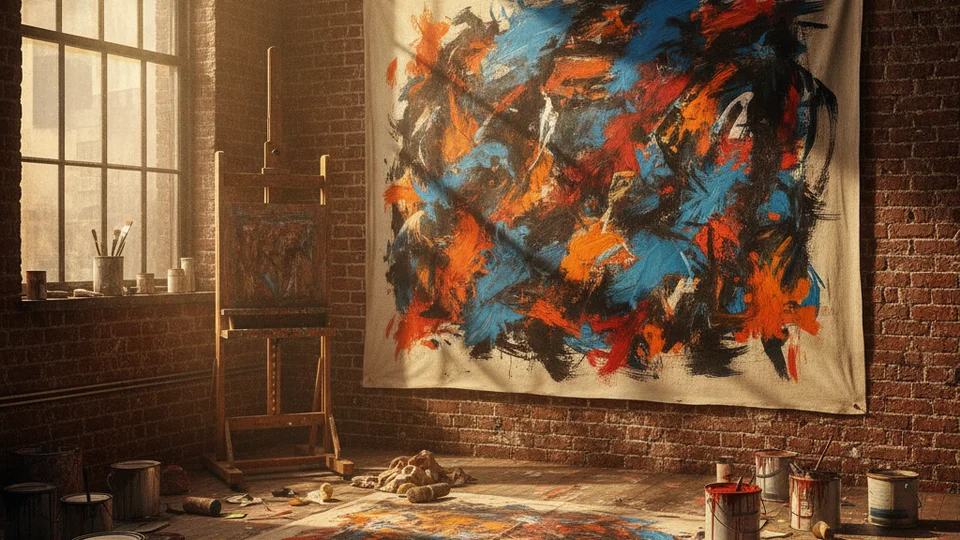
Paint flung from aboveJackson Pollock laid huge canvases on the floor and moved around them, dripping and flinging house paint from sticks and hardened brushes. A 1949 magazine spread asked, half seriously, whether he was “the greatest living painter in the United States,” and plenty of readers scoffed. The tabloid nickname “Jack the Dripper” stuck for a reason.
The complaint was simple: where’s the skill, if it’s just splatter? Look closely, though, and the drips are anything but random — they build dense, rhythmic webs, layer over layer, that reward the eye the longer you stay. Pollock made the act of painting itself the subject, and whether that thrills you or leaves you cold is a question people still argue over in front of the canvases.
The Physical Impossibility of Death in the Mind of Someone Living — Damien Hirst
A shark in a tankIn 1991 Damien Hirst suspended a fourteen-foot tiger shark in a glass tank of formaldehyde. It became one of the defining images of the Young British Artists, and one of the most argued-over: was this sculpture, taxidermy, or an expensive stunt? A British tabloid famously summed up the doubters with the headline “50,000 pounds for fish without chips.”
Hirst’s defenders pointed to the title and the feeling the piece produces — standing before a real predator, preserved but unmistakably dead, is a genuine confrontation with mortality. When the original shark deteriorated and had to be replaced, it reopened an old question: if you swap the parts, is it still the same artwork? The debate is arguably part of the work.
Each of these works picked a fight with an assumption — that art has to be beautiful, or handmade, or serious — and the argument it started is often more valuable than the object itself.
My Bed — Tracey Emin
An unmade bed, exactly as it wasTracey Emin’s “My Bed,” shortlisted for the Turner Prize in 1999, was precisely what it sounds like: her own bed, unmade, surrounded by the debris of a low period — rumpled sheets, empty bottles, cigarette packets, stained clothes. Some visitors were appalled; two performance artists once jumped on it in protest, and headlines demanded to know how a messy bedroom could be art.
Emin’s answer was that the honesty was the point. The bed was a raw, unflinching self-portrait of depression and survival, presented without cleanup or apology. You can find it self-indulgent or bracingly truthful — but the discomfort it stirs up is exactly what confessional art is trying to reach.
Love Is in the Bin — Banksy
The painting that shredded itselfAt a London auction in 2018, Banksy’s “Girl with Balloon” sold for just over a million pounds — and the instant the hammer fell, a shredder hidden in the frame whirred to life and fed the canvas halfway through its own blades. The room gasped. Banksy had rigged the frame in advance, aiming to destroy the work at the moment it became a commodity.
The twist: the half-shredded piece, renamed “Love Is in the Bin,” was judged more valuable than before, and it later resold for many times the original price. Was it a sincere protest against the art market, or a brilliant piece of marketing that the market simply absorbed? That knot — you can’t tell where the critique ends and the spectacle begins — is what keeps people talking.
Comedian — Maurizio Cattelan
A banana taped to a wallAt an art fair in 2019, Maurizio Cattelan presented “Comedian”: a fresh banana fixed to the wall with a strip of silver duct tape. Editions of it sold for six figures, the crowds grew so large the piece was removed, and at least twice a visitor simply peeled the banana off and ate it. The internet had a field day, and “it’s just a banana” became the rallying cry of the skeptics.
What buyers actually purchased wasn’t the fruit — it was a certificate and instructions to replace the banana as it rots. That’s the joke and the argument rolled into one: Cattelan was needling the absurd machinery of art-world value, and the frenzy proved his point better than the banana ever could. Whether that makes it clever or empty is, fittingly, up to you.
Notice what these seven have in common. Not one of them is really asking you to admire a beautiful object. They’re asking you to argue — about what art is for, who gets to decide, and whether a thing’s meaning can outweigh the skill that went into making it. You’re allowed to walk away unconvinced. But the fact that a urinal or a banana can still start that conversation, decades on, might be the most artful thing about them.
Frequently asked questions
Why is a urinal considered art?
In 1917 Marcel Duchamp took an ordinary porcelain urinal, signed it “R. Mutt,” and submitted it as a sculpture called Fountain. His argument was that the artist’s real act was choosing the object and asking you to see it differently, not making it by hand. That idea is widely credited with launching conceptual art, and it forced a question the art world has never fully settled: can an idea alone count as art?
What was Andy Warhol trying to say with his Campbell’s Soup Cans?
Warhol showed thirty-two canvases in 1962, one for each soup variety the company then sold, holding a mirror up to a culture soaked in advertising and mass production. He was asking why a grocery-store label shouldn’t be as worthy a subject as a bowl of fruit. The work divided viewers sharply but made Pop art’s central debate impossible to ignore.
Why did Banksy’s painting shred itself at auction?
When Girl with Balloon sold for just over a million pounds in 2018, a shredder Banksy had hidden in the frame fed the canvas halfway through its own blades the instant the hammer fell. The aim was to destroy the work at the moment it became a commodity, a protest against the art market. Renamed Love Is in the Bin, the half-shredded piece was later judged more valuable and resold for many times the original price.
Why do people say “it’s just a banana” about Maurizio Cattelan’s Comedian?
At a 2019 art fair Cattelan taped a fresh banana to the wall and sold editions of it for six figures, prompting skeptics to dismiss the whole thing. But buyers weren’t purchasing the fruit — they got a certificate and instructions to replace the banana as it rots. Cattelan was needling the absurd machinery of art-world value, and the online frenzy arguably proved his point better than the banana itself.
Sources
How much do you remember?
3 quick questions from the story above.
Enjoyed that? Play a full trivia quiz:
Play a Art quiz