Some buildings you recognize before you can name them — a domed silhouette against the sky, a jagged spire, a wall of golden stone. We put them on stamps and screensavers and bucket lists, and somewhere along the way they stop being buildings at all and turn into logos for whole countries. But every one of them was built by real people, for real reasons, and most carry a story that’s stranger or sadder or more human than the postcard lets on.
Here are eight of the world’s most beautiful buildings, with the architect or era behind each and the tale worth remembering. A few of these are documented fact; one or two have picked up a coat of legend over the years — and we’ll tell you which is which.
The Taj Mahal
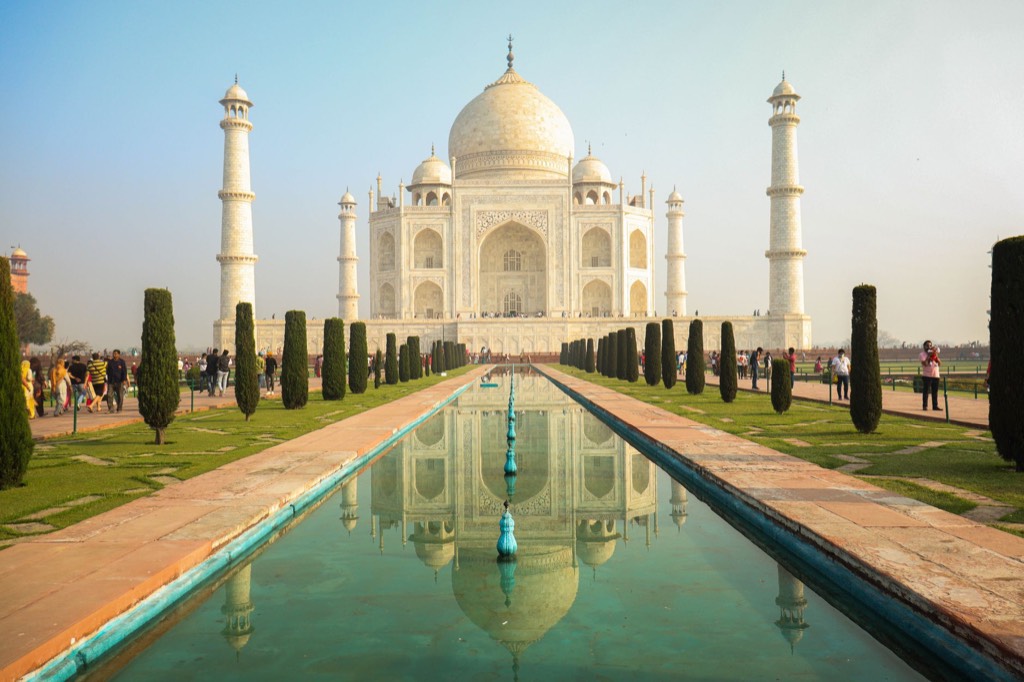
Agra, IndiaWe tend to file the Taj Mahal under “palace,” but it’s a tomb. The Mughal emperor Shah Jahan built it in the mid-1600s for his wife Mumtaz Mahal, who died giving birth to their fourteenth child. Grief on that scale doesn’t usually leave a monument this composed — a perfectly symmetrical dome of white marble that seems to change color with the light, pale at dawn, golden at dusk.
You’ve probably heard that Shah Jahan planned a mirror-image tomb in black marble for himself across the river. It’s a wonderful story, and almost certainly a myth — there’s no solid evidence for it, and the “black Taj” ruins turned out to be a discolored white marble pool. What’s true is quieter and sadder: Shah Jahan was deposed by his own son and spent his final years under house arrest, reportedly gazing at his wife’s tomb from a distance.
The Sagrada Família
Barcelona, SpainAntoni Gaudí took over this Barcelona basilica in 1883 and spent the last 43 years of his life on it, growing so devoted that he eventually moved into his workshop on site. He knew he’d never see it finished. “My client,” he liked to say, “is not in a hurry” — meaning God. When he died in 1926, hit by a tram, he was carrying so little that he was mistaken for a pauper and nearly turned away from the hospital.
It’s still not done. More than a century after Gaudí’s death, cranes rise over the spires and crews are still building toward his design, funded largely by the millions of visitors who file through each year. That makes it one of the longest-running construction projects on Earth — a cathedral begun before the automobile that may be completed in the age of the smartphone.
The Sydney Opera House
Sydney, AustraliaIts sail-like shells are so iconic now that it’s easy to forget the building nearly destroyed the man who designed it. In 1957 a little-known Danish architect named Jørn Utzon won an international competition — the story goes his entry had been pulled from a reject pile by one of the judges. His radical vision was gorgeous and, as it turned out, fiendishly hard to actually build.
The budget ballooned from an estimated 7 million Australian pounds to over 100 million, and the timeline stretched for years. Amid political pressure and public feuding, Utzon resigned in 1966 and left Australia, never returning to see it completed. The building opened in 1973 to worldwide acclaim; its architect watched from the other side of the planet.
St. Basil’s Cathedral
Moscow, RussiaThe swirl of candy-colored onion domes on the edge of Red Square was built for Ivan the Terrible in the 1550s to mark a military victory. There’s no other building quite like it — nine chapels bundled into one riotous, asymmetrical bloom of color that looks less designed than dreamed.
And then there’s the legend. Ivan, the tale goes, was so dazzled by the finished cathedral that he had the architect blinded so he could never create anything to match it. It’s a chilling story that fits Ivan’s reputation perfectly — which is probably why it has survived. Historians consider it almost certainly untrue; there’s no reliable record of it, and the man often credited with the design appears to have kept working afterward. A great story, but treat it as folklore.
The Guggenheim Bilbao
Bilbao, SpainThe youngest building on this list, opened in 1997, and proof that new architecture can still stop you cold. Frank Gehry’s museum is a heaving mass of titanium curves that catch the light like fish scales, sitting on the riverfront of a Spanish industrial city most tourists had never thought to visit.
Then something remarkable happened. Bilbao had been a declining port town, and the museum drew such a flood of visitors that it single-handedly revived the local economy. Urban planners now talk about “the Bilbao effect” — the idea that one spectacular building can put a whole city back on the map. Very few pieces of architecture get a phenomenon named after them.
They were built by real people, for real reasons — and most carry a story stranger or sadder than the postcard lets on.
The Colosseum
Rome, ItalyNearly two thousand years old and still one of the most recognizable buildings on the planet. Rome’s great amphitheater was completed around AD 80 under the emperor Titus, an engineering marvel that could hold tens of thousands of spectators and, by some accounts, even be flooded to stage mock naval battles.
The reason it looks half-eaten today isn’t just time. For centuries after the fall of Rome, the Colosseum was treated as a giant quarry — locals hauled off its marble and stone to build palaces and churches, including parts of St. Peter’s Basilica. The gaps in its walls are, in a sense, scattered across the rest of the city.
Neuschwanstein Castle
Bavaria, GermanyThe fairy-tale castle on a Bavarian crag was commissioned in the 1860s by King Ludwig II, a reclusive monarch obsessed with the operas of Richard Wagner and with an idealized, storybook version of the Middle Ages. It looks ancient, but it’s a 19th-century fantasy, fitted with then-modern touches like running water and central heating.
Ludwig nearly bankrupted himself building his dream and was declared insane and removed from power; he died mysteriously days later, and the castle he’d built as a private refuge was opened to the paying public within weeks. Its most famous legacy came later: it helped inspire the Sleeping Beauty castle at Disneyland, which is why it looks so uncannily like a place you’ve already been.
Petra
Ma'an Governorate, JordanNot built so much as carved. Two thousand years ago the Nabataeans, a wealthy Arab trading people, cut an entire city directly into rose-colored sandstone cliffs in what is now southern Jordan — temples, tombs, and the towering facade of the Treasury, all sculpted from the living rock.
Petra was a thriving hub for centuries, then slowly faded as trade routes shifted, until it was largely unknown to the outside world for around a thousand years — remembered only by local Bedouin. A Swiss explorer, disguised as a traveler, reached it in 1812 and reintroduced it to Europe. If the Treasury’s facade looks familiar, that may be because it played the resting place of the Holy Grail in Indiana Jones and the Last Crusade.
What ties these eight together isn’t just that they’re beautiful. It’s that beauty was almost never the whole point. They were built out of grief, or devotion, or vanity, or civic ambition — and then quarried, abandoned, mythologized, or reborn by the centuries that followed. Look a little longer at the building everyone recognizes, and it almost always has a story it hasn’t finished telling.
Sources
How much do you remember?
3 quick questions from the story above.
Enjoyed that? Play a full trivia quiz:
Play a Art quiz