You’ve seen these statues a hundred times — on postcards, in textbooks, glowing on a screen behind a museum caption. They’re so familiar that you probably stopped really looking at them years ago. But every one of them is hiding something: a strange origin, a stubborn mystery, or a story that turns out to be better than the polished version you were handed.
Here are eight of the most famous statues in the world, and the secrets behind them. A couple of these are solid fact, a couple are the kind of tale that’s grown taller with each retelling — and we’ll be honest about which is which.
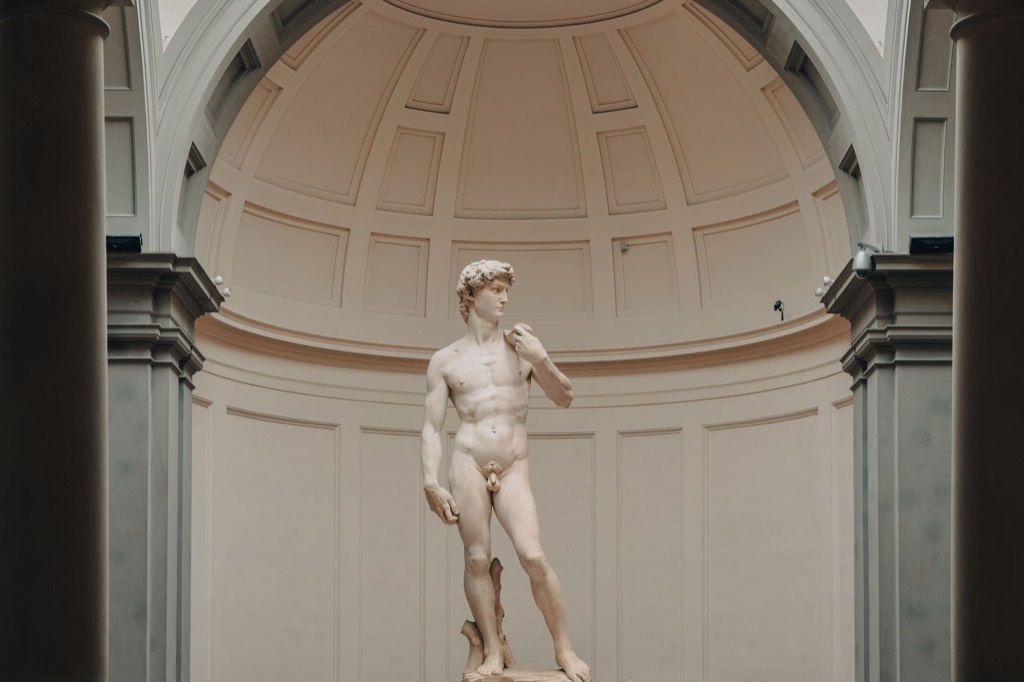
Michelangelo’s David
Carved from a rejectThe most admired figure in Western art was cut from a block of marble nobody else wanted. The slab had been quarried decades earlier and knocked about by two previous sculptors who gave up on it, leaving it scarred and, everyone assumed, ruined. It sat outside in a cathedral workyard for years, exposed to the weather, nicknamed “the Giant.”
In 1501, a 26-year-old Michelangelo took on the flawed, awkwardly narrow block that his elders had abandoned. He worked out a pose that fit its shape — which is part of why David stands the way he does — and three years later unveiled a masterpiece. The reject became the most famous statue on earth.
The Statue of Liberty
His mother's face, and a lighthouse planTwo stories cling to Lady Liberty, and they sit at different points on the fact-to-legend scale. The first is that sculptor Frédéric Auguste Bartholdi modeled her stern, calm face on his own mother, Charlotte. It’s widely repeated and probably has real truth in it — people who knew Charlotte reportedly recognized her — though Bartholdi never fully spelled it out, so treat it as likely rather than certified.
The second is firmer. Before she became America’s welcome sign, Bartholdi had pitched a very similar colossal woman holding a torch as a lighthouse at the entrance to the Suez Canal in Egypt. That project fell through — but the idea of a giant robed figure with a raised light didn’t. It sailed across the Mediterranean and, eventually, the Atlantic.
Christ the Redeemer
Struck by lightning, on purpose and notThe figure watching over Rio de Janeiro from the top of Corcovado mountain is one of the youngest icons here, finished in 1931. Its outer skin is soapstone, chosen partly because the soft, pale material is durable and easy to work — a practical decision that gives the statue its distinctive smooth finish.
Perched on a mountain with arms spread wide, it’s a natural lightning rod, and it gets hit several times a year. A 2014 strike knocked a chunk off one of the thumbs. The custodians keep a stock of the original soapstone on hand precisely so they can patch the damage the sky keeps dealing out.
The Little Mermaid
Copenhagen's most abused statueThe small bronze mermaid on a rock in Copenhagen’s harbor, inspired by the Hans Christian Andersen tale, is surprisingly modest — barely more than four feet tall. Tourists are often startled by how little she is after seeing her on all those brochures.
She’s also one of the most vandalized statues in the world. Since 1913 she has been decapitated more than once, lost an arm, been blown off her rock with explosives, and been splashed with paint again and again as a form of protest. The city keeps the original mold, which is the only reason she keeps coming back looking like herself.
Manneken Pis
A tiny statue with a huge wardrobeBrussels’ most famous resident is a bronze boy, about two feet tall, cheerfully relieving himself into a fountain basin. There are several colorful legends about why — a boy who put out a fire, or foiled an enemy’s fuse, with a well-aimed stream — but these are folklore, retrofitted onto a statue whose real origin is simply a decorative 17th-century fountain figure.
Here’s the genuinely charming part: he has a wardrobe of hundreds of costumes, and he gets dressed up dozens of times a year in outfits donated from around the world. There’s a schedule. There’s a dedicated museum for the clothes. A little bronze boy has a better-organized closet than most of us.
A couple of these are solid fact, a couple have grown taller with each retelling — and it’s worth knowing which is which.
The Thinker
A bit part in a much bigger sceneAuguste Rodin’s brooding, chin-on-fist figure is now shorthand for deep thought itself. But he was never meant to sit alone. The Thinker began as one small element near the top of a massive sculpted doorway called The Gates of Hell, a swirling composition Rodin worked on for decades, based on Dante’s Inferno.
Up there, the seated man was likely meant to be a poet — quite possibly Dante himself — gazing down at the tormented figures below. Only later was he enlarged, cast on his own, and set loose to become the standalone icon we know. The famous loner was originally a supporting player.
Venus de Milo
The mystery of the missing armsThe ancient Greek marble in the Louvre is as famous for what she’s missing as for what remains. When she was dug up on the island of Milos in 1820, her arms were already gone, and we genuinely don’t know what she was doing with them — holding an apple, a shield, spinning thread, leaning on a pillar. Scholars have argued about it for two centuries.
There’s a persistent story that the arms were snapped off in a brawl on the dock as rival buyers fought over her. That tale is almost certainly not true — it’s a good yarn with little evidence behind it. The likeliest answer is far more ordinary: the arms simply broke off and were lost at some point over the roughly two thousand years before anyone found her.
The Terracotta Army and the Moai
Two statues that go deeper than you thinkTwo for the price of one, because both hide their secret below the surface. China’s Terracotta Army — thousands of life-size clay soldiers guarding the tomb of the first emperor — was found by farmers digging a well in 1974. Every single figure has a distinct face, and they were originally painted in bright colors that mostly flaked away within moments of hitting the air after two millennia underground.
And the giant stone heads of Easter Island, the moai, aren’t just heads. Excavations have shown that many of them have full torsos buried beneath the soil — bodies that slowly got covered by centuries of sediment washing down the slopes. The “heads” you picture were standing on hidden shoulders the whole time.
What ties these together isn’t just fame. It’s that the familiar image is almost never the whole story — the reject block, the lighthouse that never was, the arms nobody can explain, the bodies under the dirt. Look a little longer at the thing everyone thinks they know, and it usually has one more secret to give up.
Sources
How much do you remember?
3 quick questions from the story above.
Enjoyed that? Play a full trivia quiz:
Play a Art quiz