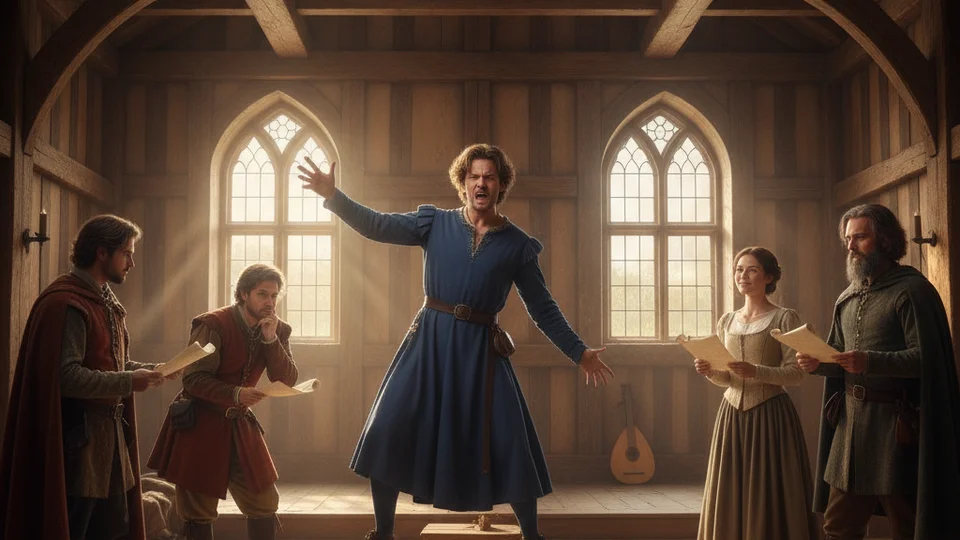
We tend to imagine words as ancient things, worn smooth by centuries of use, with no author anyone could name. Most are. But not all. Some of the words you reach for without thinking were struck fresh by a single writer, at a single desk, on a single afternoon — and then escaped the page and kept going.
Here are nine everyday words with a known parent. We’ve kept Shakespeare out of it — he’s a whole story of his own — and we’ve been honest about the difference between coining a word and merely being the first to write it down where it stuck. Because once you know who to thank, you never quite hear these the same way again.
Chortle
Lewis CarrollCarroll built this one from scratch in his 1871 poem “Jabberwocky,” in Through the Looking-Glass: “He chortled in his joy.” It’s a portmanteau — Carroll’s own term, by the way — squashing “chuckle” and “snort” into a single gleeful sound.
What’s remarkable is that it feels like it has always existed. Most of Carroll’s invented nonsense stayed on the page, but “chortle” walked right off it and into the dictionary, where it now sits looking perfectly respectable, as if it never came from a poem about a burbling monster.
Nerd
Dr. SeussThe first known appearance of “nerd” in print is in Dr. Seuss’s 1950 book If I Ran the Zoo, where it names a small, grumpy imaginary creature the narrator would collect: “a Nerkle, a Nerd, and a Seersucker, too.”
Here’s where we should be careful, though. Seuss printed the word, but he didn’t give it today’s meaning — the socially awkward brainy type. That sense bubbled up in American slang not long after, and whether it grew from Seuss or arrived by some other route is genuinely uncertain. Call him the first to write it, not the inventor of what it means now.
Robotics
Isaac AsimovThe word “robot” itself came from a 1920 play by the Czech writer Karel Capek. But “robotics” — the whole science of building and running the things — was coined by Isaac Asimov, who assumed he was just using an obvious existing term in his 1940s science-fiction stories.
He wasn’t. As far as anyone can tell, nobody had written it down before him. A word Asimov thought he was borrowing turned out to be one he’d accidentally created, and it’s now stamped on university departments and factory floors around the world.
Utopia
Thomas MoreThomas More invented this one in 1516 as the title of his book about an imaginary perfect society. He stitched it together from Greek roots, and there’s a sly joke buried in it: it can mean either “good place” or “no place,” depending on how you read the first syllable.
That pun is the whole point. More was gently suggesting that the perfect society is exactly the one that doesn’t exist. Five centuries later we still use his word for any ideal we’re chasing — usually without noticing that its author baked a warning right into the name.
Yahoo
Jonathan SwiftLong before it was a search engine, “Yahoo” was an insult coined by Jonathan Swift in Gulliver’s Travels in 1726. The Yahoos are a race of filthy, brutish, human-shaped creatures — Swift’s savage caricature of humanity at its worst.
The word slid out of the book to mean a crude, loutish person, and it’s kept that sense ever since. So the next time you call someone a yahoo, know that you’re quoting one of the angriest satires in the English language.
Some of the words you reach for without thinking were struck fresh by a single writer, at a single desk, on a single afternoon.
Pandemonium
John MiltonMilton coined this for his 1667 epic Paradise Lost, where Pandaemonium is the literal name of the capital city of Hell — a grand palace where the fallen angels gather. He assembled it from Greek: roughly, “the place of all demons.”
Over time the capital P dropped away and the meaning loosened, until it came to mean any scene of wild uproar and chaos. When you say a room descended into pandemonium, you’re borrowing the name Milton gave to the headquarters of the damned.
Freelance
Sir Walter ScottThe word first turns up in Sir Walter Scott’s 1819 novel Ivanhoe, where a “free lance” is a medieval mercenary — a knight whose lance served no lord in particular and could be hired by anyone who’d pay.
It’s a lovely, literal image, and it drifted almost perfectly into the modern world. The freelancer of today, hopping from client to client, is doing exactly what Scott’s hired knight did — just with a laptop instead of a lance.
Cyberspace
William GibsonScience-fiction author William Gibson coined “cyberspace” in the early 1980s — first in a short story, then unforgettably in his 1984 novel Neuromancer. He described it as a “consensual hallucination,” a vast imagined space you’d move through inside a computer network.
Gibson later admitted he had only the vaguest idea how computers actually worked; he just liked the sound of the word. Then the internet arrived and made his invented realm feel eerily prophetic, and his coinage became the everyday name for the place we now half-live.
Serendipity
Horace WalpoleThe writer Horace Walpole coined “serendipity” in a 1754 letter, inspired by an old Persian fairy tale, “The Three Princes of Serendip,” whose heroes were forever making happy discoveries by accident. Serendip was an old name for Sri Lanka.
Walpole tossed it off almost casually to a friend, describing a lucky find of his own. It stayed a rare, bookish word for ages before blooming into one of the most beloved terms in English — the perfect name for finding something wonderful you weren’t even looking for.
There’s something quietly heartening in all this. We think of language as a vast inheritance nobody owns, and mostly it is — but every so often a single person adds a brick, and the whole edifice grows by one word. A poem, a satire, a stray letter to a friend, and suddenly there’s a new way to say something. So the next time you chortle at a yahoo or stumble on a bit of serendipity, spare a thought for the writer who handed you the word.
Frequently asked questions
What is the difference between coining a word and just being first to write it down?
Coining a word means actually inventing it, while being first to print it means the word may have existed in speech or come from elsewhere. The article is careful about this distinction — Lewis Carroll genuinely built “chortle” from scratch, but Dr. Seuss merely printed “nerd” first without giving it today’s meaning of a brainy, socially awkward type.
Which famous writer was deliberately left out of this list of word coiners?
Shakespeare was intentionally kept out, because he is a whole story of his own. If you want the Bard’s contributions, those live in our piece on 9 everyday phrases that came straight from Shakespeare. The nine words here all have other known parents, from Milton to William Gibson.
Why does the word “utopia” contain a hidden joke?
Thomas More built “utopia” from Greek roots in 1516 so that it can mean either “good place” or “no place,” depending on how you read the first syllable. The pun was the whole point: More was gently suggesting that the perfect society is exactly the one that doesn’t exist. We still use his word for any ideal we chase, usually without noticing the warning baked into it.
Did William Gibson understand computers when he coined “cyberspace”?
No — Gibson later admitted he had only the vaguest idea how computers actually worked when he coined “cyberspace” in the early 1980s, most memorably in his 1984 novel Neuromancer. He simply liked the sound of the word and described it as a “consensual hallucination.” The internet then arrived and made his invented realm feel eerily prophetic. For more surprising naming stories, see the surprising origins of 10 famous brand names.
Sources
How much do you remember?
3 quick questions from the story above.
Enjoyed that? Play a full trivia quiz:
Play a Literature quiz