Some questions never really leave you. You ask them as a kid, get a shrug or a half-answer, and then just carry them around for the rest of your life without ever getting to the bottom of them. Why is the ocean salty? Why does ice float when almost everything else sinks? Why do onions make you cry when you’re only trying to make dinner?
None of these are hard, exactly — they just rarely get explained. So here are seven of them, starting with the salt, with the real science laid out plainly. A couple, it turns out, science still hasn’t fully nailed down. We’ll be honest about which.
Why is the ocean salty?
Rivers do the deliveringIt seems backwards, because the rivers running into the sea are fresh. But rain is slightly acidic, and as it falls on rock and soil it dissolves tiny amounts of mineral salts and carries them downhill. Every river in the world is quietly ferrying that dissolved rock out to sea, a little at a time.
Here’s the part that makes the ocean salty rather than just faintly mineral: water evaporates off the surface and rises as fresh vapor, leaving the salt behind. The salt has nowhere to go, so over hundreds of millions of years it has concentrated. If you could dry the oceans out completely, the leftover salt would blanket the continents in a layer hundreds of feet deep.
Why does ice float?
Water breaks its own ruleAlmost every substance gets denser when it freezes — the molecules pack in tighter, so the solid sinks in its own liquid. Water refuses to play along. As it freezes, its molecules lock into an open, hexagonal lattice that actually takes up more room than liquid water does.
More room for the same amount of stuff means lower density, so ice floats. It sounds like a minor quirk, but life depends on it. Because lakes freeze from the top down, a layer of ice caps the water and insulates everything below, letting fish survive the winter. If ice sank, ponds would freeze solid from the bottom up.
Why do onions make you cry?
A tiny chemical alarmAn onion spends its life storing sulfur compounds in its cells, minding its own business. The moment you slice into it, you rupture those cells and let enzymes mix with the sulfur, which kicks off a quick chemical reaction that puffs a volatile gas up into the air.
That gas drifts up to your eyes, reacts with the moisture on their surface, and forms a mild dose of sulfuric acid. Your eyes do the sensible thing and flush it out with tears. Chilling the onion first slows the reaction down, and a sharp knife ruptures fewer cells than a dull one — both genuinely help.
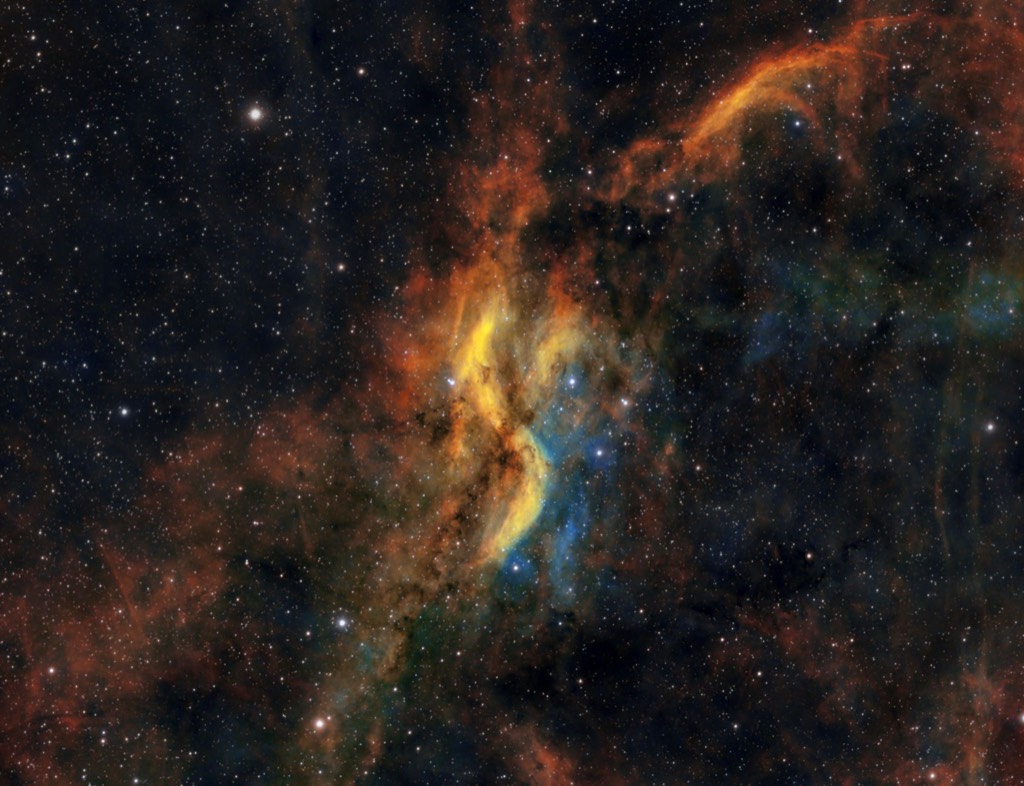
Why is the night sky dark?
A deeper puzzle than it looksThis one sounds too obvious to ask — it’s dark because the sun’s gone down. But think it through: if the universe were infinite, unchanging, and full of stars in every direction, then every line of sight would eventually land on a star, and the whole night sky should blaze as bright as the sun. It doesn’t. That contradiction has a name: Olbers’ paradox.
The resolution is that the universe isn’t infinitely old and it’s expanding. Light from the most distant stars simply hasn’t had time to reach us yet, and the expansion stretches much of the light that does arrive out into wavelengths our eyes can’t see. So the darkness overhead is actually telling you something profound about the age and size of everything.
The darkness of the night sky isn’t nothing. It’s a clue that the universe had a beginning.
Why do we have fingerprints?
The honest answer: we're not sureYou’d think this would be settled by now, but it isn’t. For a long time the obvious explanation was grip — that those ridges help us hold on to things, the way tire treads grip a road. The trouble is that tests have come out mixed, and some experiments suggest the ridges actually reduce contact with smooth surfaces rather than improve it.
The leading idea now is touch. The ridges may sharpen your sense of texture, setting up tiny vibrations as your finger moves across a surface that the nerves underneath can read. They probably also help wick away sweat and give skin a bit of stretch. What we can say for certain is that they form from stresses in the skin before birth, which is why no two people — not even identical twins — share the same set.
Why does hair turn gray?
The color factory shuts downYour hair isn’t actually gray — it has simply lost its color. Each strand is colored by pigment cells at its root that pump out melanin as the hair grows. With age, those pigment cells gradually run down and produce less and less, so new hair grows in without its usual dose of color.
Strip the pigment away and what’s left looks white or gray, depending on how it catches the light against the strands that still hold color. When it turns is mostly written in your genes — if your parents went gray early, you probably will too. Stress may nudge the process along, but it isn’t the villain the old saying makes it out to be.
Why does the moon look bigger near the horizon?
Your brain, not the skyA full moon rising over the rooftops can look enormous, then shrink to something ordinary once it climbs overhead. Here’s the twist: it isn’t bigger at all. Measure it, or hold up a coin at arm’s length, and the moon is the exact same size low or high. If anything it’s very slightly farther away — and therefore smaller — when it’s on the horizon.
What you’re experiencing is an illusion happening inside your head, and even the experts still argue over the exact mechanics of it. The most popular explanation is that trees, buildings, and hills near the horizon give your brain a sense of distance, and it “corrects” the moon’s size upward to match. High in an empty sky, with nothing to compare it to, the moon looks smaller. The wonder is real — the growth is not.
What ties these together isn’t that they’re trivia — it’s that the answers are hiding in plain sight, in the tap water and the kitchen and the sky over your house. Some are pinned down cold, like the salt and the floating ice. Others, like why you have fingerprints, are still genuinely open, which is somehow the best part. It means there are ordinary questions out there that nobody has fully answered yet.
Sources
How much do you remember?
3 quick questions from the story above.
Enjoyed that? Play a full trivia quiz:
Play a Science quiz